
Key takeaways
Picking the right secondary packaging machine starts with a simple but often confused question: are you packing flexible bags or rigid cartons? The two look superficially similar , both end with sealed corrugated cases stacked on a pallet , but the engineering decisions, throughput envelopes, hygiene considerations and capex profiles are meaningfully different. Specifying the wrong configuration leads to one of two costly outcomes: a machine that under-runs because pouches behave nothing like cartons, or a machine that over-runs because cartons need none of the careful handling pouches require.
This guide explains exactly how a bag case packer differs from a carton packer, when each is the right specification, and how Cybernetik’s case packing portfolio , including a SCARA-based bag case packer with staggered pouch lifting at up to 40 pouches per minute and a six-axis carton packer for rigid formats , is sized to your specific product. If you are evaluating a secondary packaging investment for a multi-format line, this is the decision tree to walk before the RFQ.
What Is a Bag Case Packer?
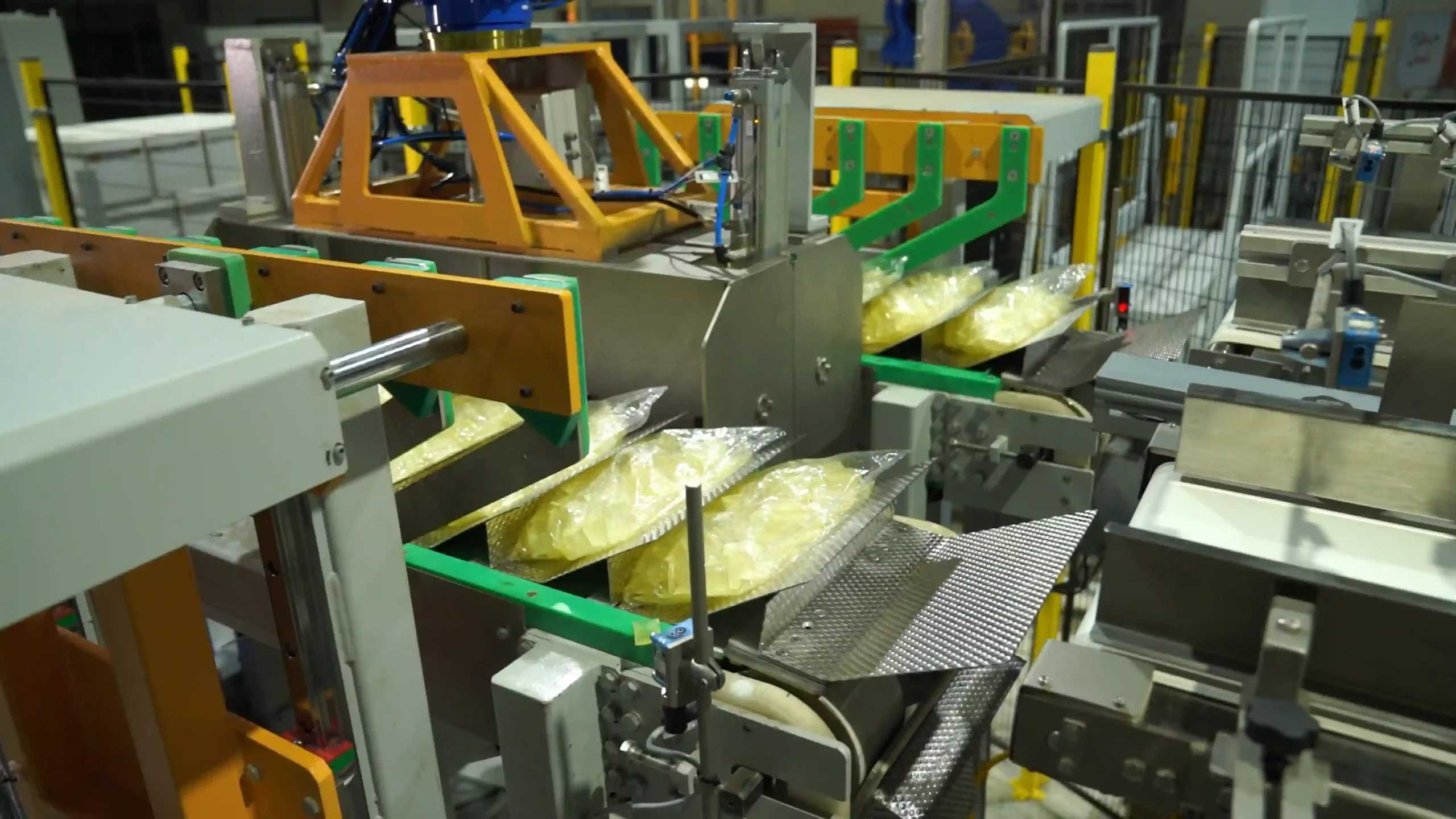
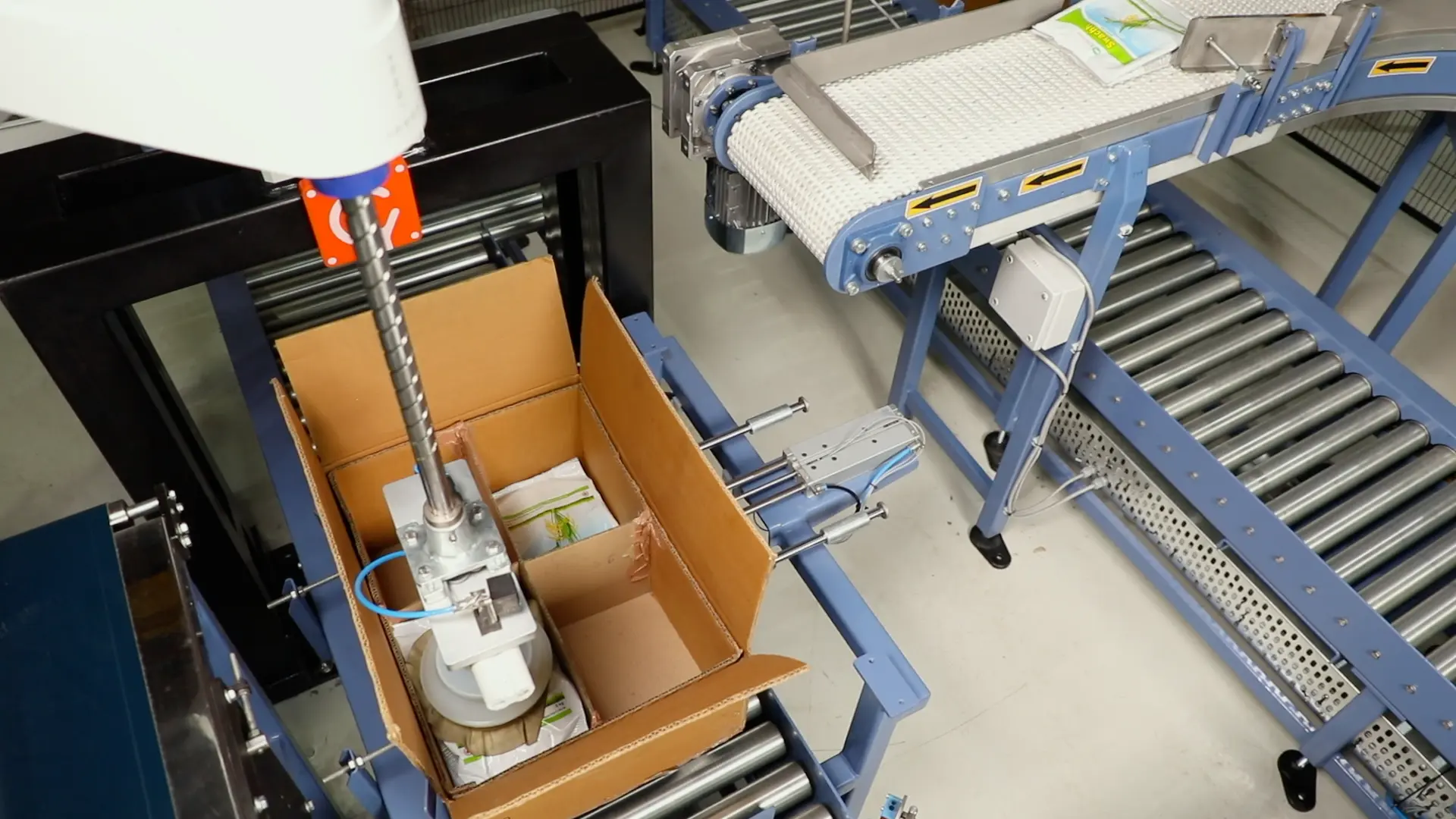
A bag case packer, also called a pouch case packer or flexible packaging case packer , is a piece of secondary packaging equipment that takes filled, sealed flexible bags (stand-up pouches, pillow pouches, stick packs, sachets, gusseted bags) from the upstream bagger or filler and loads them into a corrugated shipping case in a defined density-optimized pattern. Because flexible bags compress, sag and reshape under load, bag case packers use specialized handling , typically vacuum suction or finger-grip pickup, gentle deceleration, and density-optimized loading patterns that rigid carton packers do not require.
Cybernetik’s bag case packer is built around a SCARA robotic arm and a patented staggered pouch lifting system that creates overlap during pouch packing, maximizing the packaging density of pouches inside cartons or cases. Running at up to 40 pouches per minute with a 6 kg payload envelope, it handles single or multiple SKUs as well as SKUs of different sizes and type, with recipe-based changeover from the HMI.
What Is a Carton Packer?
A carton packer, sometimes called a case packer for rigid formats, loads primary-packed rigid products (bottles, jars, cans, flow-wrapped bars, blister packs in trays) into a shipping case. Because rigid products do not deform, the packer can use more direct pickup mechanics: vacuum suction cups for smooth surfaces, soft-clamp jaws for embossed bottles, or finger grippers for irregular shapes. The matrix loading pattern is fixed by the rigid product geometry, not by density optimization.
Cybernetik’s carton packer for bottles is a six-axis robotic system running at up to 120 bottles per minute with a 200 kg payload envelope, handling PET, glass and HDPE bottles in customizable matrix formations. The carton packer for flow-wrapped bars, biscuits and similar formats is configured with end-of-arm tooling tuned to each product’s specific pickup requirements.
Five Key Differences Between Bag Case Packers and Carton Packers
1. Product Format and Rigidity
The fundamental difference is the product itself. A bag case packer handles flexible packaging , products that sag, compress and reshape under pickup forces. A carton packer handles rigid packaging , products that retain their shape regardless of how they are gripped. This single difference cascades into every other design decision: pickup mechanics, loading pattern, conveyor design and inspection strategy all flow from whether the product is flexible or rigid.
2. Pickup and Handling Mechanics
Bag case packers use gentle vacuum pickup or two-point finger grippers calibrated to lift a pouch without crushing the seal or creasing the front panel. The pickup force is tuned to the bag’s filled weight, not to a rigid envelope. Carton packers use higher-force pickup, vacuum cups for smooth bottles, soft-clamp jaws for glass, finger grippers for irregular shapes, with grip strength tuned to lift weight at speed without slippage.
3. Pack Density and Loading Pattern
This is where Cybernetik’s bag case packer shines. The patented staggered pouch lifting system creates overlap during pouch packing, interleaving pouches so each fills the void space left by its neighbours. This dramatically increases the number of pouches that fit inside a standard shipping case, reducing both packaging material cost and pallet count for the same shipment. Carton packers, in contrast, load rigid products in fixed matrix patterns (2×3, 2×4, 3×4 etc.) determined by product geometry , there is no equivalent density gain.
4. Speed and Throughput
Carton packers typically run faster than bag case packers because rigid product handling is faster: pickup is positive, placement is direct, and there is no settling time. Cybernetik’s six-axis carton packer for bottles reaches up to 120 bottles per minute, while the SCARA bag case packer for pouches reaches up to 40 pouches per minute. Both are sized to typical upstream feeder rates: pouches typically arrive at 30–50 per minute from a VFFS bagger, bottles at 80–120 per minute from a rotary filler.
5. Inspection and Quality Control
Bag case packing requires upstream inspection to catch leaking seals, under-filled bags and torn pouches, defects that, in flexible packaging, are common and consequential. Carton packing inspection focuses on different failures: tilted bottles, missing caps, label damage, broken glass. Cybernetik integrates the right inspection station for each application: vision-based pouch checks before the bag case packer; weigh-and-inspect stations for bottles before the carton packer.
Side-by-Side Comparison: Bag Case Packer vs Carton Packer
The table below compares the two configurations on the parameters that matter most for a packaging engineer or plant head evaluating which to specify.
| Specification | Bag Case Packer | Carton Packer (Rigid) |
|---|---|---|
| Product Format | Flexible bags, pouches, sachets | Bottles, jars, cans, bars, blisters |
| Robotics Platform | SCARA (Cybernetik) | Six-axis (Cybernetik) |
| Throughput | Up to 40 pouches/min | Up to 120 bottles/min |
| Payload | Up to 6 kg | Up to 200 kg |
| Pickup Mechanism | Vacuum cup or finger grip, low force | Vacuum, soft-clamp or finger grip, high force |
| Loading Pattern | Density-optimized; staggered overlap | Fixed matrix; product geometry |
| Pack Density Gain | Significant via staggered lifting | Limited; constrained by rigid shape |
| Upstream Inspection | Pouch seal & fill checks | Cap, fill, label & tilt checks |
| Hygiene Build | GMP-built option | GMP-built option |
| Recipe Changeover | Under 5 min via HMI | Under 5 min via HMI |
| Best For | Pouched food, pharma, FMCG | Bottled beverages, dairy, chemicals |
When to Choose a Bag Case Packer
Specify a Cybernetik bag case packer when one or more of the following applies to your line:
When to Choose a Carton Packer
Specify a Cybernetik carton packer (rigid format case packer) when one or more of the following applies:
 “The right case packer starts with understanding the product: flexible bags demand density and gentle handling, while rigid cartons demand speed and precision”

.
See it in action
Can the Same Machine Handle Both? Mixed-Format Lines
For plants that run both flexible and rigid formats, for example, a co-packer serving multiple brands, Cybernetik builds case packing lines with quick-change end-of-arm tooling and dual-recipe HMIs that can switch between bag and carton modes in roughly 15 to 30 minutes. This is not a true single machine in both modes; it is a thoughtfully engineered platform that accepts both tooling sets and runs each at its rated speed. For mid-volume mixed lines this hybrid approach often delivers better economics than two specialized machines, while for high-volume dedicated production specialized machines remain superior.