
Key takeaways
Belt conveyors fail at high temperature in a specific and predictable order. The belt stretches first, so tracking goes and take-up runs out of travel. Then the cover hardens and cracks. Then the carcass delaminates, and the belt is scrap. None of this is sudden, which is why plants often run a degrading belt for months while blaming the tracking.
Specifying a heat resistant belt conveyor properly means answering a question most enquiries skip: what temperature, for how long, and measured where. A conveyor carrying 180 °C product in intermittent slugs is a different machine from one running a continuous 120 °C bed, even though the second number is lower.
Establish the Actual Thermal Duty First
Four numbers define the duty, and getting them wrong is the most common cause of premature belt failure.
Belt manufacturers quote continuous and peak ratings, and the difference between them is large. A belt rated 150 °C continuous may tolerate 180 °C in short bursts. Specifying against the peak figure for a continuous duty is how belts fail in months rather than years.
Belt Materials and Their Limits
Belt material is the single largest decision, and cost rises steeply with temperature capability, so overspecifying is as wasteful as underspecifying.
| Belt material | Typical continuous limit | Suits | Watch out for |
|---|---|---|---|
| PVC | Around 60 to 70 °C | General duty, warm but not hot product | Softens and stretches quickly above its limit |
| Polyurethane | Around 80 °C | Food contact with moderate heat and washdown | Loses mechanical properties as temperature climbs |
| Heat resistant rubber | Around 150 to 200 °C, higher for short peaks | Bulk material from dryers, kilns and ovens | Cover hardens and cracks with repeated thermal cycling |
| Silicone | Around 200 to 260 °C | Hot, sticky food product needing release properties | Lower tensile strength, more vulnerable to cuts |
| PTFE coated glass fabric | Around 260 °C | Oven belts, baking and heat sealing | Limited flexibility, needs larger pulley diameters |
| Stainless steel mesh or solid belt | Well above 300 °C | Furnaces, sterilisers, high temperature processing | Higher cost, heavier, needs different drive and tracking design |
Two points about the table. First, the limits are guidance rather than guarantees, because rating depends on the specific compound, the carcass construction and the duty cycle. Second, temperature capability and food compliance are separate questions. A belt that handles 200 °C is not automatically approved for direct food contact, and a food grade belt is not automatically heat tolerant.
What Else Changes at High Temperature
Everything else gets hot too
The belt gets the attention, but pulleys, bearings, drive components and the frame all sit in the same environment. Standard bearing grease degrades well below the temperatures a heat resistant belt tolerates, so bearing selection, lubrication and sometimes shaft cooling arrangements have to be specified alongside the belt.
Thermal expansion moves the geometry
Steel frames grow measurably when heated. On a long conveyor running near an oven, that growth is enough to shift alignment and affect tracking, which means fixed and floating support points have to be planned rather than allowed to happen.
Take-up needs more range
Belts elongate under heat, and heat resistant belts are no exception. Take-up travel that would be adequate on an ambient conveyor may be consumed within weeks on a hot one, so additional range belongs in the design.
Cooling is often the better answer
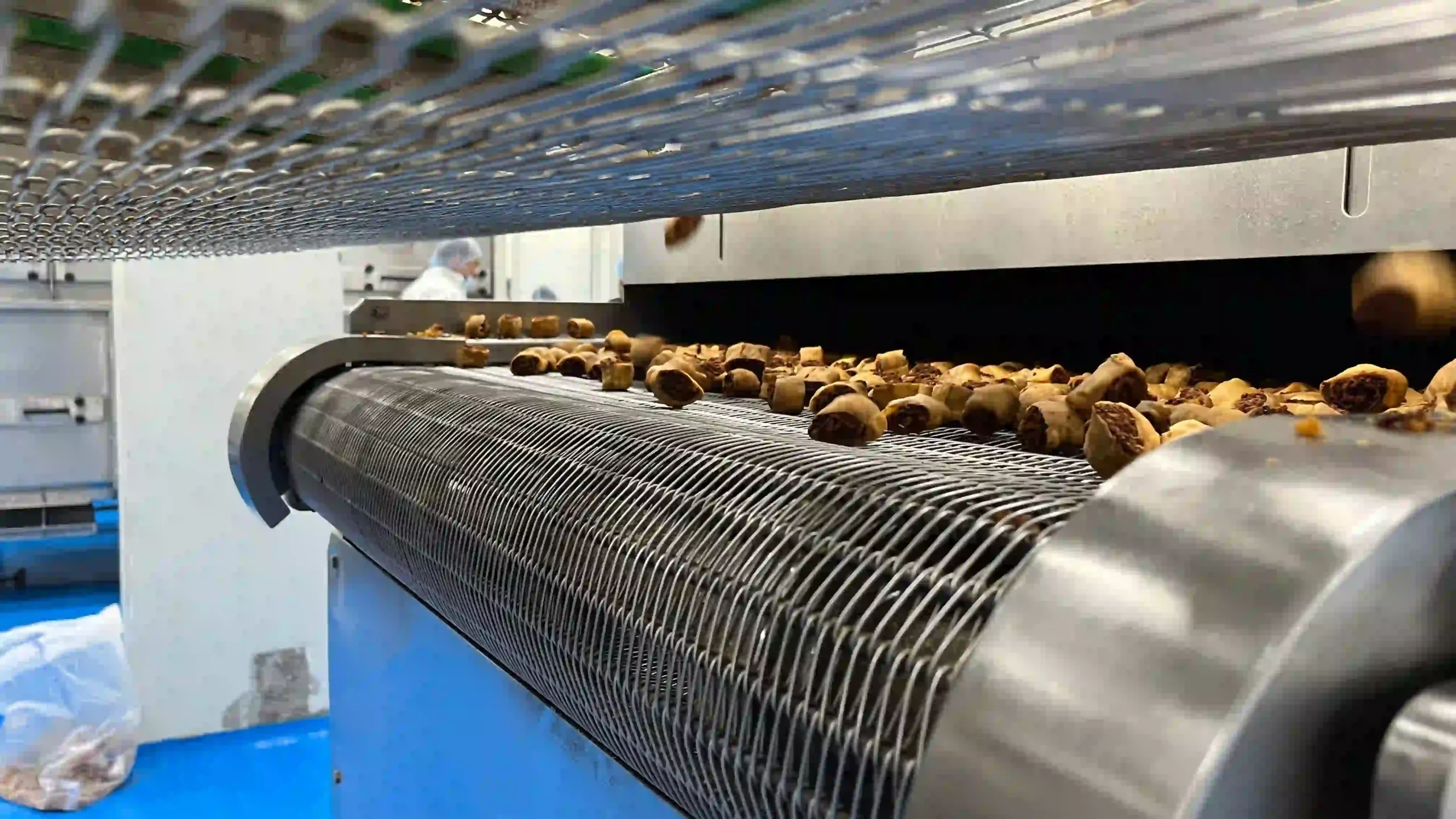
Before committing to a high temperature belt, it is worth asking whether the product needs to be that hot when it reaches the conveyor. In snack and food production the usual requirement is to bring hot product down quickly, and a convective cooling conveyor cools fresh product while conveying it, turning the transport stage into a process stage and allowing standard belt materials downstream.
Where cooling has to be faster or the product tolerates immersion, a submerged cooling conveyor carries product through a liquid bath, removing heat far more rapidly than air ever will and eliminating the high temperature belt problem entirely.
Powders and granules do not flow because of a pressure gradient. They flow because gravity or a mechanical device moves them, and they resist that movement in ways fluids do not.
 “High-temperature conveying is not simply about choosing a belt that can withstand heat; the belt, bearings, drive, frame, and take-up must all be engineered for the same thermal duty.“

See it in action
Applications
Selection Checklist
- State peak and continuous temperature separately, and say which one the duty is.
- Specify contact time per pass and whether operation is continuous or intermittent.
- Confirm whether food contact compliance is required alongside heat resistance.
- Check that bearings, drives and frame are rated for the same environment as the belt.
- Allow additional take-up travel for thermal elongation.
- Ask whether cooling upstream would remove the requirement altogether, and what that would cost.
- Establish expected belt life at the stated duty, and the cost of a replacement belt, before comparing capital prices.
That last point decides most of these projects. A cheaper conveyor with a belt that lasts eighteen months is more expensive over five years than a properly specified one, and the difference is rarely visible in the quotation.
Cybernetik High Temperature Conveying
Cybernetik engineers conveying as part of complete process lines, which in high temperature applications usually means addressing the heat rather than only surviving it.
The conveying range spans flat and trough belt conveyors, flight cleated belts, vibratory conveyors, screw conveyors, bucket elevators, and convective and submerged cooling conveyors, alongside the cooking, grinding, mixing, sifting and packing equipment they connect. Cooling conveyors are built in SS304 food grade construction for rapid in-transit cooling, enabling the transition from batch to continuous production. The full range sits under process automation solutions.
Cybernetik has operated for more than three decades, is headquartered in Pune with additional facilities in Gujarat and Raigad and international offices in the United States and UAE, and has installed over 6,000 systems across 30 plus countries, including more than 400 custom automation solutions. With over 600 employees and divisions spanning Process Automation, Packaging Automation, CleanTech, Extraction, Labs and Defence, thermal handling problems are engineered rather than specified from a catalogue. Further background sits on the Cybernetik about page.