
Key takeaways
Efficient material handling and packaging are essential for manufacturers working with powders, granules, pellets, flakes, and other bulk materials. As production volumes continue to increase, businesses are looking for packaging solutions that improve productivity while maintaining accuracy, hygiene, and workplace safety. Bag filling equipment plays an important role in modern manufacturing by automating the process of weighing, filling, and handling different types of bags. These systems help manufacturers reduce material waste, improve packaging consistency, and increase operational efficiency across multiple industries.
From food processing and pharmaceuticals to chemicals, minerals, and agriculture, bag filling systems are used to support a wide range of industrial applications. Choosing the right equipment requires a clear understanding of material characteristics, production requirements, bag specifications, and automation needs. This guide explains the different types of bag filling equipment, common applications, important features, and key factors manufacturers should consider when selecting a bag filling solution.
What Is Bag Filling Equipment?
Bag filling equipment is an industrial packaging system designed to accurately fill materials into bags of different sizes and capacities. These systems can handle powders, granules, flakes, pellets, and other bulk materials while maintaining precise weight control and consistent filling performance.
Modern bag filling systems integrate multiple technologies, including weighing systems, bag clamping mechanisms, material feeding equipment, conveyors, dust extraction systems, and automated controls. Depending on production requirements, manufacturers can choose between semi-automatic and fully automated configurations.
Advanced systems can also integrate with upstream and downstream equipment, allowing manufacturers to create a complete packaging line that includes material processing, bag filling, sealing, conveying, and palletizing.
Types of Bag Filling Equipment
1. Open-Mouth Bag Filling Equipment
Open-mouth bag filling systems are commonly used for powders, grains, fertilizers, food products, and industrial materials. The operator places the bag under the filling station, and the equipment automatically dispenses the required quantity of material.
These systems offer flexibility and are suitable for manufacturers that require a cost-effective solution for handling multiple products and packaging formats.
2. Valve Bag Filling Equipment
Valve bag filling systems use specially designed bags with a valve opening that allows material to enter while minimizing dust generation. These systems are commonly used in the cement, chemical, mineral, and construction industries.
Because the bag automatically closes after filling, valve bag systems improve packaging efficiency while maintaining a cleaner production environment.
3. Big Bag Filling Equipment
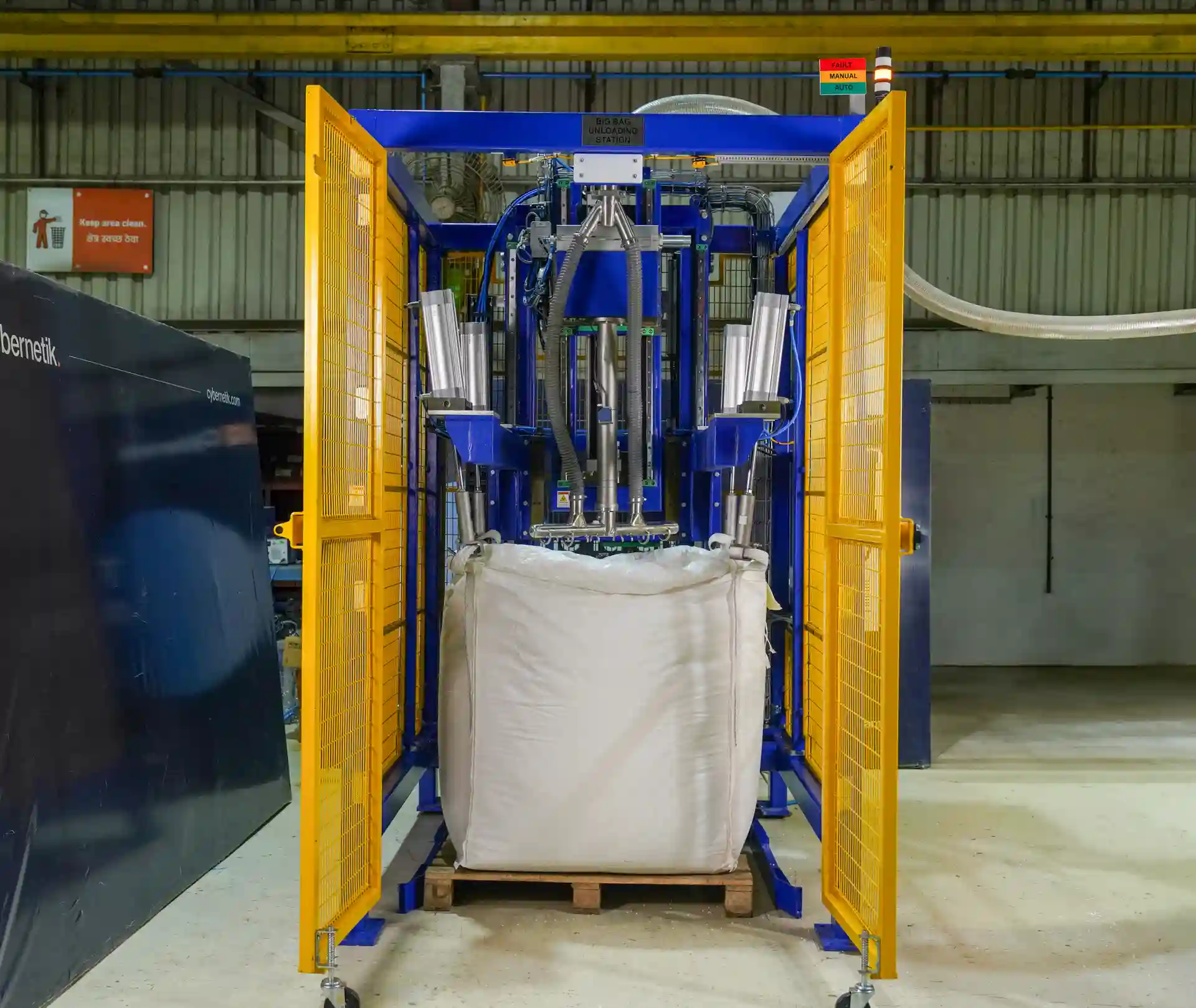
Big bag filling equipment is designed for large-capacity packaging applications involving FIBCs, jumbo bags, and bulk bags. These systems can fill bags weighing up to 1,500 kg, making them ideal for high-volume industrial operations.
Modern big bag filling machines include advanced features such as in-line weighing, pneumatic bag clamping, dust extraction ports, adjustable bag support systems, vibratory settling mechanisms, and palletizing integration.
4. Fully Automated Bag Filling Systems
Fully automated systems combine bag feeding, weighing, filling, sealing, conveying, and palletizing into a single integrated solution. These systems minimize operator involvement while maximizing production efficiency.
Manufacturers with high production requirements often choose fully automated systems because they improve throughput while maintaining consistent packaging quality.
Key Features of Modern Big Bag Filling Equipment
Modern industrial bag filling equipment offers several features that improve productivity, safety, and operational efficiency.
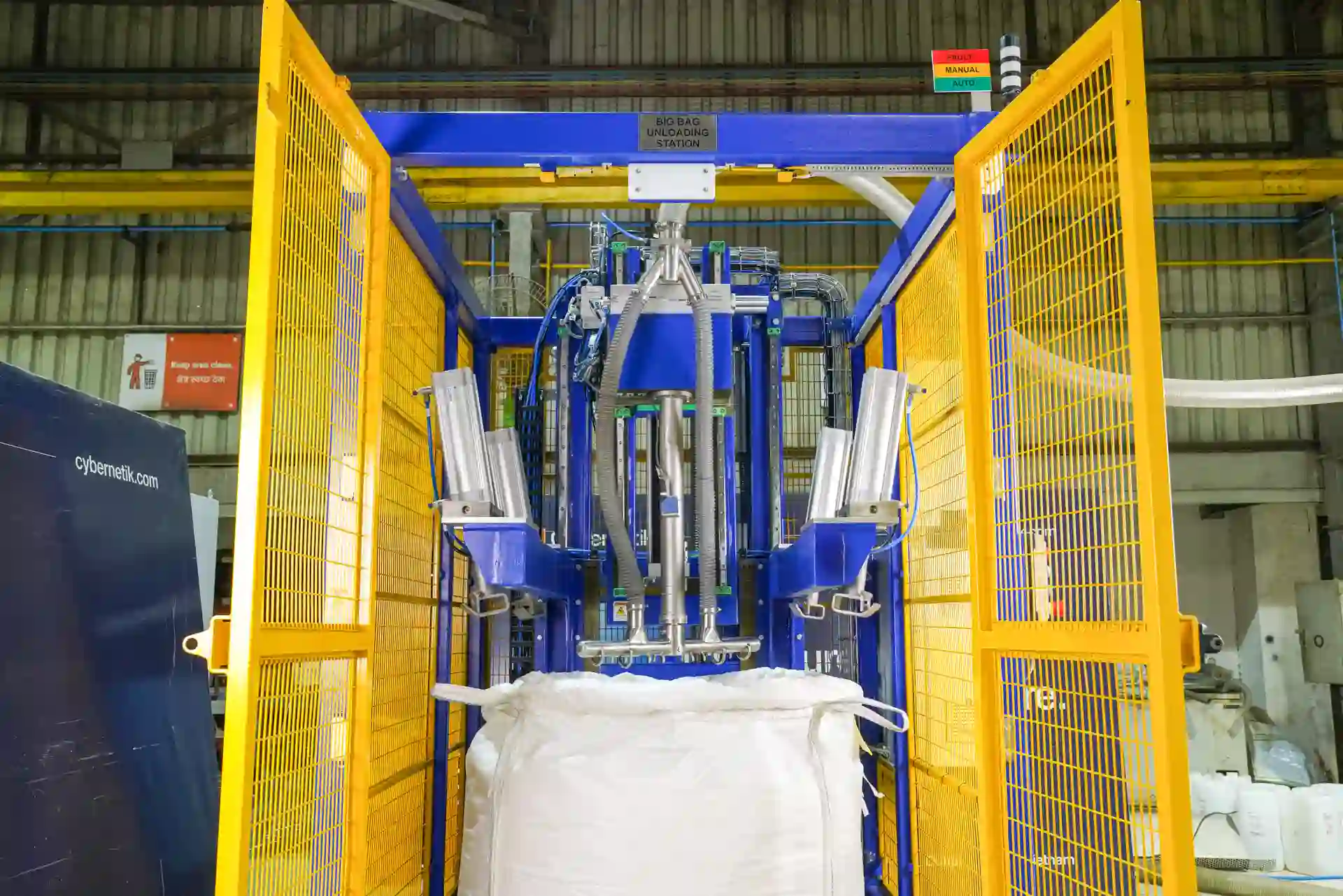
Big Bag Filling Machine Specifications
| Parameter | Specification |
| Bag capacity | Up to 1,500 kg |
| Products handled | Large bags |
| Weighing technology | In-line weighing |
| Bag handling | Pneumatic clamp and lifter |
| Material settling | Vibratory motor |
| Hygiene features | GMP construction |
| Dust control | Dust extraction port |
| Safety option | ATEX construction |
| Integration | Upstream and downstream automation |
| Optional system | Integrated palletizer |
Industrial Applications of Bag Filling Equipment
Bag filling equipment is used across multiple industries because different materials require precise and consistent packaging solutions.
1. Food Processing
Manufacturers use bag filling systems to package flour, sugar, starch, spices, grains, and other food ingredients. GMP-compliant equipment helps maintain product quality while meeting food safety requirements.
2. Chemical Manufacturing
Chemical manufacturers rely on automated filling systems to package powders, additives, pigments, and specialty chemicals. Dust-controlled environments improve both product quality and workplace safety.
3. Pharmaceutical Manufacturing
Pharmaceutical applications require precise material handling, contamination control, and strict process consistency. Hygienic bag filling systems help manufacturers maintain compliance with industry standards.
4. Agriculture and Fertilizers
Agricultural manufacturers use large-capacity filling systems to package fertilizers, seeds, animal feed, and other bulk products. Automated filling improves packaging speed while reducing manual labor requirements.
5. Minerals and Industrial Materials
Mining, cement, and mineral processing facilities use big bag filling equipment to package heavy materials that require durable, high-capacity packaging solutions.
 “High-performance bottle case packing requires more than speed – it demands precise robotics, flexible changeovers, integrated quality control, and reliable end-of-line automation.“

See it in action
How to Select the Right Bag Filling Equipment
Selecting the right bag filling equipment requires a detailed evaluation of production requirements, material characteristics, and long-term operational goals.
Several factors should be considered before making an investment.
Material Characteristics
Different materials behave differently during the filling process. Powders, granules, flakes, and pellets require different feeding mechanisms and filling technologies. Understanding material flow properties is essential when selecting equipment.
Bag Capacity Requirements
Manufacturers should determine the required bag size before selecting a filling system. Small bags, valve bags, FIBCs, and jumbo bags all require different equipment configurations.
Production Throughput
Production volume directly affects equipment selection. Facilities with high production requirements often benefit from fully automated systems that improve throughput and reduce manual intervention.
Hygiene and Safety Requirements
Food and pharmaceutical manufacturers should prioritize GMP-compliant equipment, while companies handling combustible materials should consider explosion-resistant ATEX configurations.
Automation and Integration
Modern manufacturing facilities increasingly rely on integrated production environments. Choosing equipment that can connect with conveyors, sealing systems, palletizers, and warehouse automation improves long-term operational flexibility.
Equipment Selection Criteria
| Selection Factor | Questions to Consider |
| Material type | Is the material a powder, pellet, flake, or granule? |
| Bag type | Will the system handle open-mouth bags, valve bags, or FIBCs? |
| Production volume | What is the required production capacity? |
| Automation level | Is a semi-automatic or fully automated solution needed? |
| Hygiene requirements | Does the application require GMP-compliant construction? |
| Safety requirements | Is ATEX-certified equipment necessary? |
| Future expansion | Can the equipment support future production growth? |
Why Choose Cybernetik for Bag Filling Equipment?
Cybernetik designs advanced bag filling solutions that combine precision, hygiene, safety, and automation to support modern manufacturing requirements. The company’s big bag filling systems are engineered to improve packaging accuracy while ensuring smooth material handling across different industrial applications. With a strong focus on operational efficiency and system integration, Cybernetik helps manufacturers build reliable and scalable packaging processes.
Key advantages include:
Cybernetik’s modular approach allows manufacturers to improve packaging efficiency while maintaining the flexibility needed to support future production growth.