
Key takeaways
Twenty years ago, a robotic case packer was a status symbol. Plants invested in one for the engineering showpiece, then realized the SKU mix it could handle was narrower than the brochure suggested. Today, after two decades of evolution in vision systems, end-of-arm tooling, servo control and PLC-level coordination, the calculus has reversed completely. Robotic case packing is no longer the premium choice for niche applications , it is the default specification for any multi-SKU manufacturer serious about throughput, hygiene and changeover economics.
This guide examines what genuinely separates a robotic case packer from a mechanical one, the architectural choices Cybernetik makes when designing a robotic packaging system, and the operational economics that explain why even mid-volume manufacturers now lead with robotics. If the last time you priced a robotic case packer was more than five years ago, the numbers you remember are no longer the numbers on the table.
What Is a Robotic Case Packer?
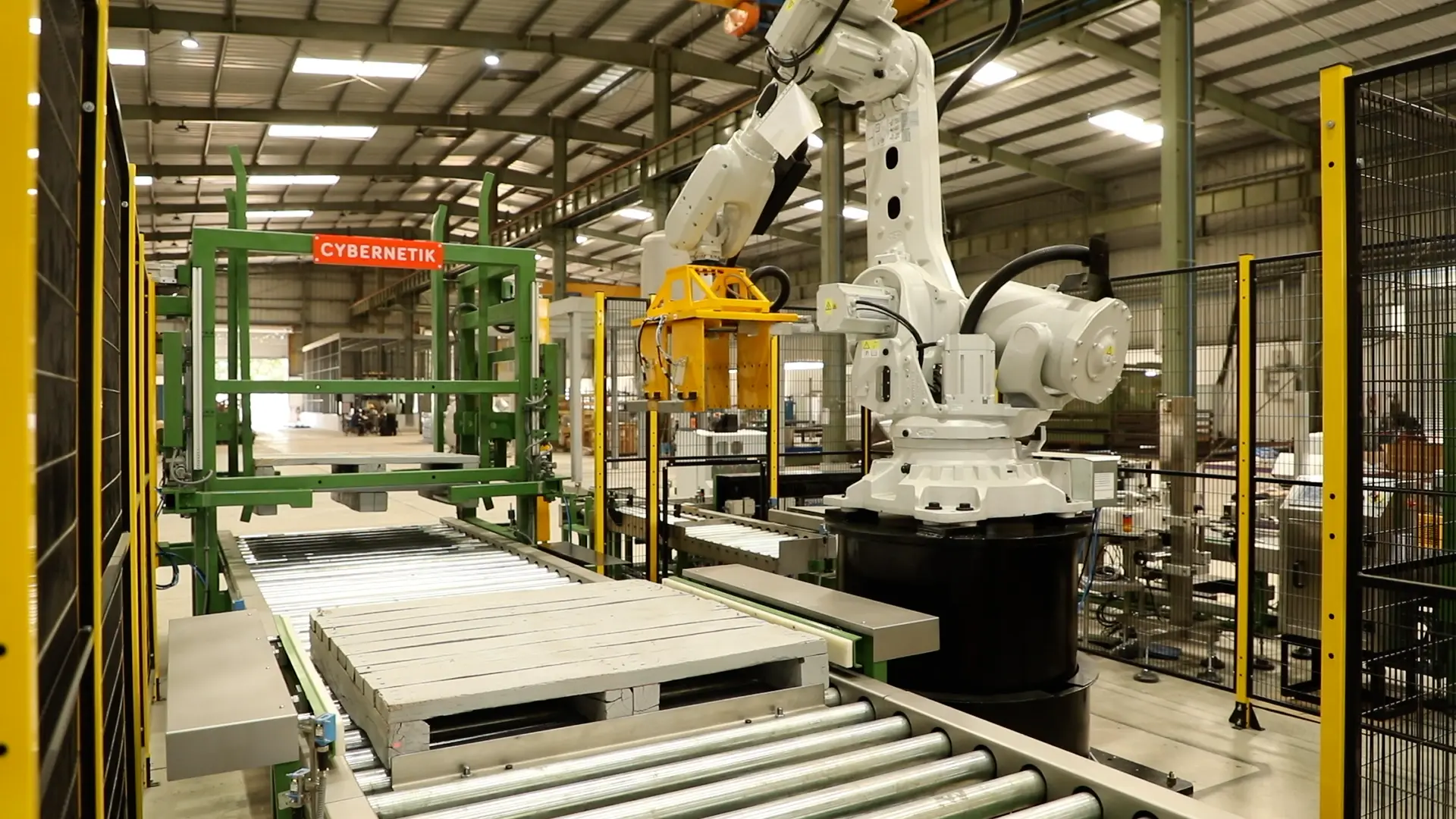
A robotic case packer is a secondary packaging machine that uses one or more articulated robotic arms , typically six-axis, SCARA, delta or collaborative , to pick, group and load primary-packed product into shipping cases. Unlike a mechanical case packer, where pickup, loading and matrix arrangement are determined by fixed-geometry pushers, indexers and chutes, a robotic case packer changes its motion path, grip force and pickup pattern by software recipe.
This software-defined motion is what makes a robotic case packer fundamentally different. A mechanical case packer is engineered around a single product geometry; changing SKUs means changing parts. A robotic case packer is engineered around a motion envelope; changing SKUs means changing a recipe. For a multi-SKU manufacturer, that distinction translates directly into changeover time, capex efficiency and total cost of ownership.
Cybernetik’s robotic case packer platform supports SCARA arms for high-cadence light-payload work (up to 40 pouches per minute, 6 kg envelope), six-axis arms for heavier rigid formats (up to 120 bottles per minute, 200 kg envelope), and integrated vision systems for orientation-aware pickup on randomly oriented infeeds. Every configuration ties into a unified PLC + SCADA architecture that coordinates the broader robotic packaging system from filler to palletizer.
Five Ways a Robotic Case Packer Changes Line Economics
The case for robotic case packing is rarely about raw speed alone. It is about how robotics changes every line economic that matters to a packaging engineer.
1. Software-Defined SKU Changeover
On a mechanical case packer, every SKU change requires physical reset of pushers, guides and pickup mechanisms. On a robotic case packer, the operator selects the new SKU on the HMI and the machine reconfigures its motion path, grip parameters and case dimensions in software. Changeover times drop from 30–60 minutes to under five minutes, freeing planned production hours that used to be lost to setup.
2. Vision-Guided Pickup from Randomly Oriented Infeeds
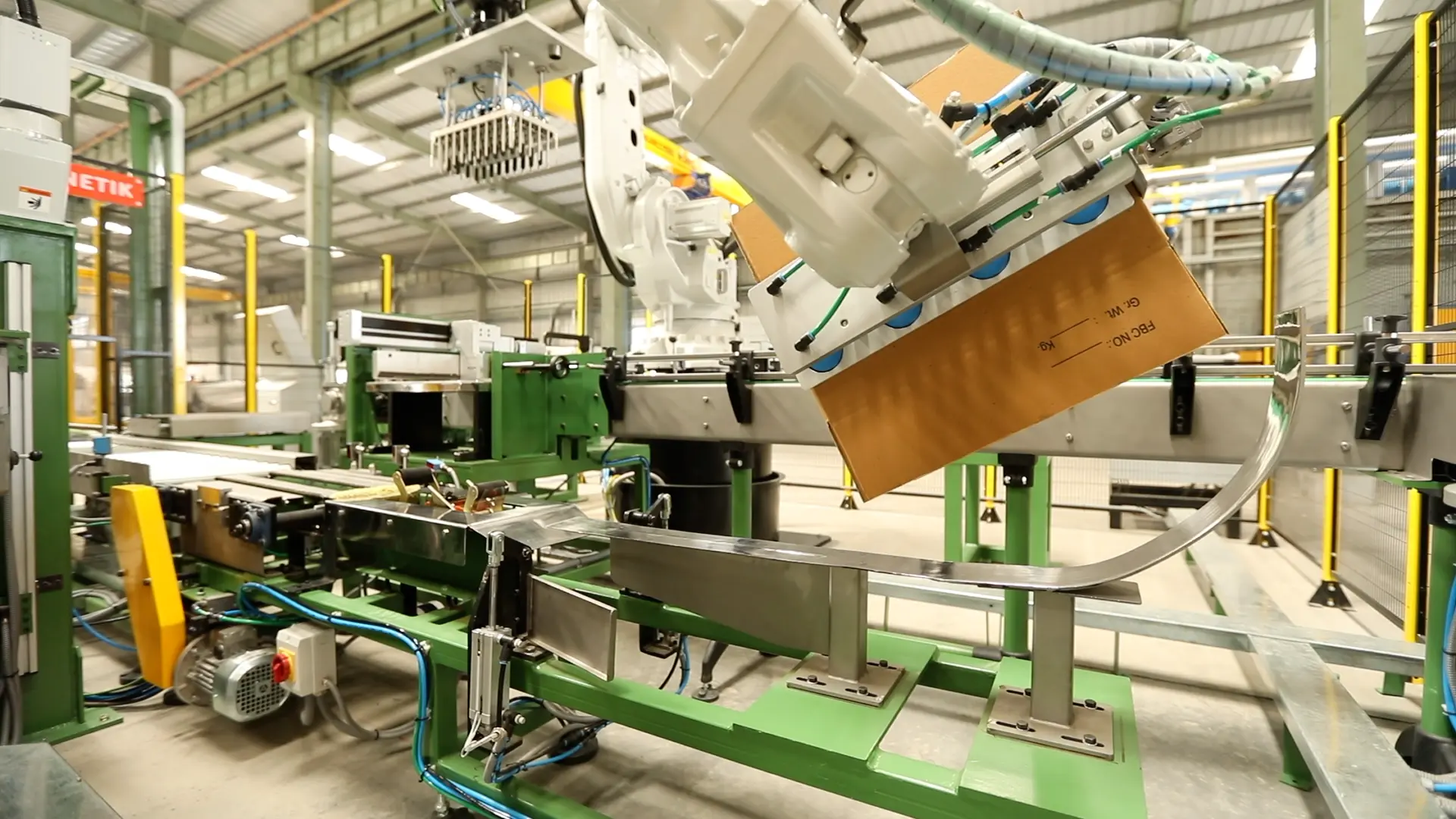
Upstream stages do not always deliver product in perfect single-file pitch. Cybernetik’s robotic case packer integrates vision systems that read each product’s position and orientation in real time and adapt the arm’s pickup path on the fly , eliminating the jams that plague mechanical case packers fed from imperfect upstream conveyors.
3. Multi-SKU Production on a Single Machine
Where a mechanical case packer locks the line into a narrow SKU range, a robotic case packer can run dozens of SKU variants from a single physical asset , different bottle sizes, different pouch formats, different case matrices. This collapses the capex required to support a diverse product portfolio.
4. Reduced Direct Product Contact for Hygiene
Robotic end-of-arm tooling with food-grade and pharma-grade grippers can pick fragile or sterile product without operator contact, supporting GMP and FDA compliance on lines where mechanical case packers would require regular intervention by hand.
5. Predictable Maintenance and Higher Uptime
Robotic arms have far fewer moving parts in the pickup path than equivalent mechanical case packers. Servo-driven motion is monitored continuously, predictive maintenance alerts fire on wear before failure, and spare-parts stocking is simpler because the wear items are common across the robot fleet.
Choosing the Right Robotic Configuration for Your Line
Not every robotic case packer is the right answer. The right arm topology depends on payload, cycle time, motion envelope and SKU breadth.
Six-Axis Robotic Case Packer
Six articulated joints deliver the broadest motion envelope and the heaviest payload capability , up to 200 kg on Cybernetik’s bottle case packer. Best for heavy, rigid, multi-orientation pickup such as glass bottles, large HDPE jars or grouped sub-cases. The trade-off is slower per-cycle motion than topology-optimized arms.
SCARA Robotic Case Packer
Four-axis SCARA arms are faster on lighter payloads because the kinematics are optimized for vertical pickup with planar motion. Cybernetik’s SCARA pouch case packer handles up to 40 pouches per minute with a 6 kg envelope. Best for light flexible packaging, pharma sachets and food pouches.
Delta Robotic Pickup for Primary Stages
Delta robots, used in Cybernetik’s Robotic High Speed Pick and Place System for Enrobed Chocolate, deliver extreme cadence (up to 480 parts per minute with four delta arms working in parallel) for primary stages just upstream of the case packer. While not strictly case packers, they often share the line PLC with the case packer downstream.
Side-by-Side Comparison
The table below compares Cybernetik’s three robotic configurations against the parameters that matter most to a packaging engineer.
| Specification | Six-Axis | SCARA | Delta (primary) |
| Payload | Up to 200 kg | Up to 6 kg | Up to 1 kg |
| Throughput | Up to 120 units/min | Up to 40 units/min | Up to 480 parts/min |
| Motion Envelope | Spherical, multi-orientation | Planar + vertical | Inverted parallel |
| Best Product | Bottles, jars, heavy cases | Pouches, sachets, light bars | Naked chocolate, biscuits |
| Vision Compatibility | High | High | High |
| Hygiene Build | GMP-ready | GMP-ready | FDA-compliant |
| Best Use | Multi-SKU bottle/jar lines | Multi-SKU pouch lines | Pre-wrapper primary feed |
What Cybernetik’s Robotic Case Packer Handles
Robotically picked primary packs
Vision-system applications
Case formats loaded
 “The right robotic case packer delivers the flexibility, precision, and scalability manufacturers need to keep modern multi-SKU production lines running efficiently.“

See it in action
Why Plants Standardize on the Cybernetik Robotic Packaging System
Cybernetik’s robotic case packer is engineered alongside the broader robotic packaging system, carton erector, sealer, palletizer, so that line-wide coordination is built in from the first design review.
Industries That Lead with a Robotic Case Packer
When Robotic Case Packing Becomes the Obvious Specification
If two or more of the following describe your current operation, the robotic case packer business case is typically a clear winner against mechanical alternatives.
Where these conditions cluster, the payback on a Cybernetik robotic case packer typically runs twelve to twenty-four months on changeover savings, labour reduction, scrap elimination and uptime gains combined.