
Key takeaways
At low to mid production volume, almost any palletizing equipment works adequately. A semi-automatic palletizer, two operators and a pallet jack can process 200 cases per hour with acceptable consistency. The economics are mediocre but the production line is not visibly constrained. At high volume , 800, 1,000, 1,200 cases per hour , that tolerance disappears. A palletizing system that works at 400 cases per hour becomes the documented production ceiling at 1,000. The pallet-change pause that costs a few seconds at low volume costs minutes per shift at high volume. The layer-pattern inconsistency that causes occasional transit damage at moderate throughput causes systematic damage at full production cadence. High-volume packaging lines expose every weakness in palletizing equipment in a way that lower volumes disguise.
This guide covers the engineering requirements that specifically apply to high-volume palletizing equipment, the palletizing system configurations Cybernetik builds for lines running above 500 units per hour, the supplier selection criteria that separate a palletizer manufacturer with genuine high-throughput credentials from one with catalogue claims, and the verified technical specifications that anchor the investment decision. If your line already runs fast upstream and the palletizer is the constraint, this is where the resolution starts.
What Is Palletizing Equipment, and How Does High Volume Change the Specification?
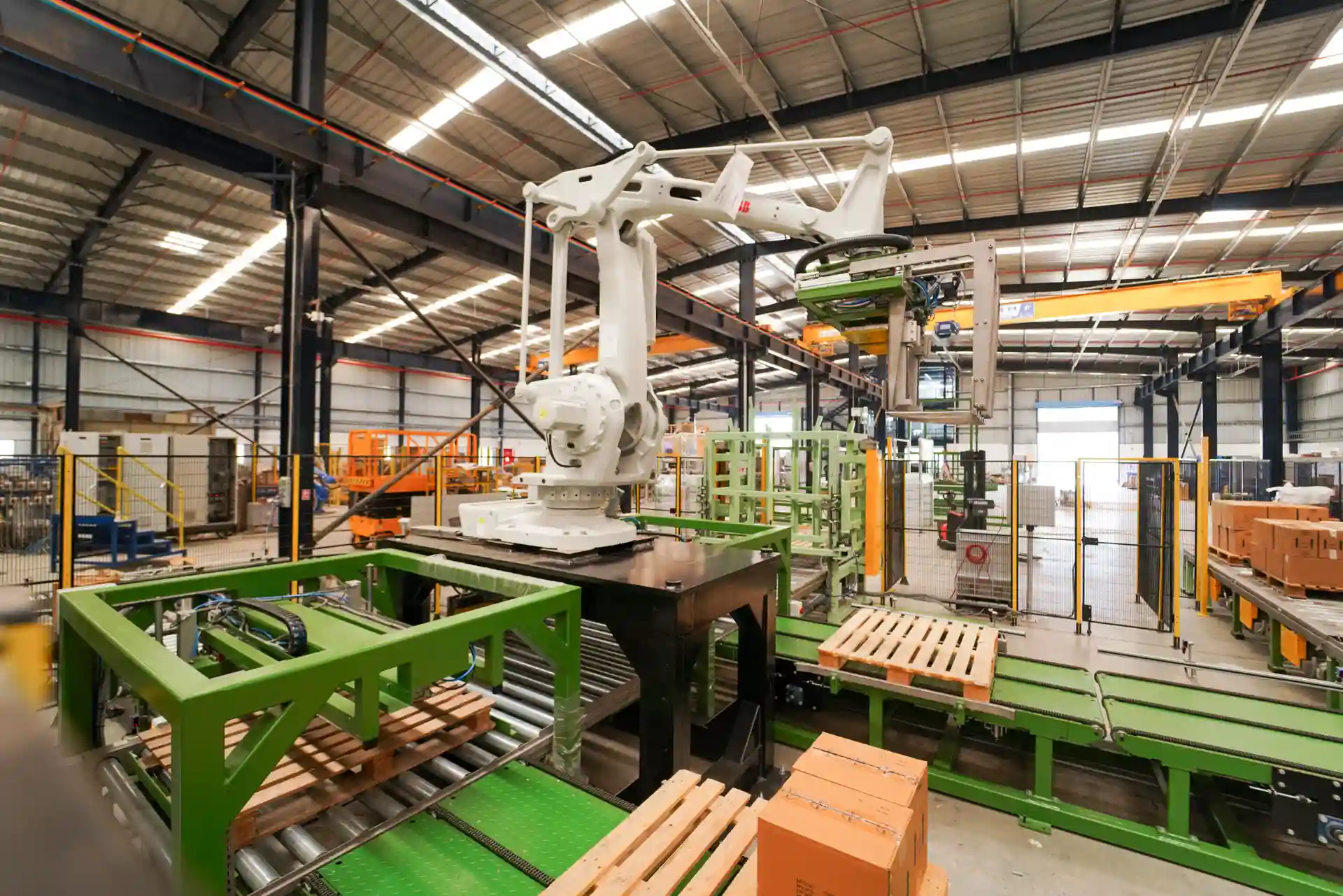
Palletizing equipment is the full system of machines and conveyors at the end of a packaging line that takes packed units off the upstream case packer, stacks them onto pallets in a defined pattern and transfers the loaded pallet to dispatch or stretch-wrap. The system typically spans a pallet dispenser, infeed conveyor with case registration, robotic or servo-driven palletizing machine, outfeed conveyor to the stretch-wrap station, and the control architecture , PLC, HMI, safety system , that runs all five stages as a coordinated unit.
At high volume, the system specification tightens on every dimension. Throughput is the obvious constraint , palletizing equipment for a 1,200-case-per-hour line must sustain that rate shift-long, not merely achieve it at peak. But throughput is not the only thing that changes. The pallet dispenser must feed empties fast enough that the inter-pallet gap does not create a case accumulation problem upstream. The infeed conveyor must handle case surges without jamming. The end-of-arm tooling must maintain grip reliability after tens of thousands of cycles. The control architecture must coordinate with the upstream case packing line and downstream stretch-wrap in real time, not through operator handoffs. High-volume palletizing equipment is a system specification problem, not a machine specification problem.
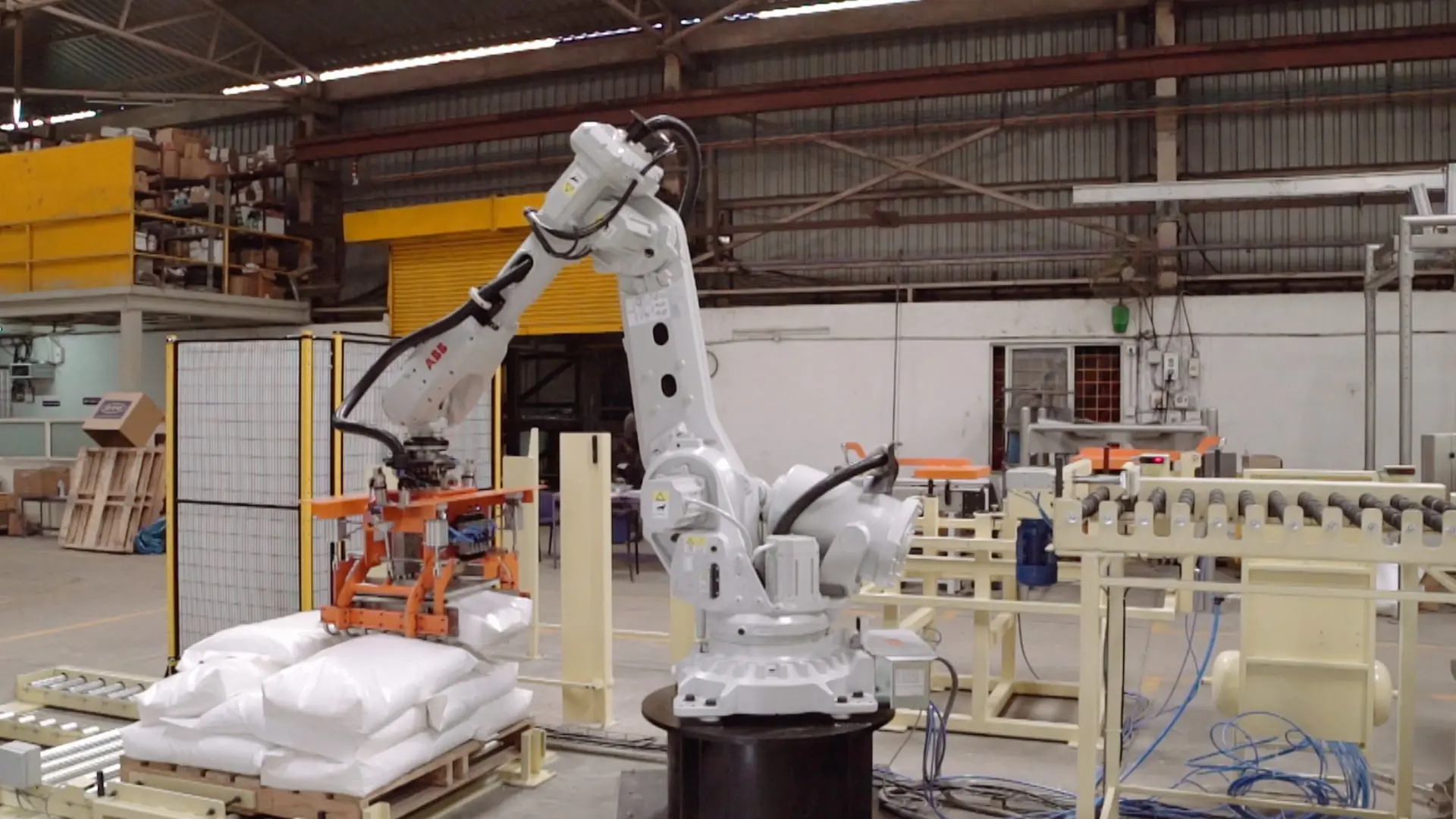
Cybernetik designs palletizing systems as complete end-of-line solutions, not as standalone palletizer units. The six-axis robotic palletizer handles up to 1,200 boxes per hour with 150 kg payload, simultaneous picking of up to three units and an automated pallet dispenser with 10-pallet magazine capacity. It integrates upstream with case packing equipment and downstream with stretch-wrap through a single PLC architecture. The gantry palletizer processes 210 units per hour at 10 kW for mid-volume applications. Both configurations are available from Cybernetik as a palletizer manufacturer with four manufacturing facilities and verified throughput data from deployments across more than thirty countries.
Five Engineering Requirements for High-Volume Palletizing Equipment
1. Throughput Matching Across the Full Production Shift
High-volume palletizing equipment must be specified at a throughput that exceeds the upstream case packer’s rated output, not matches it. A palletizing system rated exactly at filler capacity operates at the margin; any upstream surge fills the infeed buffer and propagates a stoppage back through the line. Cybernetik’s six-axis palletizing equipment is rated at 1,200 boxes per hour and 600 bags per hour, providing 15 to 20 percent throughput headroom over typical high-volume filler outputs, absorbing upstream surges without creating downstream starvation.
2. Zero-Downtime Pallet Change via Automatic Pallet Dispenser
At 1,200 cases per hour, a manual pallet-change pause of two minutes per pallet equates to 40 cases not palletised. Multiply across the number of pallet changes per shift and the throughput loss is material. Cybernetik’s automatic pallet dispenser holds up to 10 pallets per magazine load, releases one pallet per cycle and transfers the completed pallet to the outfeed conveyor automatically, making the inter-pallet gap the mechanical transfer time only, not the operator response time. This is the single highest-impact specification difference between high-volume and mid-volume palletizing equipment.
3. Multi-Line Feed Coordination for Parallel Production
High-volume packaging operations often run two or more upstream lines feeding the same palletizing system, particularly in FMCG and chemical manufacturing where multiple case packing lines operate in parallel. Cybernetik’s palletizing equipment supports multi-line infeed configurations where a single robotic arm palletises cases arriving from separate upstream conveyors, assigning each to the correct client pallet in the correct recipe pattern from the same physical system. This eliminates the one-palletizer-per-line infrastructure cost that parallel production lines would otherwise require.
4. Predictive Maintenance and Uptime Engineering at Scale
At 1,200 cases per hour and sixteen-hour production days, cumulative arm cycles reach tens of millions per year. Palletizing equipment without predictive maintenance capability runs to failure; scheduled maintenance windows at this throughput are unplanned production losses. Cybernetik’s six-axis palletizing system instruments servo motor load, gripper cycle counts and arm motion deviation continuously, generating predictive wear alerts before failure events. Spare parts are standardised across the configuration, common EOAT components, common servo units , to minimise restocking complexity at high-volume facilities.
5. Safety Architecture That Does Not Cap Throughput
Full ISO 12100 enclosed guarding is the correct safety specification for high-volume palletizing environments where robotic arm velocity, payload weight and operator proximity create genuine risk. Guarding designs that restrict arm reach envelope or require frequent access interruptions actively cap throughput. Cybernetik’s high-volume palletizing equipment uses interlocked access gates positioned away from the operating envelope, light barriers on peripheral zones and e-stops that pause safely without triggering full system restarts, preserving both compliance and throughput.
Palletizing System Configurations for High-Volume Lines
Cybernetik builds palletizing systems in three configurations matched to high-volume requirements. The right choice depends on packed unit format, throughput tier and whether lines converge on a single palletizing station.
Six-Axis Robotic Palletizing System, Primary High-Volume Configuration
Six-axis articulated arm with payload up to 150 kg (boxes/cartons) or 50 kg (bags), throughput up to 1,200 boxes per hour or 600 bags per hour, simultaneous picking of up to three units per arm cycle, automated pallet dispenser with 10-pallet magazine, stack height up to 1,800 mm, footprint 3,600 × 7,880 mm, power 28.7–35 kW, ISO 12100 full enclosure. Full recipe library for all active SKU pallet matrix patterns. The standard specification for high-volume food, beverage, chemical and pharmaceutical lines. Available with automated tool changer for mixed bag/box/drum format operations.
Gantry Palletizing System, Compact High-Volume for Single Formats
3-axis servo-actuated gantry system, 210 units per hour at 9 seconds per cycle, maximum pallet height 2,000 mm, up to 10 SKU matrix formations via rotary axis EOAT, 10 kW power, one operator for pallet changeover. Light curtain safety with compact footprint, no full enclosure. The correct specification when throughput demand is moderate-to-high on a single stable format and CAPEX and floor space are constrained. Particularly suited to food grain, chemical powder and pharmaceutical sachet palletizing where 210 units per hour is the line ceiling.
Multiline Palletizing System, Parallel High-Volume Production
Configured for facilities running two or more parallel production lines feeding a common palletizing station. A single six-axis robotic arm handles cases arriving from separate upstream conveyors simultaneously, assigning each to the correct pallet in the correct recipe-defined matrix. This configuration suits high-volume FMCG, chemical and food manufacturers running parallel case packing lines where separate palletizing equipment per line would double the capital cost and floor allocation without proportional throughput benefit.
Palletizing Equipment and High-Volume Specification Comparison
Verified technical specifications from Cybernetik’s high-volume palletizing system configurations.
| Parameter | Six-Axis Robotic | Gantry | Multiline Six-Axis |
|---|---|---|---|
| Throughput , Boxes | Up to 1,200 boxes/hr | 210 units/hr | Multi-line combined |
| Throughput , Bags | Up to 600 bags/hr | Up to 210 bags/hr | Multi-line combined |
| Payload | 150 kg (boxes) / 50 kg (bags) | Format-matched | Up to 150 kg per arm |
| Simultaneous Pick | Up to 3 units/cycle | 1 unit/9 s cycle | 1–3 per arm per line |
| Max Stack Height | 1,800 mm | 2,000 mm | 1,800 mm |
| Pallet Dispenser | Auto , 10-pallet magazine | Semi-automatic | Auto , 10-pallet magazine |
| Power Consumption | 28.7–35 kW | 10 kW | 28.7–35 kW per arm |
| Safety | ISO 12100 full enclosure | Light curtains + guards | ISO 12100 full enclosure |
Full Scope of Palletizing Equipment in a High-Volume System
Palletizing system equipment scope
Packed unit formats within high-volume scope
Integration with upstream and downstream packaging equipment
 “At high production volumes, palletizing becomes a system engineering challenge where throughput, automation, and reliability must work together”

See it in action
Why Cybernetik Is the Palletizer Manufacturer for High-Volume Lines
Cybernetik’s palletizing equipment credentials rest on verified production data, not catalogue projections. Every advantage below is drawn from deployed system specifications.
High-Volume Industries Specifying Cybernetik Palletizing Equipment
High-throughput rice, grain, flour and snack food lines where bag palletizers at up to 600 bags per hour and box palletizers at up to 1,200 boxes per hour both operate at the limit of what manual operations can attempt.
When High-Volume Palletizing Equipment Becomes the Right Specification
Where two or more of the following describe your current end-of-line operation, the palletizing equipment specification has fallen behind the production volume it needs to serve.
Where these conditions appear, Cybernetik’s high-volume palletizing system investment typically returns in twelve to twenty-four months on throughput recovery, inter-pallet-pause elimination, labour reduction and unplanned-downtime savings combined.