
Key takeaways
In large-volume manufacturing , fertilisers, chemicals, food grains, cement, animal feed , the palletizing stage is not just an operational detail. It is the throughput ceiling. An upstream bagging machine that can fill 600 bags per hour means nothing if the palletizing station can only clear 200. The gap between filling speed and palletizing speed is dead capacity: product backs up, lines stop, and the throughput gains from investing in high-speed filling equipment are never realised.
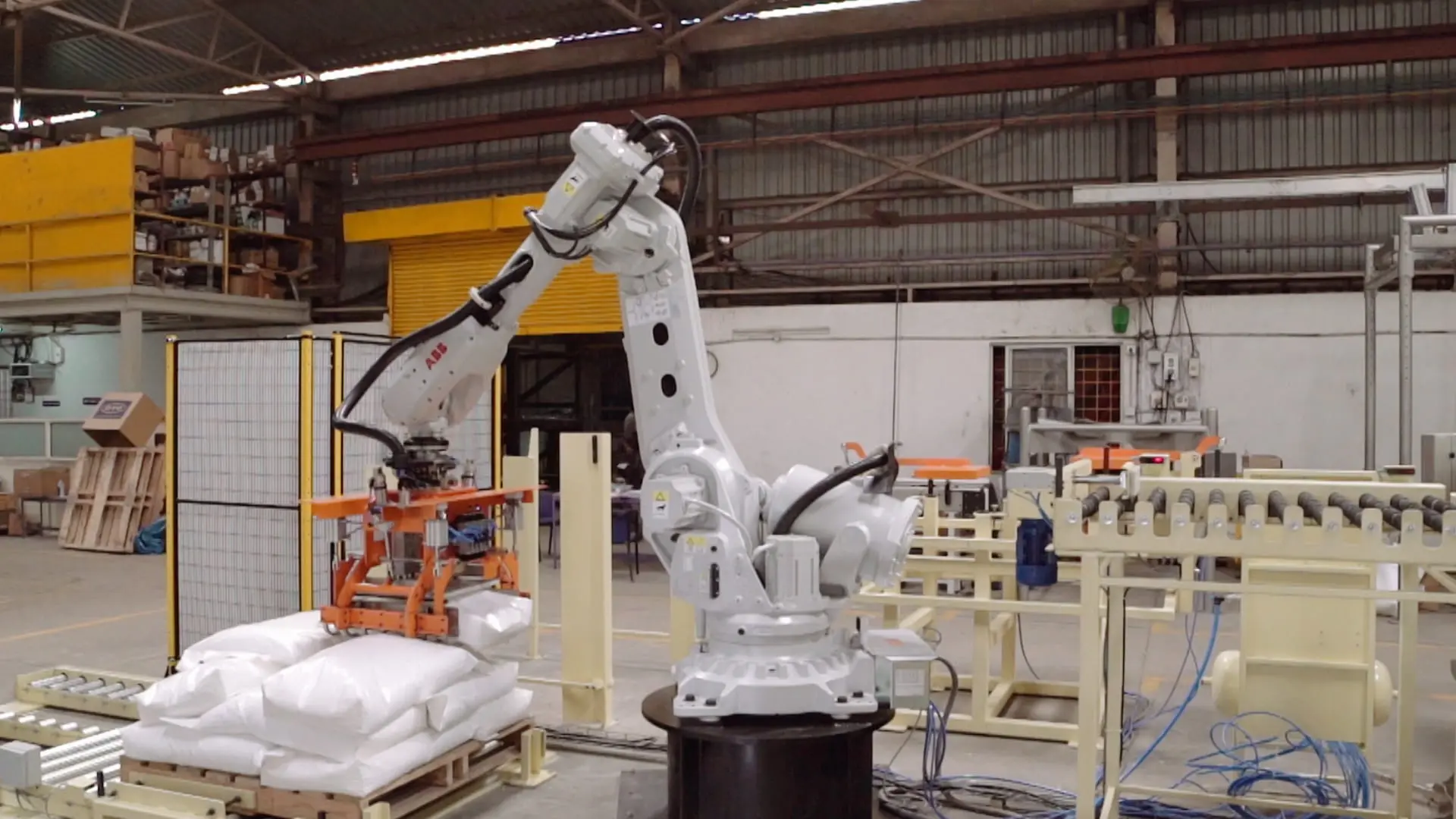
A high speed bag palletizer eliminates this ceiling. Engineered to match or exceed the output of upstream bagging equipment, a high-speed robotic bag palletizer handles up to 600 bags per hour at up to 50 kg per bag , continuously, without fatigue, without shift degradation, and without the injury exposure that defines manual palletizing at scale. This guide covers what drives high-speed bag palletizer performance, the specifications of Cybernetik’s range, how a single system serves multiple upstream lines, and the integration architecture that turns individual machines into a unified high-throughput bulk packaging line.
Why High Speed Is the Critical Parameter for Large Volume Bag Palletizing
In small or mid-volume operations, a palletizer running at 150 bags per hour is adequate. The upstream bagging machine runs at a similar rate, manual supplementation fills the gap when needed, and the line operates within its constraints. Scale the same logic to a large-volume operation running three or four bagging lines , each capable of 200 to 300 bags per hour , and the constraint calculus changes entirely.
The Throughput Gap Problem
The most common cause of underperformance in large-volume bulk packaging is not the bagging equipment , it is the palletizing stage. Manual palletizing teams at 25 to 50 kg bag weights can realistically sustain 80 to 120 bags per hour per person under ideal conditions; actual sustained throughput over a two-shift day runs 20 to 30% lower due to fatigue. When three upstream lines each fill 250 bags per hour, the palletizing station must clear 750 bags per hour to prevent line stoppages. No manual team achieves this consistently.
Speed Without Accuracy Fails
Throughput alone is not the measure of a high speed bag palletizer. Pallet quality , layer pattern accuracy, stack height consistency, load stability , must be maintained at the higher rate. A machine that stacks fast but builds unstable pallets creates a downstream problem: stretch-wrapping failures, in-transit damage, and warehouse storage rejections that cancel the throughput gain. Cybernetik’s high-speed bag palletizer uses a reference system that positions each bag and pallet precisely before every pick-and-place cycle, ensuring that matrix accuracy is maintained at 600 bags per hour as reliably as at 100.
Speed Degradation Over the Shift Is Not Acceptable at Scale
Manual throughput degrades over a shift. At large volume , where the operation runs two or three shifts continuously , this degradation compounds into a significant daily shortfall. A high speed bag palletizer runs at rated throughput from the first bag of the morning to the last bag of the night shift, with no fatigue curve, no break requirement, and no performance drop between shift transitions. For a plant running 20 hours per day at 600 bags per hour, the difference between rated machine throughput and degraded manual throughput is tens of thousands of bags per month.
How Cybernetik’s High Speed Bag Palletizer Achieves 600 Bags Per Hour
Speed at scale is not a single design choice , it is the result of several engineering decisions that work together. Cybernetik’s high speed bag palletizer achieves its 600 bag per hour rated throughput through six interconnected design elements:
High Speed Bag Palletizer: Full Technical Specifications
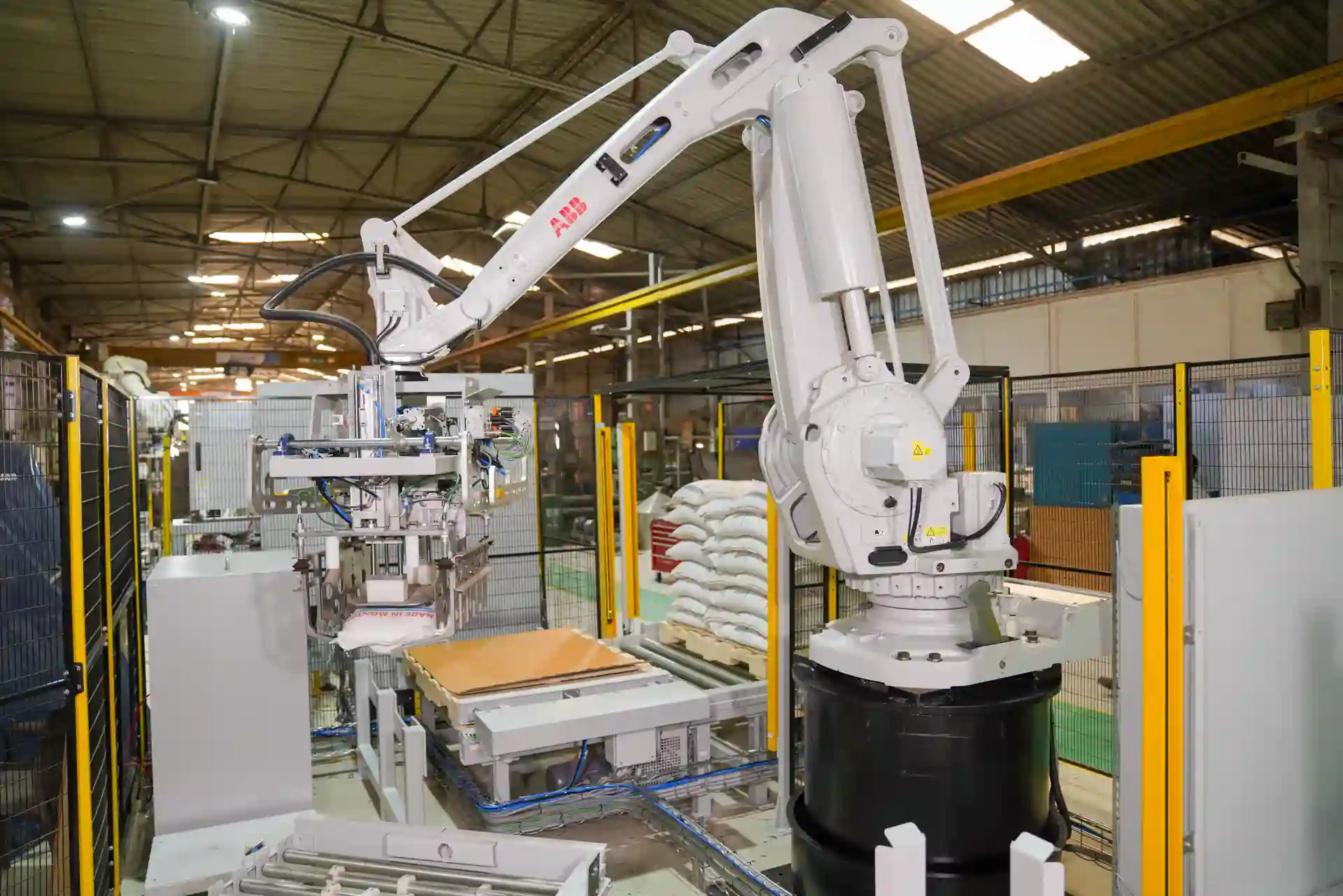
The table below documents the complete technical specification of Cybernetik’s six-axis robotic high speed bag palletizer , the primary configuration for large-volume operations. All values are standard specifications; customisation is available for specific throughput, payload, environment, and integration requirements.
| Parameter | High Speed Bag Palletizer , Six-Axis Robotic |
|---|---|
| Capacity | Up to 600 bags/hour (10 bags/min), Customisable |
| Payload | Up to 50 kg (25 kg and 50 kg configurations), Customisable |
| Footprint | 5 × 5.5 m, Customisable |
| Reach | Up to 3.1 m |
| Vertical Stack Height | Up to 1,800 mm |
| Rated Power | 35 kW, 3-phase 415 VAC, Customisable |
| Compressed Air | 10 CFM @ 6 bar |
| Pallet Sizes | 1200 × 1200 mm | 1200 × 1000 mm | 1145 × 1145 mm , Customisable |
| Pallet Material | Wooden, Plastic, Metal |
| Pallet Magazine Capacity | Up to 10 pallets of 150 mm each, Customisable |
| Bag Types | Gusseted bags, Gusseted flat-bottom bags, Sacks, Bales |
| Bag Material | Polyethylene (PE), Polypropylene (PP) |
| End-of-Arm Tooling | Servo / pneumatic grippers, customised per bag format and weight |
| Pallet Handling | Automated pallet dispenser + optional common gripper for bag and pallet |
| Changeover | Recipe-based HMI, no mechanical retooling for SKU changes |
| Control System | PLC + SCADA with recipe storage, OEE reporting, track-and-trace |
| Optional Features | Automated tool changer (drum/other unit handling), bag labelling & printing integration, upstream bagging machine integration, downstream stretch-wrapper integration |
| Safety | ISO 12100 risk assessment, guarded enclosures, safety curtains, interlocked access, CE/OSHA compliant |
| Applications | Food (grains, granules, powders, pellets), Chemicals & agro (seeds, fertilisers, pesticides), Pharmaceuticals (medicinal powders and granules), Construction materials, Minerals |
| View Full Product Page | Cybernetik Bag Palletizer → |
Large-Volume Industries That Run High Speed Bag Palletizers
High speed bag palletizers serve large-volume manufacturing operations where the combination of high throughput, heavy bag weight, and multi-shift operation makes manual palletizing operationally and economically unsustainable. The following industries represent the highest-volume installed base for Cybernetik’s high speed bag palletizer range.
| Industry | Typical Product | Bag Weight | Why High Speed Is Critical |
|---|---|---|---|
| Fertilisers & Agro | NPK, urea, DAP, seeds | 25–50 kg | Seasonal peak demand , must clear maximum volume in short windows |
| Chemicals | Granules, powders, crystals | 25–50 kg | Multi-shift continuous operation; export order volumes |
| Food , Grains & Flour | Wheat, rice, flour, starch | 25–50 kg | High-volume commodity processing; GMP compliance required |
| Construction Materials | Cement, gypsum, dry mortar | 25–50 kg | Heavy bags; multi-line output; high injury risk at manual scale |
| Animal Feed | Compound feed, premix, aqua feed | 25–50 kg | Multi-SKU high-volume lines; recipe changeover without stoppages |
| Minerals & Mining | Silica, calcium carbonate, talc | 25–50 kg | Abrasive bag exteriors; dusty environments; high operator injury risk |
| Polymers & Petrochemicals | PE, PP, PVC pellets and resin | 25 kg | Multi-line output from extrusion; precise pallet patterns for export |
High Speed Bag Palletizer vs Manual Palletizing: Large-Volume Performance Comparison
| Metric | High Speed Bag Palletizer | Manual Palletizing Team |
|---|---|---|
| Peak throughput | 600 bags/hr | 80–120 bags/hr per operator |
| Shift degradation | Zero , rated speed maintained all shift | 20–30% throughput drop over 8 hours |
| Operators required | 1 supervisor (multiple lines) | 4–6 operators per line per shift |
| Pallet pattern consistency | ±0 , every pallet identical per recipe | Variable , errors increase with fatigue |
| Injury risk | Near zero , guarded cell | High , repetitive 50 kg lifting |
| SKU changeover | HMI recipe selection , seconds | Manual retraining , minutes to hours |
| Multi-line capacity | Single robot serves 2–3 lines | Dedicated team per line required |
| Throughput scalability | Modular , add arm or conveyor section | Linear with headcount; hiring and training cost |
| Annual labour cost | Supervisor only; ROI typically 18–30 months | Multiple operators × 2–3 shifts × 300 days |
 “As production volumes increase, high speed palletizing becomes a strategic investment that improves efficiency, reduces manual handling, and supports long-term operational growth.”

See it in action
Scalability: How the High Speed Bag Palletizer Grows With Your Operation
Large-volume operations are not static. Seasonal demand peaks, new product lines, capacity expansions, and export volume growth all create throughput requirements that exceed the original design capacity. Cybernetik’s high speed bag palletizer is engineered for scalability at three levels:
Level 1, Multi-Line Infeed Expansion
The standard six-axis robotic bag palletizer cell is designed to accept infeed conveyors from additional upstream bagging lines without replacing the robot arm. Adding a third bagging line to a two-line cell requires extending the infeed conveyor network and updating the SCADA sequencing recipe. The robot arm and end-of-arm tooling remain unchanged. This is the most cost-efficient form of capacity expansion for large-volume operations.
Level 2, Robot Arm Upgrade
When throughput requirements exceed the capacity of the existing robot arm , for example, moving from 600 to 900 bags per hour across multiple lines , the modular cell design allows the robot arm to be upgraded to a higher-speed model within the existing cell frame, conveyor infrastructure, and safety guarding. PLC and SCADA configuration is updated; the cell does not require a full replacement.
Level 3, Dual-Robot Cell
For very high throughput requirements, multiple high-volume lines converging at a single palletizing area, a dual-robot cell configuration places two six-axis arms within a shared cell, each serving dedicated infeed and outfeed positions. The two robots operate under a single SCADA system with coordinated sequencing. This is Cybernetik’s highest-throughput bag palletizing configuration and is deployed in large fertiliser, cement, and food commodity operations.
Specifying a High Speed Bag Palletizer: Five Parameters to Define Before You Engage Vendors
The following five parameters must be specified before engaging vendors for a high speed bag palletizer. Getting these right at the outset determines whether the quoted system delivers the throughput required , or whether the shortfall appears post-installation.