Key takeaways
When production rates are high , 30, 60, or over 100 cases per minute from multiple lines simultaneously , and floor space around the palletizer is constrained, the technical and commercial case for a high level palletizer system is clear. High level palletizers receive product from overhead infeed conveyors, form layers at elevation, and lower them onto the pallet below , a short-stroke lowering motion that is fundamentally faster than the long-stroke lifting motion of a low level system. The result is a throughput ceiling that conventional floor-level palletizers simply cannot reach: up to 10 layers per minute in high-speed configurations, versus 1 to 3 for their low-level counterparts.
Cybernetik’s palletizing range addresses high level palletizer requirements through its high-throughput robotic, multiline, and elevated-architecture configurations , systems that deliver the throughput, precision, and multi-line capability associated with top tier palletizer performance, within a unified PLC and SCADA integration framework. This page explains what a high level palletizer is, how it differs from low level alternatives, why it is the right choice for high-speed production environments, and how Cybernetik’s configurations map to these requirements.
What Is a High Level Palletizer?
A high level palletizer is a palletizing system that receives product from an elevated overhead infeed conveyor , typically at heights of 100 to 144 inches (approximately 2.5 to 3.6 metres) above floor level , forms a complete product layer at that elevated position, and then lowers the full layer onto the pallet below. As the pallet builds, the pallet platform descends incrementally with each completed layer. The critical mechanical advantage is the short-stroke lowering motion: because the layer is always formed at the same elevated height and simply lowered a short distance, cycle time per layer is consistent regardless of pallet height , unlike a low level system where the layer-forming mechanism must travel an increasing distance to the top of the growing pallet with each successive layer.
This architecture , elevated infeed, layer formation at height, short-stroke descent , is the reason high level palletizers deliver up to 10 layers per minute in demanding configurations, compared to the 1–3 layers per minute typical of low level systems. For operations running 30 or more cases per minute, it is often the only palletizer architecture that can maintain pace with the upstream line without creating a bottleneck.
High Level vs Low Level Palletizer: The Performance Difference
The distinction between high level and low level palletizers runs deeper than infeed height. It affects throughput ceiling, floor space utilization, integration complexity, and total cost of ownership across the machine’s working life.
| Performance Factor | High Level Palletizer | Low Level Palletizer |
|---|---|---|
| Infeed Height | 100–144 inches , overhead conveyor | 30–36 inches , floor/waist-level conveyor |
| Layer Speed | Up to 10 layers/min | 1–3 layers/min |
| Cycle Motion | Short-stroke lowering , consistent speed | Long-stroke lifting , slows as pallet grows |
| Cases/Min (typical) | 30–60+ cases/min | Up to ~20–25 cases/min |
| Floor Footprint | Smaller , conveyors and mechanism elevated | Larger , all components at floor level |
| Ceiling Height Needed | 5–7+ metres | 4–6 metres standard |
| Infrastructure Cost | Higher , spiral lifts / elevated conveyors | Lower , uses existing floor conveyors |
| Machine Capital Cost | Higher | Lower |
| Fragile Product | Better , lowering action is gentler | Moderate , lifting action per layer |
| Future Throughput | More headroom , scalable architecture | Hard ceiling , difficult to increase |
| Best For | High-speed, high-volume, overhead-conveyor lines | Moderate throughput, standard-ceiling facilities |
Cybernetik’s High Level Palletizer Configurations
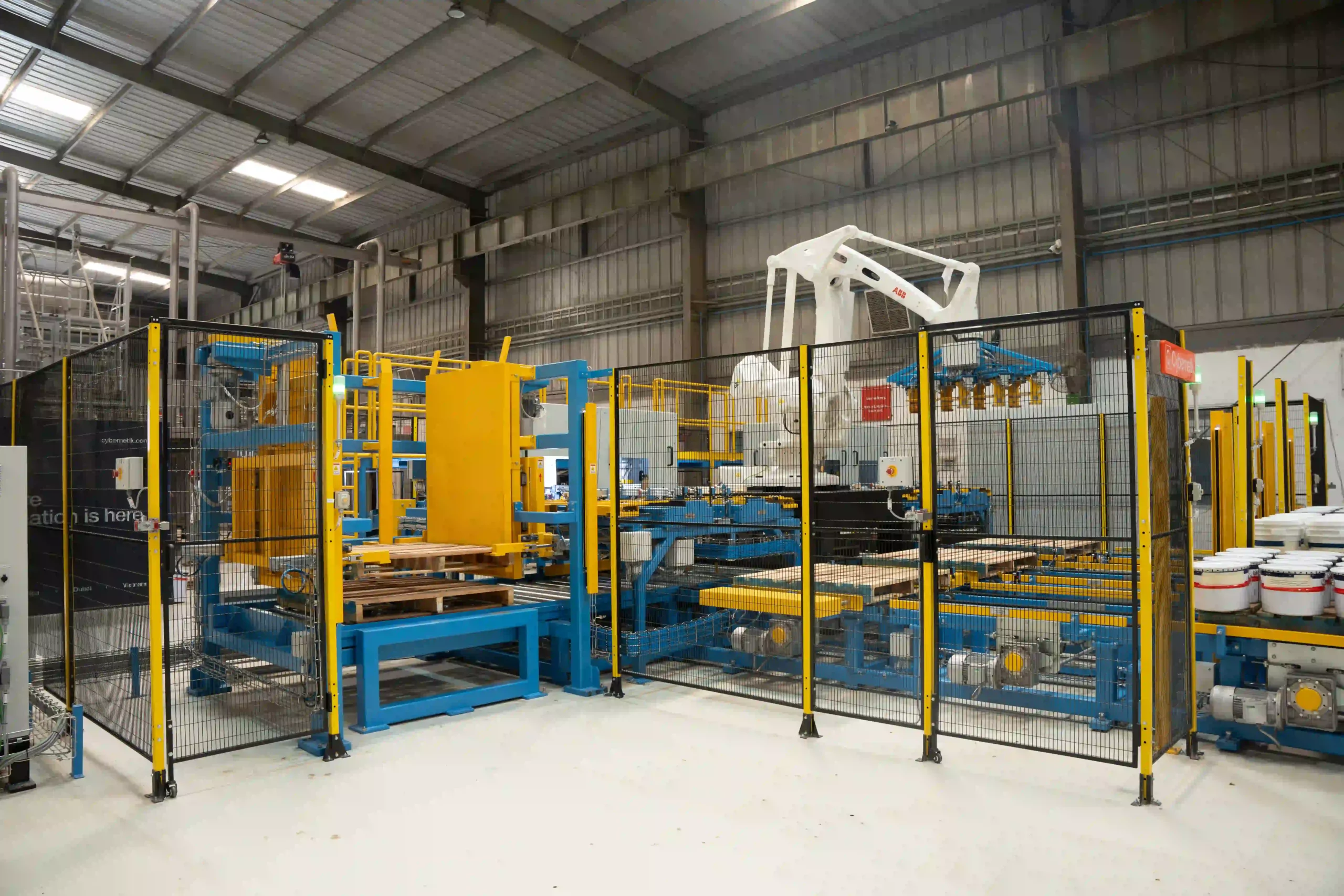
Cybernetik addresses the high level palletizer market through its high-throughput robotic and elevated-architecture configurations. These systems deliver the throughput, precision, and multi-line servicing capability of top tier palletizer performance, operating from both elevated and floor-level infeed architectures depending on the specific configuration. Here is how Cybernetik’s range maps to high-speed, high-level palletizing requirements:
1. Robotic Palletizer, High-Speed Multi-Line Top Tier Performance
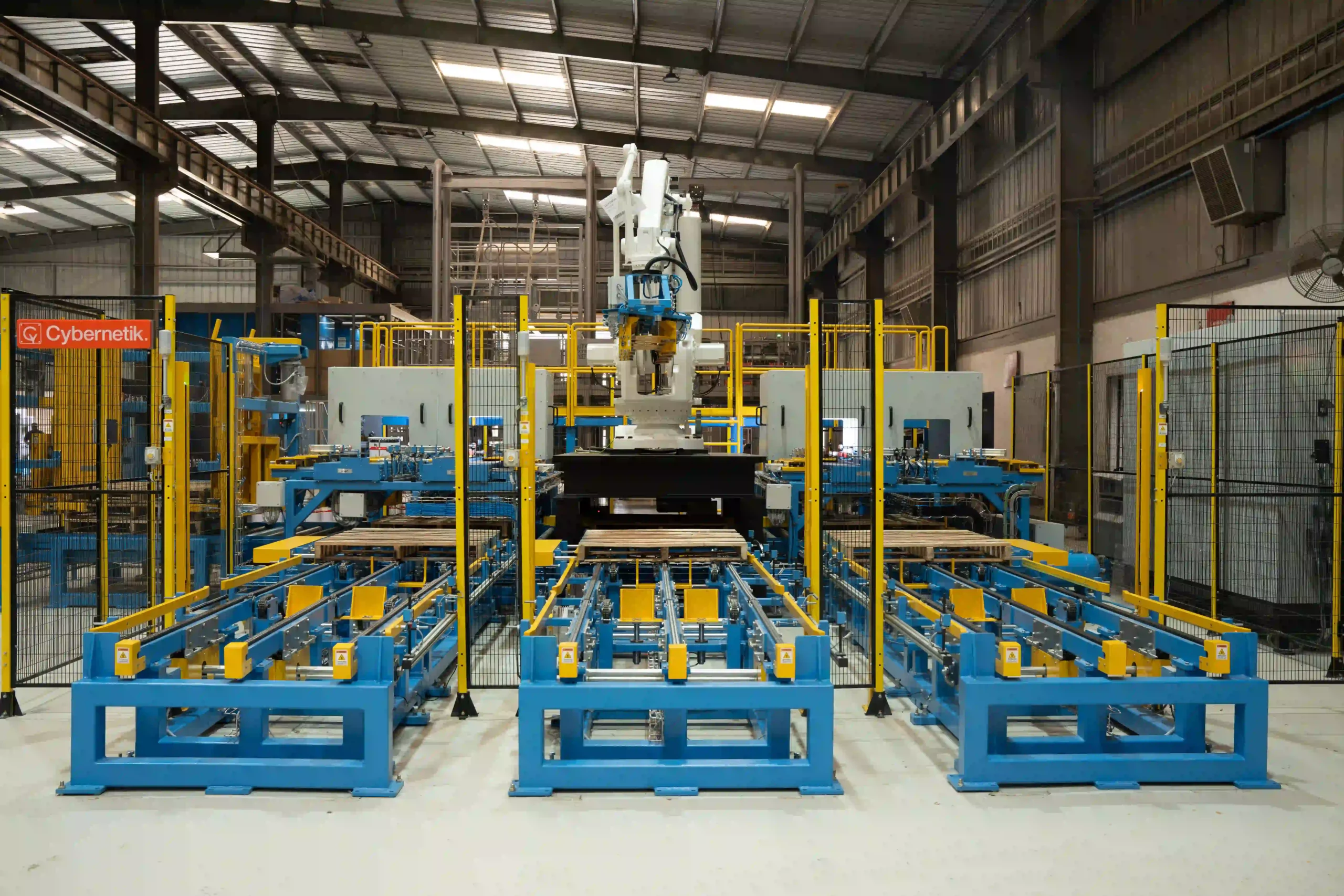
Cybernetik’s Robotic Palletizer delivers the throughput and multi-line capability associated with top tier palletizer systems through its 6-axis or 4-axis robotic arm architecture with servo/pneumatic end-of-arm tooling. A single robot services multiple upstream lines simultaneously, achieving high cycle rates by minimizing travel time between pick points on different lines. Automated pallet dispensing, recipe-based matrix selection via HMI, and full upstream and downstream PLC integration make it the primary high-speed palletizer configuration in Cybernetik’s range for cartons, cases, bags, drums, and pails.
2. Robotic Carton Palletizer , Dual-Robot High-Volume Top Tier System
The Robotic Carton Palletizer is Cybernetik’s highest-throughput carton palletizer configuration , a dual-robot system that separately and simultaneously palletizes different carton sizes at different stations in the same cycle. Two robots, triple-line and double-line stations, carton height adjustment for seamless upstream integration, simultaneous palletizing of two cartons per robot cycle, and in-built overweight/underweight carton rejection. This is the configuration deployed where throughput demand approaches or exceeds 30 cartons per minute from multi-format, multi-line carton operations , the definition of a high speed palletizer requirement.
3. Multiline Pail Palletizer, Elevated Architecture High Speed Configuration
The Multiline Pail Palletizer is Cybernetik’s most architecturally distinctive high-level configuration , with the robot physically elevated above the pallet conveyor level, enabling continuous palletizing across multiple lines without pausing for pallet changes. Up to 60 pails/min throughput. Layered build for zero dead-time operation. This is the closest architectural analogy in Cybernetik’s range to the elevated-platform, high-cycle operation that defines a conventional high level palletizer , and it delivers the throughput to match.
4. Gantry Palletizer, High-Speed Overhead Architecture for Heavy Loads
The Gantry Palletizer uses an overhead 3-axis servo-actuated gantry that operates above the pallet zone , an architecture that shares the spatial logic of high level palletizing (elevated mechanical system, floor space efficiency) while maintaining low CAPEX and minimal moving parts. Up to 210 bags/hr, 10 SKU formations, compact footprint, and low OPEX make it the right high-throughput overhead-architecture choice for heavy uniform-load operations where a multi-axis robotic arm is not needed.
When to Specify a High Level Palletizer
Seven operational criteria should drive the decision toward a high level palletizer or high-speed palletizer configuration:
 “For high-volume manufacturing, the right high level palletizer eliminates bottlenecks by delivering consistent, high-speed palletizing with precision and reliability.”