
Key takeaways
Small and medium businesses have been excluded from robotic palletising for most of its history. The entry ticket , full six-axis robotic arm, enclosed guarding cell, PLC integration, installation and commissioning , was priced for large manufacturing operations running three-shift continuous production. For an SMB running a single case packing line at 200 cases per hour with two operators, the payback calculation simply did not close. Robotic palletising was a technology that improved large manufacturers’ economics while leaving SMBs palletising by hand.
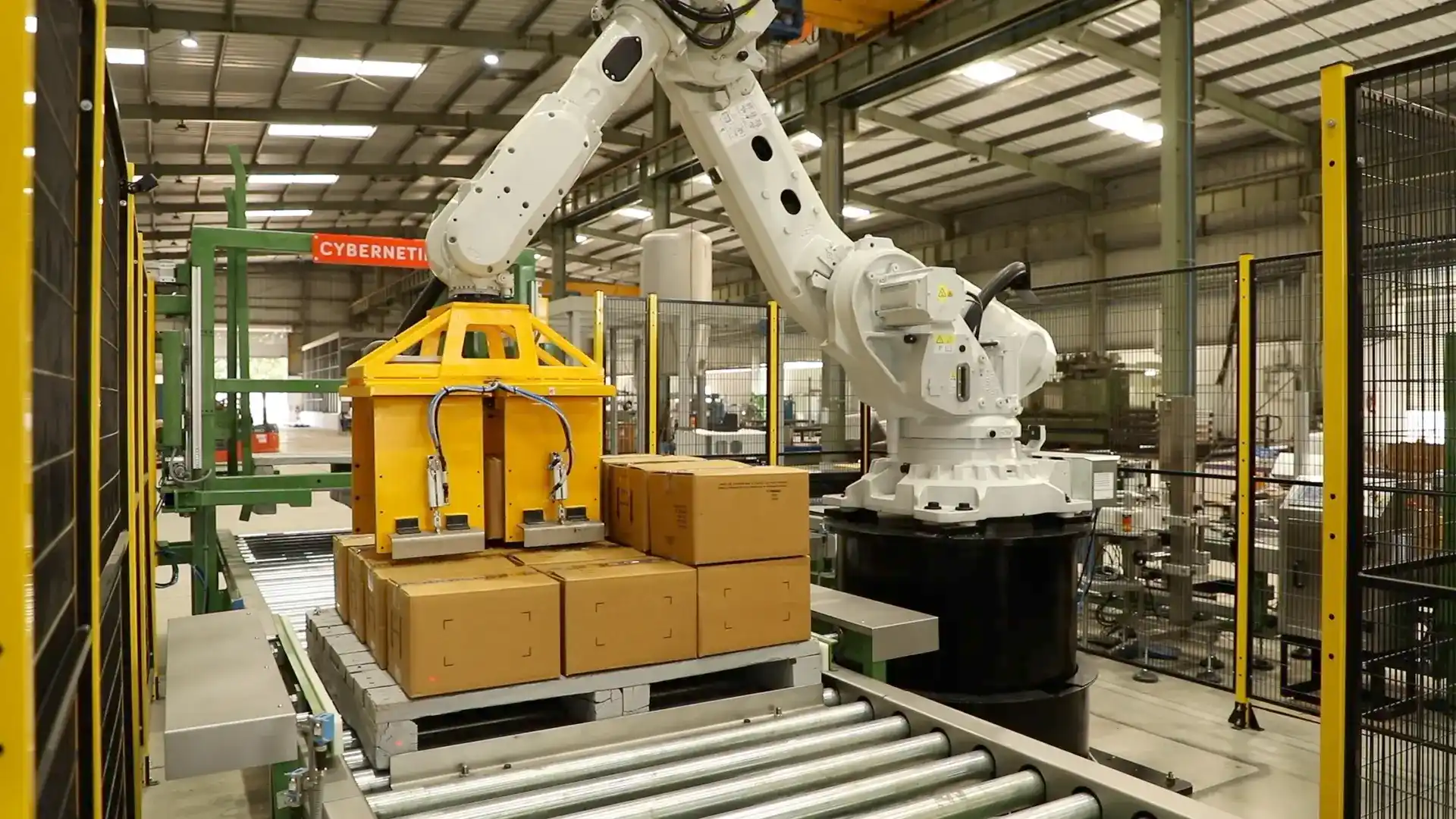
The cobot palletiser changed that calculus. A collaborative robot palletiser operates without full enclosure guarding, deploys in a fraction of the floor space of a six-axis system, handles multiple carton sizes from a single arm across multiple lines, and integrates case printing directly into the pick-and-place cycle. For an SMB, these are not incremental advantages , they are the difference between robotic palletising being accessible or inaccessible. This guide explains how Cybernetik’s cobot palletiser works, what makes it specifically suited to small and medium business operations, and the five capability differences that make it the right specification where a full six-axis palletising cell is the wrong one.
What Is a Cobot Palletiser?
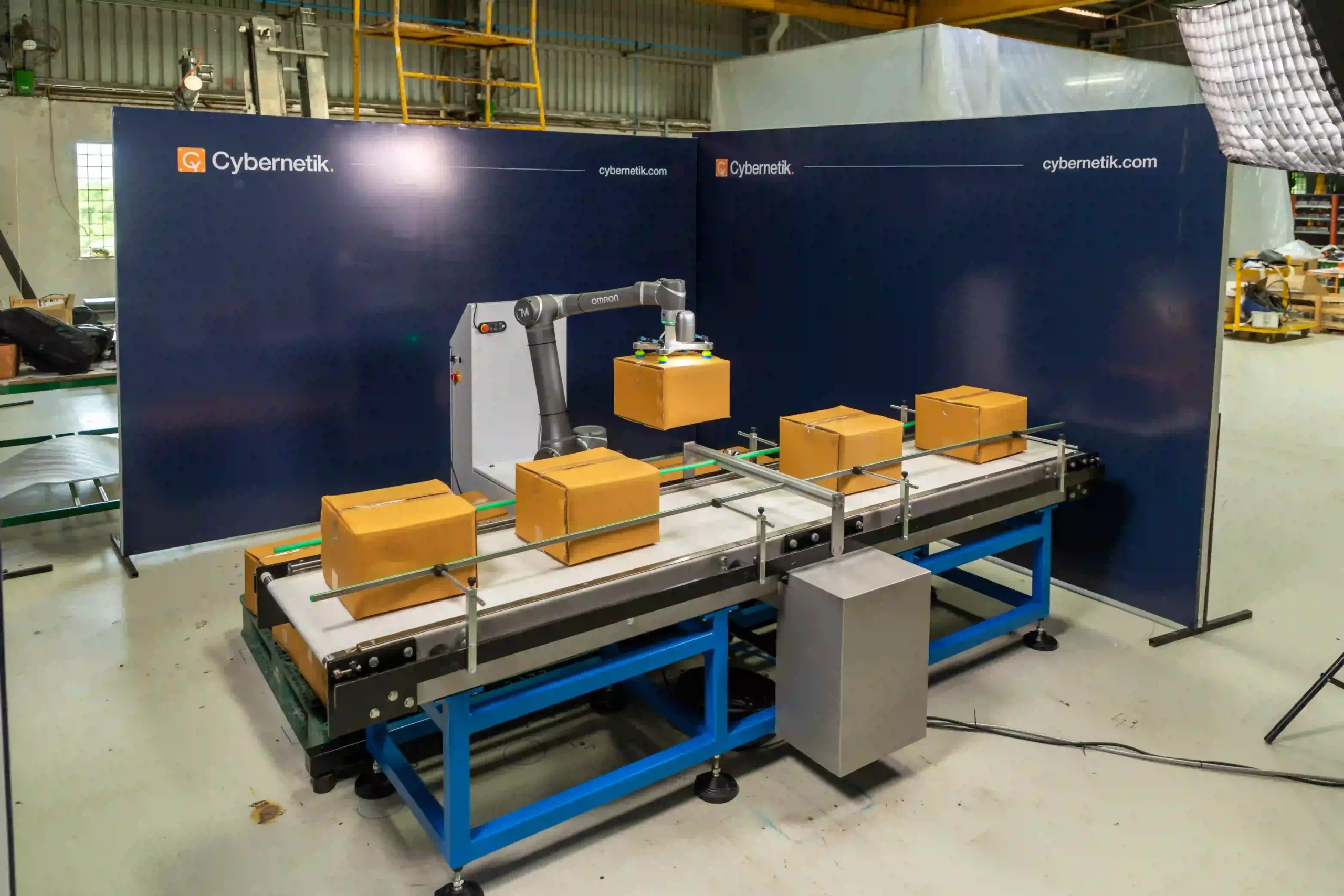
A cobot palletiser is a collaborative robot (cobot) configured for palletising operations. Unlike a conventional six-axis industrial palletiser that requires full enclosed guarding, dedicated floor space and a substantial control infrastructure, a cobot palletiser operates with inherent safety features , force-limiting, speed-monitoring and proximity detection , that allow it to work in close proximity to operators without a full guarding enclosure. The collaborative safety of the cobot arm is certified to international standards, replacing the physical barrier of an enclosed cell with software-defined safety zones.
What makes cobot palletisers specifically relevant for small and medium businesses is the combination of reduced floor space, reduced capital cost, simplified installation and operational flexibility. A cobot palletiser can be repositioned within a packaging hall as production layouts change. It can be operated by a trained production operative rather than a dedicated robotics specialist. It can handle multiple carton sizes from a single arm without mechanical reset. And on Cybernetik’s configuration, it integrates case label printing directly into the palletising cycle , eliminating a separate case printer workstation from the end-of-line layout.
Cybernetik’s Cobot Palletiser & Case Printer is an advanced end-of-line solution that palletises cartons of multiple sizes while printing case labels as part of the pick-and-place cycle. A single cobot arm operates across multiple production lines sequentially, building complete and accurate pallet matrices on each. A drop recovery system automatically detects and replaces any carton that falls during palletising, maintaining pallet matrix completeness without operator intervention. The system is designed specifically for the operational realities of small and medium businesses , flexible, compact and economical to run.
Five Reasons the Cobot Palletiser Works for SMBs Where Six-Axis Does Not
1. No Full Guarding Enclosure Required
A six-axis industrial palletiser requires a full guarding cell , enclosed walls, interlocked access gates, light curtains, a controlled safe zone occupying significant floor area beyond the arm’s working envelope. For an SMB with a compact packaging hall, this cell often takes more floor space than the rest of the secondary packaging line combined. Cybernetik’s cobot palletiser uses inherent collaborative safety , force-limiting and speed-monitoring that stop the arm on contact , rather than a physical barrier, installing in a fraction of the floor footprint with safety curtains on the periphery.
2. Single Arm Across Multiple Production Lines
An SMB running two or three case packing lines does not have the throughput on any single line to justify a dedicated palletiser per line. Cybernetik’s cobot palletiser handles multiple lines sequentially from a single arm , completing pallet builds on Line A, then cycling to Line B, then back , coordinated by the shared PLC logic with each upstream line. This multi-line single-cobot architecture is a configuration that large-scale industrial six-axis systems are not designed to perform.
3. Integrated Case Printing Eliminates a Separate Workstation
In many SMB end-of-line operations, case labelling is a manual step that happens separately from palletising , a printer-applicator, an operator, and a coordination point that creates errors and delays. Cybernetik’s cobot palletiser integrates case label printing directly into the pick-and-place cycle: carton referencing on the conveyor, label printing during the pick motion, placement on the pallet. The case printer workstation and its associated manual step are eliminated from the layout entirely.
4. Drop Recovery System for Operator-Free Pallet Completion
When a carton falls during robotic palletising, a six-axis system typically requires an operator to clear the fallen carton and restart the cycle. Cybernetik’s cobot palletiser drop recovery system uses the palletising cobot itself to detect the fallen carton and replace it with the next available carton from the infeed, maintaining pallet matrix completeness without operator intervention. For an SMB running with minimal end-of-line staff, the drop recovery system is the feature that makes cobot palletising genuinely autonomous rather than operator-assisted.
5. Multiple Carton Sizes Without Mechanical Reset
SMBs tend to run more SKU variety per line than large manufacturers, because their customer base requires it. A cobot palletiser handles multiple carton types and sizes through software-defined pick parameters , no mechanical EOAT change, no guiding reset, no production pause between carton size changes. Cybernetik’s cobot arm adjusts its grip and placement geometry per carton type on each pick cycle, building customisable matrix formations that accommodate the mixed-case variety typical of SMB product portfolios.
Cobot Palletiser vs Gantry vs Six-Axis: Choosing the Right Tier for Your Operation
SMBs often face a choice between three palletiser tiers. Understanding what each delivers, and what it costs to run, is the core of the specification decision.
Cobot Palletiser, SMB Flexible Deployment
Collaborative robot, inherent safety without full guarding enclosure, multi-line sequential operation from single arm, case printing integrated in pick cycle, drop recovery system, flexible deployment and repositioning. Lower throughput than six-axis; highest flexibility per square metre of floor space. Best for SMBs running 1–3 lines at low-to-mid throughput with mixed carton sizes, space-constrained packaging halls and case printing as a combined end-of-line requirement.
Gantry Palletiser, Mid-Volume Step Up
3-axis servo gantry, 210 units/hour, 9-second cycle time, 2,000 mm stack height, up to 10 matrix formations, 10 kW, light curtain safety, compact footprint. No full enclosure but higher throughput than cobot. Best for SMBs that have outgrown cobot throughput but cannot yet justify six-axis capital, a proven stepping stone on the automation roadmap.
Six-Axis Robotic Palletiser, High-Volume Manufacturing
Full articulated arm, up to 1,200 cases/hr at 150 kg payload, three simultaneous picks, full ISO 12100 enclosure, automated pallet dispenser. Highest capital, highest throughput, highest long-term return at scale. The right specification when production volume makes the six-axis economics close, typically above 500 cases/hour on a sustained basis.
Cobot vs Gantry vs Six-Axis Palletiser, SMB Decision Matrix
The table below maps the three palletiser tiers to the business-size and throughput parameters that most affect SMB investment decisions.
| Parameter | Cobot Palletiser | Gantry | Six-Axis |
|---|---|---|---|
| Best Business Size | SMB / startup | SMB to mid-market | Mid-market to enterprise |
| Throughput | Low to mid | 210 units/hr | Up to 1,200 cases/hr |
| Floor Space | Minimal (no enclosure) | Compact | ~28 m² (enclosure incl.) |
| Safety Architecture | Inherent cobot safety | Light curtains + guards | ISO 12100 full enclosure |
| Case Printing | Integrated standard | Not standard | Not standard |
| Multi-Line | Yes , sequential | Single line | Multiline configuration |
| Drop Recovery | Standard | Not applicable | Not applicable |
| CAPEX Profile | Lowest | Lower | Highest |
| Repositionable | Yes | Limited | Fixed |
What Cybernetik’s Cobot Palletiser Handles
Carton and case types within cobot palletiser scope
Cobot Palletiser & Case Printer capabilities
SMB end-of-line integration scope
 “Robotic palletising is no longer reserved for large factories. Cobot palletisers enable growing manufacturers to automate end-of-line operations with minimal space, lower capital, and greater flexibility.

See it in action
Why Small and Medium Businesses Choose Cybernetik’s Cobot Palletiser
Each advantage below is engineered specifically for the operational realities of small and medium businesses, not scaled-down versions of enterprise features but purpose-designed SMB capabilities.
When a Cobot Palletiser Is the Right Next Step for Your SMB
The cobot palletiser is right for your operation when two or more of the following describe your current end-of-line situation.
Where two or more apply, Cybernetik’s cobot palletiser is the specification that brings robotic palletising within the operational reach of a small or medium business , without requiring the capital, floor space or infrastructure of a full six-axis installation.