
Key takeaways
A case palletizer is the machine that decides whether the investment in your upstream packaging automation actually reaches the dispatch dock. Your filler runs at rated speed. Your case packer loads sealed cases without operator contact. Your labeller and sealer run in coordinated sequence. Then at the end of the line, a case palletizer that cannot keep pace, cannot hold pallet matrix consistency or cannot communicate with the upstream case packing line converts all of that upstream investment into a single, visible bottleneck. End-of-line automation is only as complete as the case palletizer that closes it.
This guide covers the engineering capabilities that distinguish a case palletizer built for modern end-of-line automation from one that merely handles cases in isolation, the three Cybernetik configurations for corrugated case, carton and rigid box palletizing at different throughput tiers, and the integration architecture that makes the case packer and case palletizer operate as a single coordinated system rather than two adjacent machines. Whether you are specifying a complete new line or closing an automation gap at the end of an existing one, the engineering below is the reference point.
What Is a Case Palletizer?
A case palletizer is an automated tertiary packaging machine that takes sealed corrugated cases, cartons or rigid boxes from an upstream case packing line and stacks them onto pallets in a recipe-defined layer pattern for storage, stretch-wrapping and dispatch. The case palletizer sits immediately downstream of the case packer , and immediately upstream of the stretch-wrap and dispatch stage , making it the end-of-line bridge between secondary and tertiary packaging automation.
What separates a case palletizer from a generic pallet-stacking unit is the tight coupling it maintains with the upstream case packing machine. A case packer operates at a defined cadence, producing sealed cases with known dimensions and known SKU identification. The case palletizer must read that cadence, receive that SKU data and pre-stage the correct pallet matrix recipe before the first case of each batch arrives at the pick station. Without this upstream coordination, the case palletizer introduces a handoff gap , a pause between the case packer’s output and the palletizer’s intake , that limits throughput regardless of the palletizer’s rated speed.
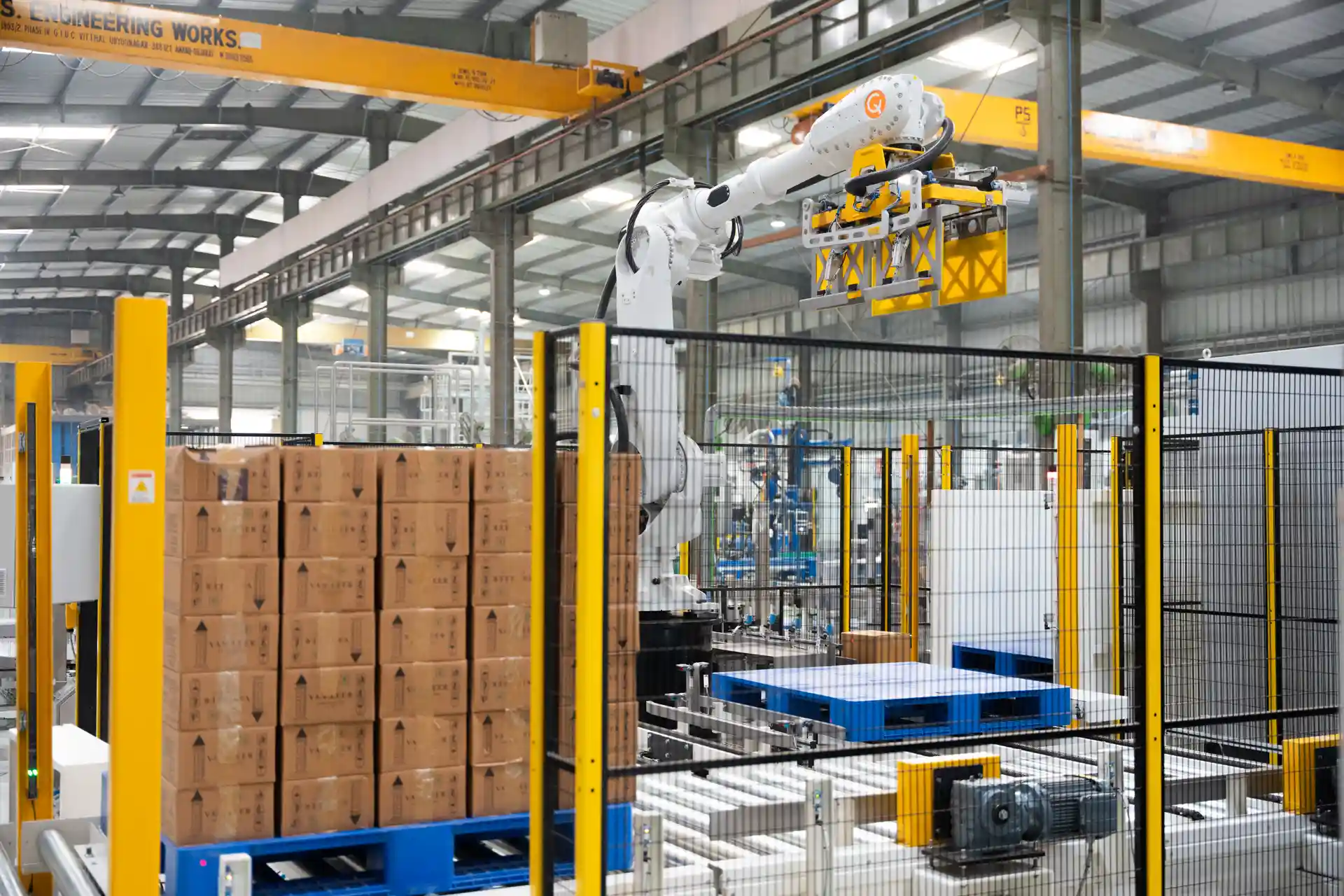
Cybernetik’s automatic case palletizer is engineered for precisely this tight coupling. The six-axis robotic case palletizer handles up to 1,200 cases per hour with 150 kg payload, simultaneous picking of up to three cases per arm cycle, automated pallet dispensing and full PLC integration with the upstream case packing line. The gantry case palletizer provides 210 cases per hour on 10 kW with compact footprint where capital or space constraints apply. Both configurations are available from four Cybernetik manufacturing facilities with verified throughput data from end-of-line deployments across more than thirty countries.
Five Capabilities That Define a Modern Automatic Case Palletizer
1. Throughput Headroom Above the Upstream Case Packer
A case palletizer rated exactly at the upstream case packer’s output operates at zero margin , any packer surge fills the infeed buffer and propagates back through the line. Cybernetik’s automatic case palletizer is sized at up to 1,200 cases per hour , providing 15 to 20 percent throughput headroom above typical high-throughput case packer outputs. This margin absorbs upstream surges, short acceleration intervals and brief downstream pauses without creating accumulation or stoppages on either side of the palletizing station.
2. Simultaneous Multi-Case Picking for High Cadence
Picking one case at a time imposes a cycle-time ceiling that cannot be overcome regardless of arm speed. Cybernetik’s six-axis case palletizer picks up to three cases per arm cycle using servo and pneumatic array grippers tuned to corrugated and rigid case dimensions. Completing each pallet layer in fewer arm cycles means more layers per shift and fewer cycle-induced stress accumulations on the EOAT , a maintenance and throughput benefit simultaneously.
3. Recipe-Driven Multi-SKU Pallet Matrix Formation
A case palletizer used on a multi-SKU packaging line must switch pallet matrix recipes between each production batch without pausing output. Cybernetik’s case palletizer stores a full HMI recipe library for all active case dimensions and pallet matrix patterns. When the upstream case packing machine signals an SKU change through shared PLC, the palletizer pre-stages the new recipe before the first case of the new batch arrives , eliminating the inter-batch pause that operator-driven recipe selection introduces.
4. Automatic Pallet Dispensing for Continuous Shift Operation
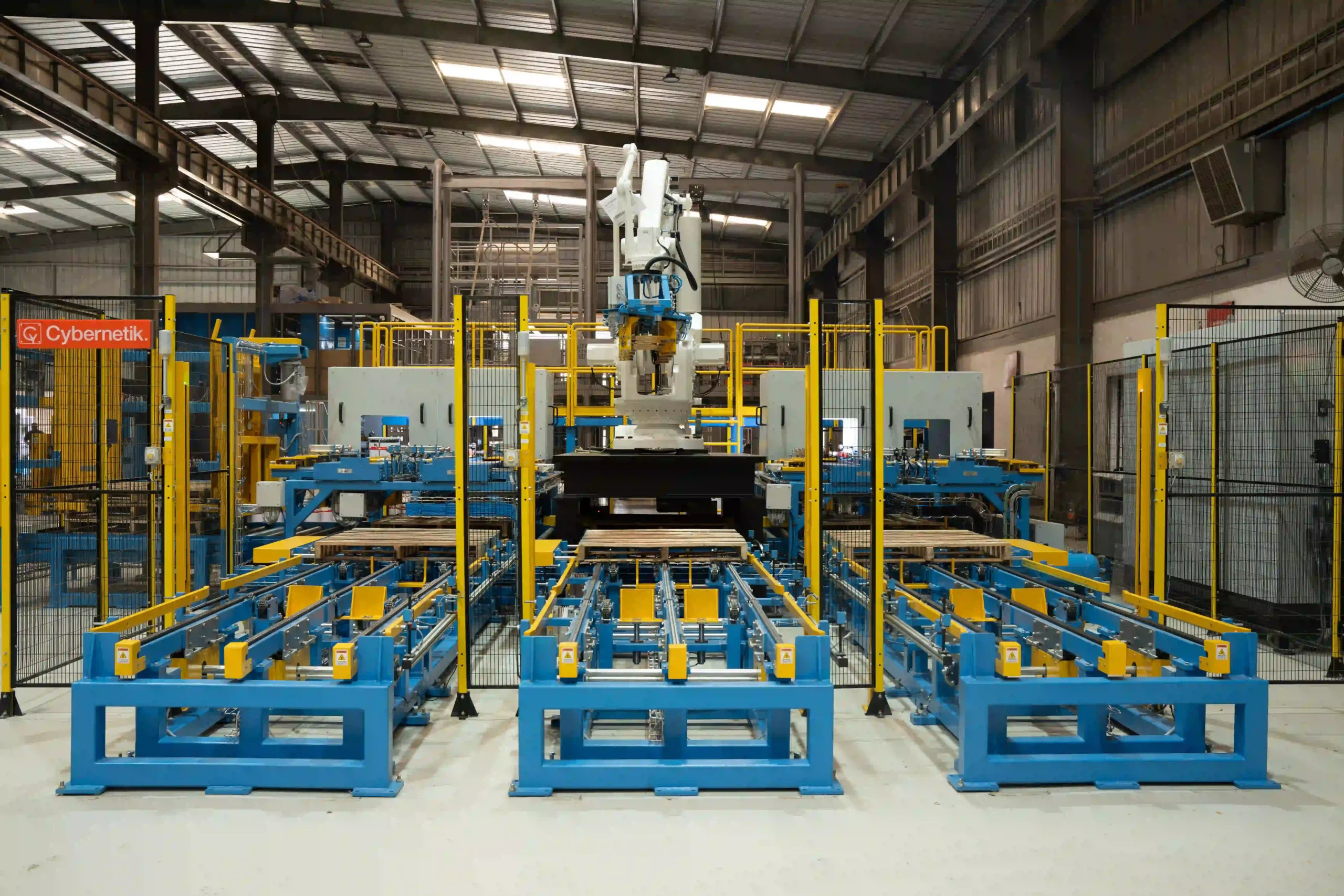
A semi-automatic case palletizer that requires manual pallet loading produces a throughput gap at every pallet change. At 1,200 cases per hour, a two-minute manual pallet-change pause represents 40 cases unpalletised per event. Cybernetik’s automatic case palletizer integrates an automatic pallet dispenser with up to 10-pallet magazine capacity, releasing one empty pallet per palletizing cycle without operator intervention. The completed pallet transfers automatically to the outfeed conveyor, restoring the palletizing cycle within the mechanical transfer time only.
5. Integrated Line Control from Case Packer to Stretch-Wrap
A case palletizer operating under separate controls from the case packing machine requires an operator to coordinate the handoff , managing case accumulation, confirming SKU transitions and signalling the downstream stretch-wrap. Cybernetik’s automatic case palletizer runs under the same PLC + HMI architecture as the upstream case packing line, receiving SKU data, case count and cadence signals directly and passing completed pallet data forward to the stretch-wrap and dispatch conveyor. The operator’s role is recipe supervision and magazine refill , not coordination.
Three Case Palletizer Configurations for End-of-Line Automation
Cybernetik builds case palletizers in three configurations that map to different throughput tiers, floor layouts and capital profiles across end-of-line automation projects.
Six-Axis Robotic Case Palletizer, Full End-of-Line Automation
Six-axis articulated arm with payload up to 150 kg, throughput up to 1,200 cases per hour, simultaneous picking of up to three cases, automated pallet dispenser with 10-pallet magazine, stack height up to 1,800 mm, footprint 3,600 × 7,880 mm, power 28.7 kW, ISO 12100 full enclosure. Full HMI recipe library for all active SKU pallet matrix patterns. Servo and pneumatic end-of-arm gripper options for corrugated RSC cases, rigid cases and handle-with-care boxes. PLC integration with upstream case packing and downstream stretch-wrap as standard. The primary configuration for end-of-line automation on high-throughput food, beverage, pharmaceutical and FMCG lines.
Gantry Case Palletizer, Compact Footprint for Capital-Constrained Lines
3-axis servo-actuated gantry system with 210 cases per hour throughput, 9-second cycle time, maximum pallet height 2,000 mm, up to 10 SKU matrix formations via rotary axis EOAT, 10 kW power and one operator for pallet changeover. Light curtain safety with compact footprint , no full enclosure. Low CAPEX and OPEX make this the right specification for end-of-line automation projects where throughput demand does not justify six-axis capital investment, or where floor space in the packaging hall prevents full-enclosure installation.
Multiline Case Palletizer, Parallel Line End-of-Line Coordination
For manufacturing operations running two or more parallel case packing lines feeding the same dispatch stage, Cybernetik configures multiline case palletizer systems where a single robotic arm handles cases from separate upstream conveyors, assigning each to the correct pallet in the correct recipe matrix. This eliminates the capital cost of a dedicated case palletizer per production line and coordinates the tertiary stage across parallel secondary packaging lines from a single control architecture.
Case Palletizer Configuration and End-of-Line Technical Comparison
Verified technical specifications from Cybernetik’s production-deployed case palletizer configurations.
| Parameter | Six-Axis Robotic | Gantry | Multiline |
|---|---|---|---|
| Throughput | Up to 1,200 cases/hr | 210 cases/hr (9 s/cycle) | Multi-line combined |
| Payload | Up to 150 kg | Format-matched | Up to 150 kg per arm |
| Simultaneous Pick | Up to 3 cases/cycle | 1 case per cycle | 1–3 per arm |
| Max Stack Height | 1,800 mm | 2,000 mm | 1,800 mm |
| Footprint | 3,600 × 7,880 mm | Compact; no enclosure | Scaled to line count |
| Pallet Dispenser | Auto , 10-pallet magazine | Semi-automatic | Auto , 10-pallet magazine |
| Power | 28.7 kW | 10 kW | 28.7 kW per arm |
| Line Integration | Full PLC (case packer + SW) | PLC integration available | Full multi-line PLC |
| Safety | ISO 12100 full enclosure | Light curtains + guards | ISO 12100 full enclosure |
Case Formats and Applications Within Cybernetik’s Case Palletizer Scope
Case and carton types handled
End-of-line integration scope
Industries and applications served
 “A case palletizer doesn’t just stack finished cases; it completes the end-of-line automation journey by synchronizing case packing, palletizing, and dispatch into one continuous workflow”

See it in action
The Cybernetik Case Palletizer Advantage for End-of-Line Automation
Cybernetik’s case palletizer is designed as an end-of-line automation component, not a standalone palletizing unit. Every advantage below reflects the integrated design philosophy.
When to Upgrade to an Automatic Case Palletizer
The case for specifying or upgrading an automatic case palletizer is most direct when two or more of the following apply simultaneously across the end-of-line operation.
Where two or more of these apply, the Cybernetik automatic case palletizer investment typically pays back in twelve to twenty-four months on throughput recovery, pallet-change elimination, SKU-transition savings and compliance closure combined.