
Key takeaways
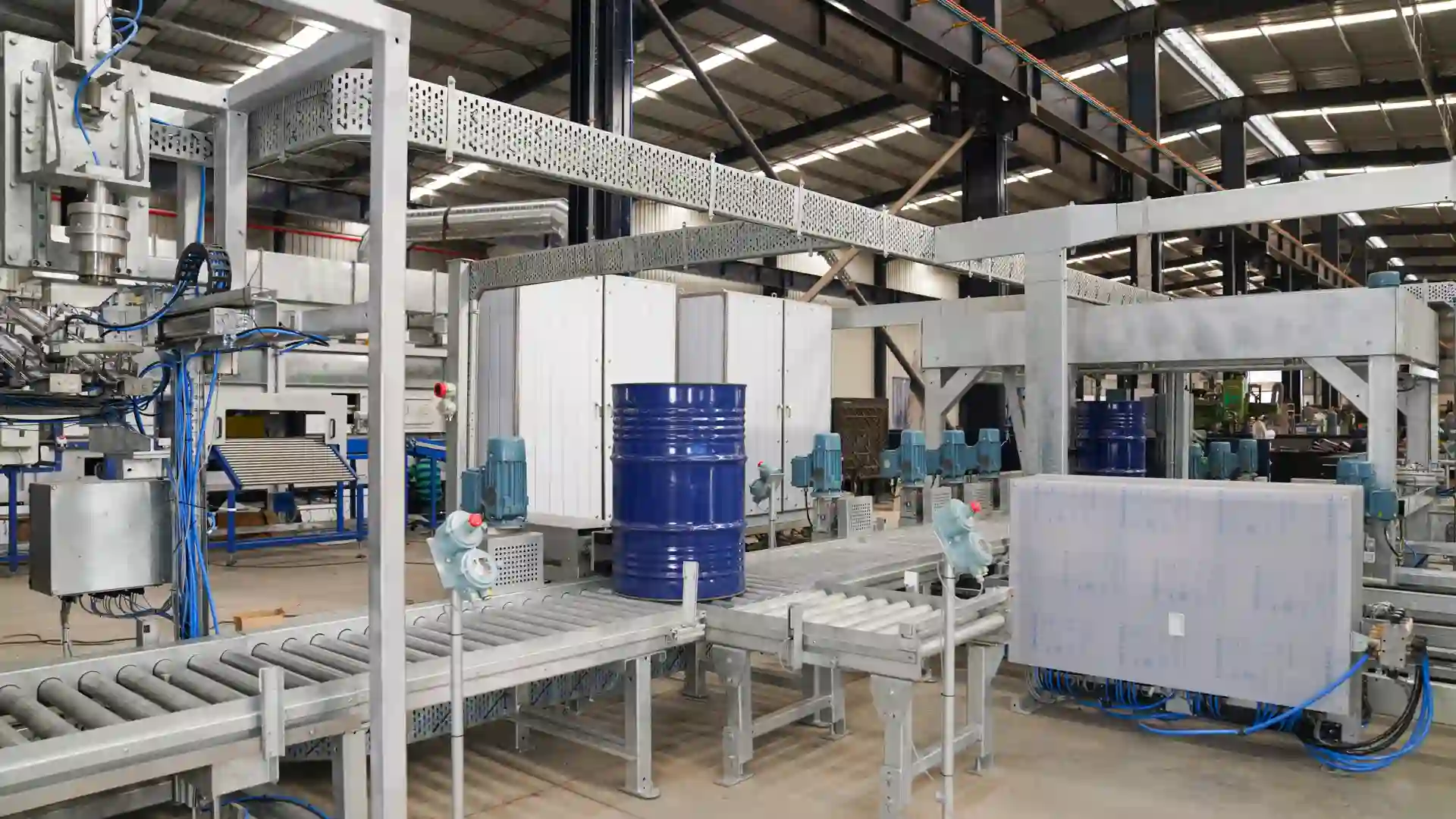
In brewing and distilling, they are called barrels. In lubricant and chemical manufacturing, they are called drums. In food processing and edible oil production, they are called containers. The industrial packaging world uses at least a dozen different names for the same basic format , a large cylindrical container of 50 to 220 litres filled with liquid, semi-liquid or granular product, sealed for transport and stacked on pallets for dispatch. The robotic palletizer that handles them is the same regardless of the name on the product label. What differs across industries is the fill weight, the rim geometry, the surface sensitivity and the regulatory environment , and those differences shape the barrel palletizer specification far more than the nomenclature does.
This guide covers what a barrel palletizing system needs to handle in an industrial context, the Cybernetik robotic barrel palletizer specifications that apply across brewing, food, chemicals, agrochemicals and general industrial packaging, and the five industrial applications where barrel palletizing automation delivers the clearest return. Whether you are palletising 200-litre solvent drums, 100-litre edible oil containers or 50-litre paint pails, the engineering framework below maps the right specification to your industrial context.
What Is a Barrel Palletizer in Industrial Packaging?
A barrel palletizer is an automated end-of-line machine that takes filled cylindrical containers , variously called barrels, drums, casks, containers or totes depending on industry , from an upstream filling or conveyor line and stacks them onto pallets in a recipe-defined matrix. In industrial packaging contexts, ‘barrel’ typically describes a rigid cylindrical container between 50 and 220 litres used for liquid, semi-liquid or granular industrial products , lubricating oils, edible oils, chemicals, beverages, food ingredients, adhesives and similar.
For robotic palletizing purposes, barrels and drums are handled by the same equipment platform. What determines the barrel palletizer specification is not the container’s common name but its physical properties: fill weight (which determines payload class), rim or closure type (which determines end-of-arm tooling selection), surface material (which determines grip approach), and the regulatory or food-safety environment of the application. A 200-litre HDPE barrel of lubricating oil and a 100-litre fibre barrel of food-grade flavouring both require a robotic barrel palletizer , but with different grippers, different motion profiles and different build standards.
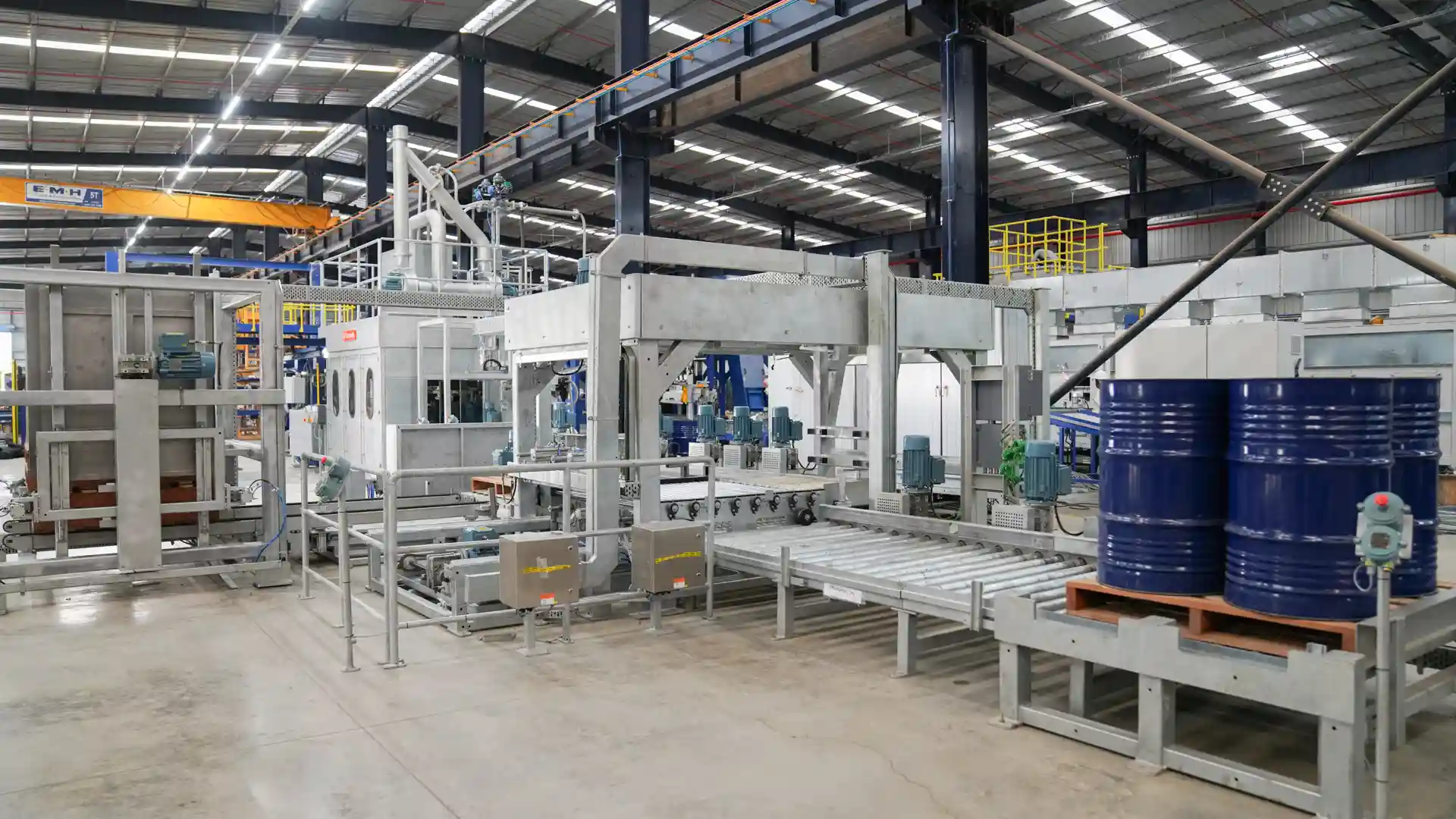
Cybernetik’s robotic barrel palletizing system handles cylindrical industrial containers at up to 6 barrels per minute with 120 kg payload , covering the full weight range from light 50-litre plastic containers through to heavy 220-litre fibre and HDPE industrial barrels. The system accommodates five container closure types: reinforced-rib, rolled-edge, chime, rimmed-top and screw-top. Servo and pneumatic gripper options are selected per barrel type. Automatic pallet dispenser with 10-pallet magazine, 3.1 m reach, 1,800 mm stack height, 7 × 7 m footprint and ISO 12100 guarding complete the standard build.
Five Industrial Packaging Applications Where Barrel Palletizing Automation Pays Back
1. Lubricant and Petroleum Product Barrels
Lubricating oil, engine oil, hydraulic fluid and specialty petroleum products are among the highest-volume industrial barrel formats globally. Barrels are typically HDPE in 20, 50, 100 and 200-litre sizes, filled at 4 to 6 barrels per minute on drum filling lines. Manual palletising at these weights generates injury claims and floor-level chemical exposure. Cybernetik’s barrel palletizer eliminates both , the six-axis arm handles the full 120 kg payload at sustained cadence within ISO 12100 enclosed guarding, removing operators from the barrel handling zone entirely.
2. Food-Grade Barrel Palletizing for Edible Oils and Ingredients
Vegetable oils, ghee, honey, syrups, molasses and juice concentrates are all filled into sealed barrels for food-service and industrial distribution. Food-grade barrel palletizing adds a build-standard requirement to the payload challenge: contact parts must meet food-grade material specifications, and the palletizing system must be cleanable without compromising integrity. Cybernetik’s barrel palletizer is available in food-grade build configurations with stainless steel contact parts and smooth-surface frames suitable for food manufacturing adjacent zones.
3. Agrochemical and Liquid Fertiliser Barrel Palletizing
Liquid fertilisers, pesticides, herbicides and micronutrient concentrates are filled into sealed HDPE and fibre barrels for agricultural distribution. Agrochemical barrel palletizing combines heavy payloads, chemical hazard classification and multi-variant barrel types in the same end-of-line specification. Cybernetik’s barrel palletizer handles drum variants across closure types and fill weights from a single platform through recipe-driven EOAT selection, with ISO 12100 guarding satisfying the chemical exposure substitution requirements that regulatory frameworks mandate.
4. Pharmaceutical and API Barrel Palletizing
Active pharmaceutical ingredients, ethanol, glycerin, sanitisers and bulk tonics are filled into sealed barrels for bulk pharmaceutical distribution. Pharmaceutical barrel palletizing requires GMP-grade construction alongside the standard payload capability , stainless steel contact parts, batch-and-pallet traceability and tamper-evident downstream handling. Cybernetik’s barrel palletizer in GMP-configured build addresses this combination without requiring a purpose-built pharmaceutical-only palletizing system.
5. Paint, Adhesive and Specialty Coating Barrel Palletizing
Paints, varnishes, adhesives and specialty coatings are among the most physically demanding barrel formats for palletising , high fill density, frequently changing product grades, hazard classifications under GHS/REACH, and strict label orientation requirements for safe chemical identification in distribution. Cybernetik’s barrel palletizer handles multi-variant paint barrel types with recipe-driven matrix formation and label-face orientation control, reducing the cross-product mixing and orientation errors that manual palletising introduces on multi-grade paint lines.
Three Barrel Palletizer Configurations from Cybernetik
Cybernetik builds barrel palletizing systems in three configurations that map to different industrial application volumes and capital profiles.
Dedicated Six-Axis Robotic Barrel Palletizer
Six-axis articulated arm with 120 kg payload, up to 6 barrels per minute, five closure-type variants across HDPE, fibre, PP and polymer barrel materials, servo and pneumatic gripper selection per barrel type, automatic pallet dispenser (10-pallet magazine), 1,800 mm stack height, 7 × 7 m footprint, 35 kW, ISO 12100 full enclosure. Best for industrial operations with a single dominant barrel format at sustained throughput , lubricants, chemicals, food-grade liquids.
Bag and Barrel Dual Palletizer
The same six-axis robotic arm handles both industrial barrels (120 kg payload, barrel EOAT) and bags (50 kg payload, bag EOAT) through an automated tool changer, switching between EOAT in a single arm cycle. This configuration is the right specification for industrial facilities that fill both barrels of liquid product and bags of powder or granule product , halving the capital investment compared to two dedicated systems.
Multi-Line Barrel Palletizer
A single robotic arm handles barrels arriving from multiple separate filling lines, assigning each barrel to the correct product pallet in the correct recipe matrix. Product identification passes from each filling line’s PLC to the palletizer automatically, preventing cross-pallet grade mixing. Best for multi-product industrial facilities running parallel barrel filling lines for different product grades.
Barrel Palletizer Technical Specification , Industrial Applications
Verified technical specifications from Cybernetik’s production-deployed barrel palletizer configurations.
| Parameter | Dedicated Barrel | Bag & Barrel Dual | Multi-Line Barrel |
|---|---|---|---|
| Throughput | Up to 6 barrels/min | Up to 6 barrels or bags/min | Multi-line combined |
| Payload | 120 kg (customisable) | 120 kg barrels / 50 kg bags | 120 kg per arm |
| Barrel Types | 5 closure/rim variants | 5 closure/rim variants | 5 closure/rim variants |
| Barrel Materials | HDPE, Fibre, PP, Polymers | HDPE, Fibre, PP + bag materials | HDPE, Fibre, PP, Polymers |
| Max Stack Height | 1,800 mm | 1,800 mm | 1,800 mm |
| Footprint | 7 × 7 m | 7 × 7 m (combined) | Scaled to line count |
| Tool Changer | Optional | Standard | Optional |
| Power | 35 kW | 35 kW | 35 kW per arm |
| Safety | ISO 12100 full enclosure | ISO 12100 full enclosure | ISO 12100 full enclosure |
Industrial Barrel Formats Within Cybernetik’s Palletizer Scope
Barrel types and closure variants handled
Industrial product categories palletised
Pallet handling and system integration
 “A barrel palletizer is more than a heavy-duty handling system; it combines intelligent robotics, precise payload control, and automated palletizing to move every barrel safely and efficiently from production to dispatch”

See it in action
The Cybernetik Barrel Palletizer Advantage for Industrial Packaging
Every specification and system feature below is drawn from Cybernetik’s production-deployed drum palletizer portfolio, verified from the live product page.