
Key takeaways
Agro and animal feed manufacturers face a palletizing challenge that is harder than most industries acknowledge. A 25 to 50 kg bag of fertiliser, compound feed, or seeds is heavy, variable in shape, and arrives from the bagging line at speeds that far outpace a manual palletizing team. Add two-shift operations, high operator turnover, and rising musculoskeletal injury rates , and what looks like a simple stacking problem becomes one of the most consequential bottlenecks on the production floor.
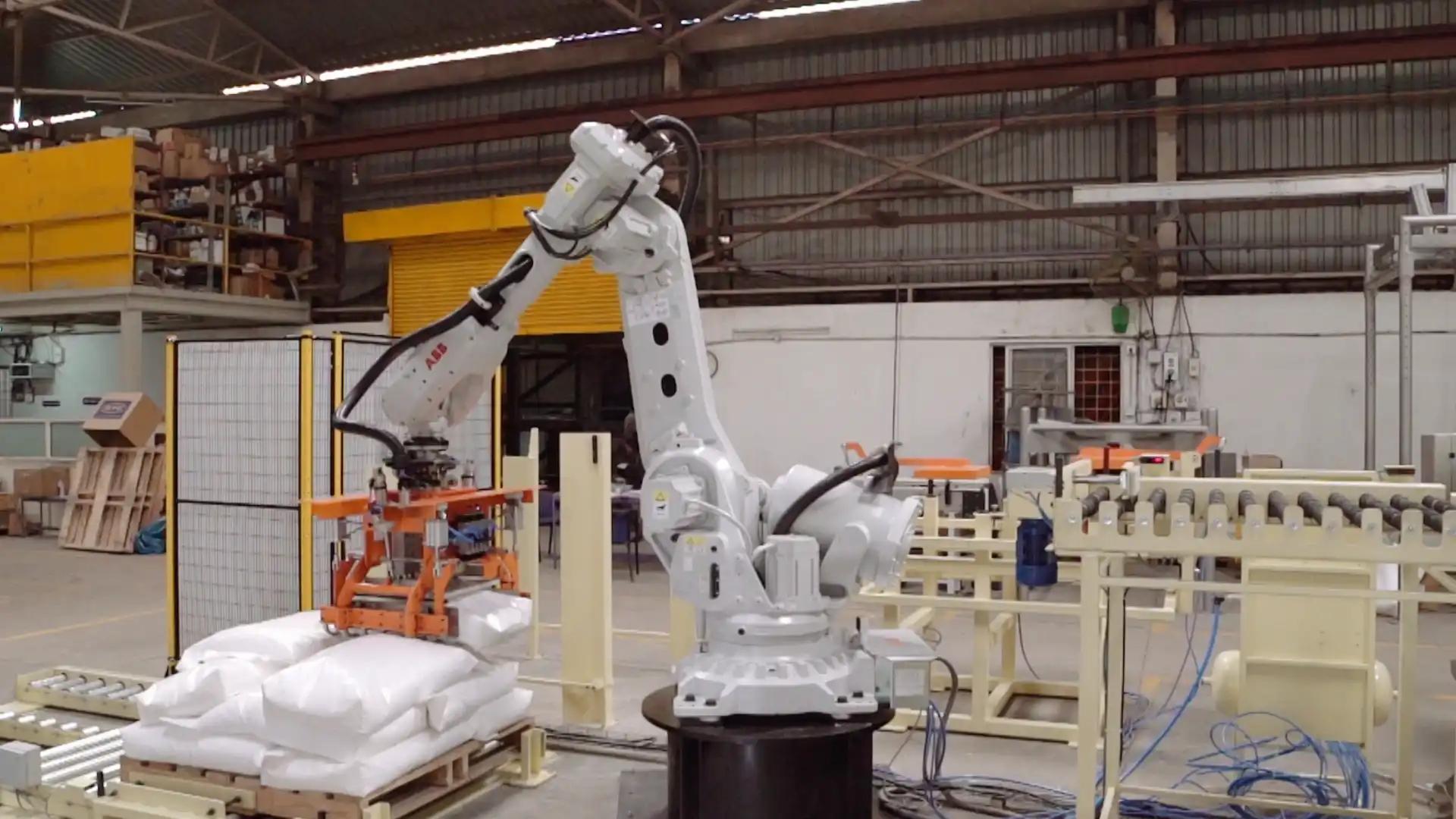
A purpose-built bag palletizing system eliminates this bottleneck. It takes bags directly from the bagging or filling line, positions them precisely using a reference system, and builds a stable, consistent pallet matrix , at up to 600 bags per hour, continuously, without fatigue and without manual handling risk. This guide explains how bag palletizing systems work in agro and feed environments, which machine configuration fits which operation, and how to integrate a bag palletizing machine into a fully automated end-of-line.
Why Agro and Feed Bag Palletizing Is a Distinct Engineering Challenge
Before selecting a bag palletizing system, it helps to understand why agro and animal feed operations create specific technical demands that differ from, say, food carton or chemical drum palletizing.
Heavy, Deformable Bags
Cybernetik manufactures eight distinct palletizing machine configurations. Each is matched to a specific combination of product type, throughput requirement, payload, and plant environment. Understanding the differences before engaging a vendor eliminates mismatched specifications and post-purchase surprises.
High Throughput from Multi-Line Bagging
Agro and feed manufacturers typically run multiple bagging lines simultaneously , open-mouth baggers, valve baggers, or FIBC fill stations , feeding into a single palletizing area. A bag palletizing machine in this environment must be fast enough to clear product from multiple infeed conveyors without creating a queue. Cybernetik’s six-axis robotic bag palletizer handles up to 600 bags per hour; a single robot cell can serve multiple upstream lines, eliminating the need for a dedicated palletizer per line.
Bag Format Variability
A single agro or feed plant may run gusseted bags, flat-bottom bags, sacks, and bales , sometimes within the same shift. Each format requires a different pallet matrix to achieve load stability and maximise pallet cube utilisation. Recipe-based changeover on the HMI allows operators to switch between bag formats and pallet patterns without retooling. Cybernetik’s reference system positions each bag and pallet precisely regardless of format, ensuring the correct matrix is built every time.
Dusty, Outdoor-Adjacent Environments
Agro and feed facilities are often dusty, operate at high ambient temperature variation, and may be located in environments with exposure to moisture and chemicals. The bag palletizing system must be built for industrial robustness , sealed enclosures, heavy-duty conveyor construction, and control panels rated for dusty environments. Cybernetik’s systems are engineered for industrial-grade reliability in these conditions, with 35 kW rated power and pneumatics rated at 100 CFM at 6 bar.
Operator Safety and Labour Availability
Manual bag stacking of 25 to 50 kg units is among the most physically demanding operations in manufacturing. Lost-time injuries from repetitive heavy lifting are a persistent cost in agro and feed operations , both the direct cost of compensation and the operational cost of retraining. Bag palletizing automation removes the manual handling exposure entirely. Cybernetik’s systems comply with ISO 12100 risk assessment standards, with guarded enclosures, safety curtains that stop operations on human presence detection, and interlocked access points.
How a Bag Palletizing System Works: Step by Step
Cybernetik’s bag palletizing system follows a continuous four-stage operating cycle that runs from bag infeed through to loaded pallet discharge:
Stage 1, Pallet Infeed and Positioning
The automated pallet dispenser releases one pallet at a time onto the outfeed conveyor. The reference system positions the pallet at the precise loading location. Alternatively, the robot uses the same gripper employed for bags to pick and place the empty pallet, eliminating a separate pallet-handling mechanism and saving capital cost. The pallet dispenser handles wooden, plastic, and metal pallets in standard sizes, 1200 × 1200 mm, 1200 × 1000 mm, and 1145 × 1145 mm, with a magazine capacity of up to 10 pallets of 150 mm each.
Stage 2, Bag Infeed and Orientation
Bags arrive from the bagging or filling line on the infeed conveyor. A settling conveyor in the gantry configuration uniformises bag thickness before pick-up, critical for consistent layer formation with deformable bags. A second reference system positions each bag at the pick-up point. The system records bag presence and registers it against the selected recipe, ensuring the correct matrix layer is built without manual supervision.
Stage 3, Pick and Place
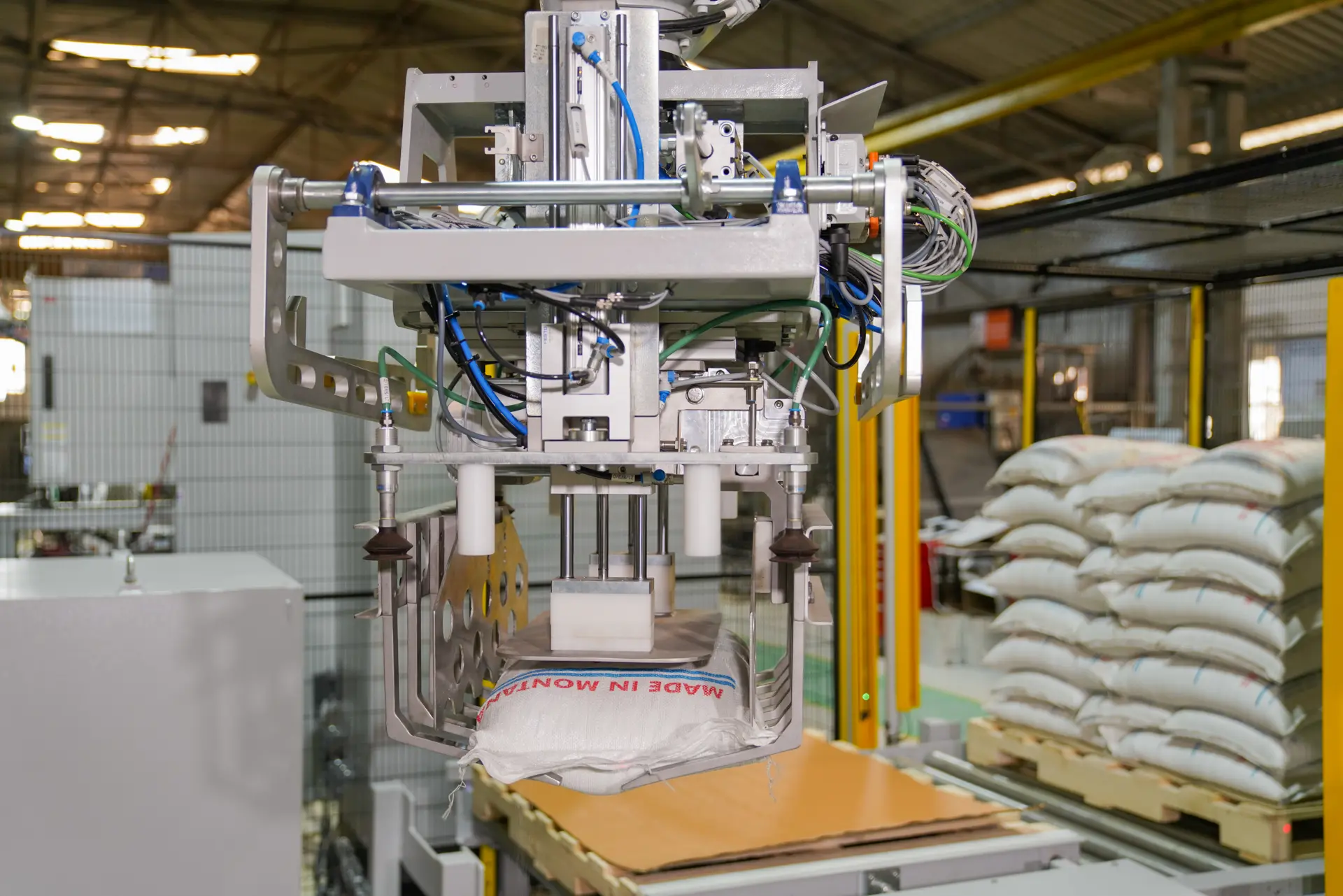
The robot arm or gantry lifts the bag using servo or pneumatic grippers customised to the bag format and weight. The six-axis robotic configuration reaches up to 3.1 m, providing the range to build pallets to a vertical stack height of up to 1,800 mm. Bags are placed layer by layer in the recipe-specified matrix formation, interlocked, brick-pattern, or column-stacked depending on product and logistics requirements. Simultaneous handling of multiple bags per cycle is available on high-speed configurations.
Stage 4, Pallet Discharge and Traceability
Once the pallet is complete, it rolls out on the outfeed conveyor towards the stretch-wrapping station or dispatch area. The track-and-trace system records pallet identity and content data for traceability and identification, important in agro and feed operations where batch traceability to field level is increasingly required by buyers and regulators. The SCADA system logs all cycle data and supports integration with upstream ERP and WMS systems.
The palletizer price a manufacturer pays is determined by the intersection of five variables. Understanding these variables allows a procurement team to build a realistic budget, compare vendor quotations on a like-for-like basis, and avoid the most common source of post-purchase cost surprises: an under-scoped integration.
Bag Palletizing Machine Configurations for Agro and Feed: Which One Fits?
Cybernetik builds three distinct bag palletizing machine configurations relevant to agro and feed operations. The right choice depends on throughput requirement, bag format variety, available floor space, and whether the operation also palletizes drums or IBCs on the same line.
Configuration 1, Gantry Bag Palletizer (Entry to Mid-Range)
The gantry palletizer uses a linear overhead gantry with four-axis movement (three linear, one rotary) to palletize bags in the required matrix. Key specifications: up to 210 bags per hour, up to 25 kg payload, 20 CFM compressed air at 6 bar, 10 × 8 m footprint. Its compact footprint relative to an equivalent robotic palletizer makes it the right choice when floor space is constrained. It is easy to program, includes anti-collision protection to prevent bag pile-up, and can optionally operate as a carton palletizer.
Best for: Dedicated single-SKU agro or feed lines running up to 210 bags per hour; plants with constrained floor space; operations prioritising simplicity and lower capital outlay.
Configuration 2, Six-Axis Robotic Bag Palletizer (Mid to High Range)
The six-axis robotic bag palletizer is the primary bag palletizing system for high-throughput agro and feed operations. Key specifications: up to 600 bags per hour (10 bags per minute), 25 to 50 kg payload (customisable), reach up to 3.1 m, stack height up to 1,800 mm, footprint 5 × 5.5 m, rated power 35 kW, pneumatics 100 CFM at 6 bar. A common gripper for both bag and pallet optimises cycle time; an optional automated tool changer enables the same robot to handle bags of different formats or switch to drum handling.
Best for: Multi-line agro and feed operations running up to 600 bags per hour; plants with multiple bag formats requiring recipe-based changeover; operations where a single robot services multiple upstream bagging lines.
Configuration 3, Bag & Drum Palletizer (Dual-Format)
The bag & drum palletizer is the configuration of choice for agro and feed manufacturers who also palletize liquid fertiliser drums, chemical drums, or IBCs on the same or adjacent lines. A single robot fitted with an automated tool changer switches between bag gripper and drum gripper tooling , delivering two palletizing machine capabilities from a single cell. Key specifications: up to 10 bags per minute, up to 6 drums per minute (product-based), 120 kg payload, 7 × 7 m footprint. The common gripper for both SKU and pallet optimises cycle time across both formats.
Best for: Agro and fertiliser manufacturers running both bag and drum formats; operations handling liquid formulations in drums alongside dry products in bags; plants seeking to reduce capital cost by consolidating two palletizing functions into one cell.
 “A modern bag palletizing system transforms one of the most physically demanding end-of-line operations into a safe, repeatable, and high-throughput process.”

See it in action
Bag Palletizing System Comparison: Gantry vs Robotic vs Bag & Drum
| Specification | Gantry Palletizer | Six-Axis Robotic | Bag & Drum Palletizer |
|---|---|---|---|
| Speed (Bags) | Up to 210 bags/hr | Up to 600 bags/hr | Up to 600 bags/hr (10 bags/min) |
| Payload | Up to 25 kg | Up to 50 kg | Up to 120 kg |
| Footprint | 10 × 8 m | 5 × 5.5 m | 7 × 7 m |
| Reach | 4-axis (3 linear + rotary) | 3.1 m (6-axis) | 3.1 m (6-axis) |
| Stack Height | As required | Up to 1,800 mm | Up to 1,800 mm |
| Drum Handling | No | Optional (tool changer) | Yes , automated tool changer |
| Multi-SKU Changeover | Recipe-based | Recipe-based + tool changer option | Recipe-based + tool changer |
| Best Application | Single-SKU, constrained space | High-volume, multi-line feed/agro | Dual-format bag + drum lines |
| View Details | Gantry Palletizer | Bag Palletizer | Bag & Drum Palletizer |
Key Features of Cybernetik’s Bag Palletizing System for Agro and Feed
Agro and Animal Feed Products Handled by Cybernetik’s Bag Palletizing System
Cybernetik’s bag palletizing systems are deployed across the full range of agro and animal feed packed products:
| Product Category | Typical Bag Format | Typical Bag Weight |
|---|---|---|
| Compound animal feed (poultry, cattle, swine) | Gusseted PP bag / flat-bottom | 25–50 kg |
| Fertilisers , granular (NPK, urea, DAP) | Gusseted bag / valve bag / sack | 25–50 kg |
| Seeds , wheat, maize, soybean, cotton | Gusseted PE/PP bag | 10–50 kg |
| Pesticides and agrochemicals , dry formulations | Gusseted bag / laminated sack | 5–25 kg |
| Micronutrient blends and soil amendments | Gusseted bag / flat-bottom bag | 5–25 kg |
| Aqua feed (shrimp feed, fish meal) | Gusseted PE bag | 20–50 kg |
| Premixes and feed additives | Gusseted bag / bale | 5–25 kg |
| Grain (wheat, rice, maize, millet) | Jute sack / PP sack | 25–50 kg |