
Key takeaways
Industrial bulk packaging – chemicals, construction materials, minerals, food commodities, fertilisers – shares one common challenge at the end of the production line: stacking heavy, deformable bags onto pallets at the speed the upstream filling equipment demands. It sounds straightforward. In practice, a 25 to 50 kg bag of cement, fertiliser granules, or chemical powder is one of the hardest units to palletize consistently – it deforms, shifts, and can burst if gripped incorrectly, and manual handling at these weights creates some of the highest injury rates in industrial manufacturing.
Purpose-built bag palletizing equipment resolves this. Engineered for industrial-grade robustness, high payload, and continuous two-shift operation, modern bag palletizing systems handle every bag format found in bulk packaging – gusseted bags, flat-bottom bags, valve bags, sacks, and bales – at speeds up to 600 bags per hour, with zero manual handling at the stacking stage. This overview covers what bag palletizing equipment is, the industries that rely on it, the key equipment configurations Cybernetik builds, selection criteria for procurement, and how to integrate it into a complete bulk packaging line.
What Is Bag Palletizing Equipment?
Bag palletizing equipment is the category of end-of-line industrial machinery that automatically receives filled and sealed bags from an upstream bagging or filling system and stacks them onto pallets in a controlled, repeatable matrix pattern. It replaces the manual palletizing station where operators stack bags by hand – a task that is physically demanding, slow relative to machine output, and inherently inconsistent in pallet quality.
The core equipment assembly in a bag palletizing system consists of:
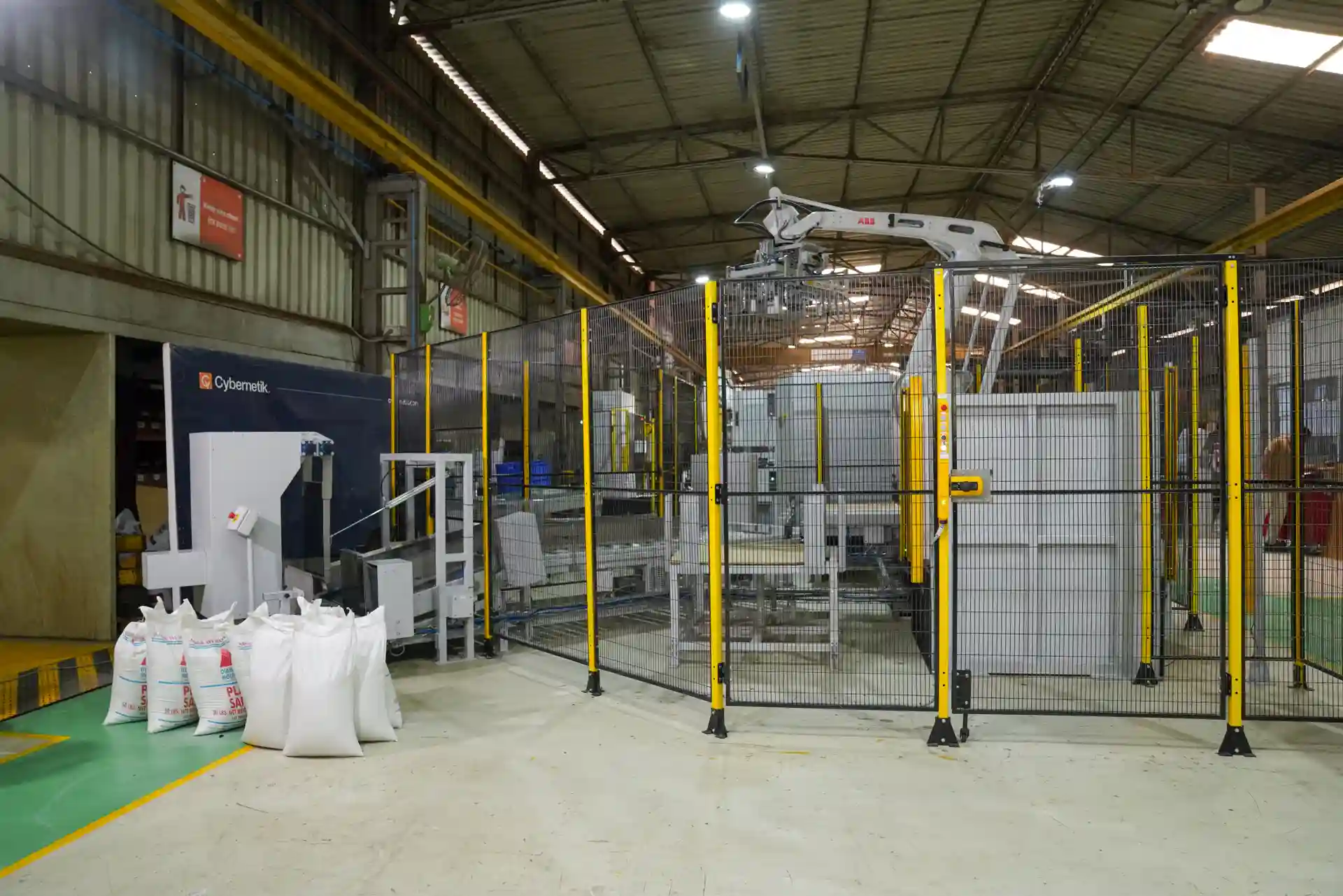
Cybernetik’s bag palletizing equipment is available in three configurations – six-axis robotic, gantry, and bag & drum dual-format – each engineered for specific throughput, payload, format variety, and integration requirements.
Industries That Rely on Bag Palletizing Equipment for Industrial Bulk Packaging
Industrial bulk packaging spans a wide range of product categories. The following industries are the primary users of bag palletizing equipment, each with its own specific demands on machine construction, throughput, and compliance.
1. Chemicals and Specialty Chemicals
Chemical manufacturers packing granules, powders, and crystals in 25 to 50 kg polypropylene or polyethylene bags face two engineering requirements above all others: robustness and safety. Chemical bag palletizing equipment must withstand dusty, corrosive environments and comply with CE and ISO 12100 safety standards. For hazardous classifications, ATEX-rated specifications are available. Cybernetik’s bag palletizer and bag & drum palletizer are deployed across chemical manufacturers including BASF, Bayer, and Tata Chemicals, handling everything from fertiliser-grade chemicals to specialty industrial formulations.
2. Construction Materials
Cement, gypsum, lime, dry mortar, sand, and aggregate manufacturers pack product in paper, PE, and laminated PP bags at high throughput across multi-line operations. Construction material bags are often valve-filled, arrive at the palletizing station with variable surface texture, and must be stacked in structurally stable matrix formations for safe transit on rough logistics routes. The six-axis robotic configuration – with its 3.1 m reach, 1,800 mm stack height capability, and up to 50 kg payload – is the standard choice for these lines.
3. Food – Grains, Flours, Starches, and Pulses
Food commodity manufacturers – grain millers, flour producers, starch processors, pulse packers – run high-volume bag palletizing operations at 25 to 50 kg per bag, often in GMP or food-safety-regulated environments. The high-speed bagging machine upstream and the bag palletizing equipment downstream must together achieve up to 10 bags per minute throughput with 0.2% weight tolerance on the fill side. In food applications, bag palletizing equipment must be built to prevent product contamination and support hygiene-compliant operation.
4. Minerals and Mining
Silica, calcium carbonate, talc, barite, and other mineral powders are packed in multi-wall paper or laminated bags. Mineral bag palletizing equipment must handle highly abrasive product residues on the bag exterior surface, deliver consistent pallet patterns for weight-sensitive export compliance, and operate reliably in dusty environments with high ambient particulate loads. The gantry and robotic configurations both accommodate mineral bag formats; the choice is driven by throughput and format variety.
5. Fertilisers and Agro Chemicals
As covered in detail in the companion guide on bag palletizing systems for agro and feed, fertiliser and agro chemical manufacturers run some of the highest-volume, most physically demanding bag palletizing operations in industrial packaging – 25 to 50 kg NPK, urea, and DAP bags at 600 bags per hour across multi-line bagging setups.
6. Polymers and Petrochemicals
Polymer resin, PVC, HDPE, and polypropylene pellets are packed in 25 kg bags and palletized at speed for dispatch to compounders and manufacturers. The bag & drum palletizer is particularly valuable in this segment where the same plant may pack resins in bags and liquid additives or masterbatches in drums – a single robot cell with an automated tool changer handles both.
7. Animal Feed and Pet Food
Compound feed, premixes, aqua feed, and pet food are packed in gusseted PE and PP bags at 5 to 50 kg. High SKU variety – multiple formulations, multiple bag weights – makes recipe-based HMI changeover essential. Cybernetik’s bag palletizing equipment handles the full bag weight range and supports multi-SKU operation without mechanical retooling between product changes.
Bag Palletizing Equipment Configurations: Gantry, Robotic, and Bag & Drum
Cybernetik builds three primary bag palletizing equipment configurations for industrial bulk packaging. Selecting the right configuration requires matching throughput, payload, bag format variety, and dual-format requirements against the specifications below.
Configuration A – Gantry Bag Palletizer
The gantry palletizer uses a linear overhead gantry structure with four-axis movement (three linear axes and one rotary axis) to palletize bags in a tailored matrix formation. It is compact relative to an equivalent robotic palletizer, easy to program, and suited to single-SKU dedicated bulk bag lines.
| Parameter | Gantry Bag Palletizer |
|---|---|
| Capacity | Up to 210 bags/hr (customisable) |
| Payload | Up to 25 kg (customisable) |
| Footprint | 10 × 8 m (customisable) |
| Axis Movement | 3 linear + 1 rotary (4 axes) |
| Pneumatics | 20 CFM @ 6 bar |
| Optional Features | Settling conveyor, anti-collision, SCADA, carton palletizing option |
| Best For | Single-SKU dedicated bulk bag lines; constrained floor space; entry to mid-range throughput |
| View Details | Gantry Palletizer → |
Configuration B – Six-Axis Robotic Bag Palletizer
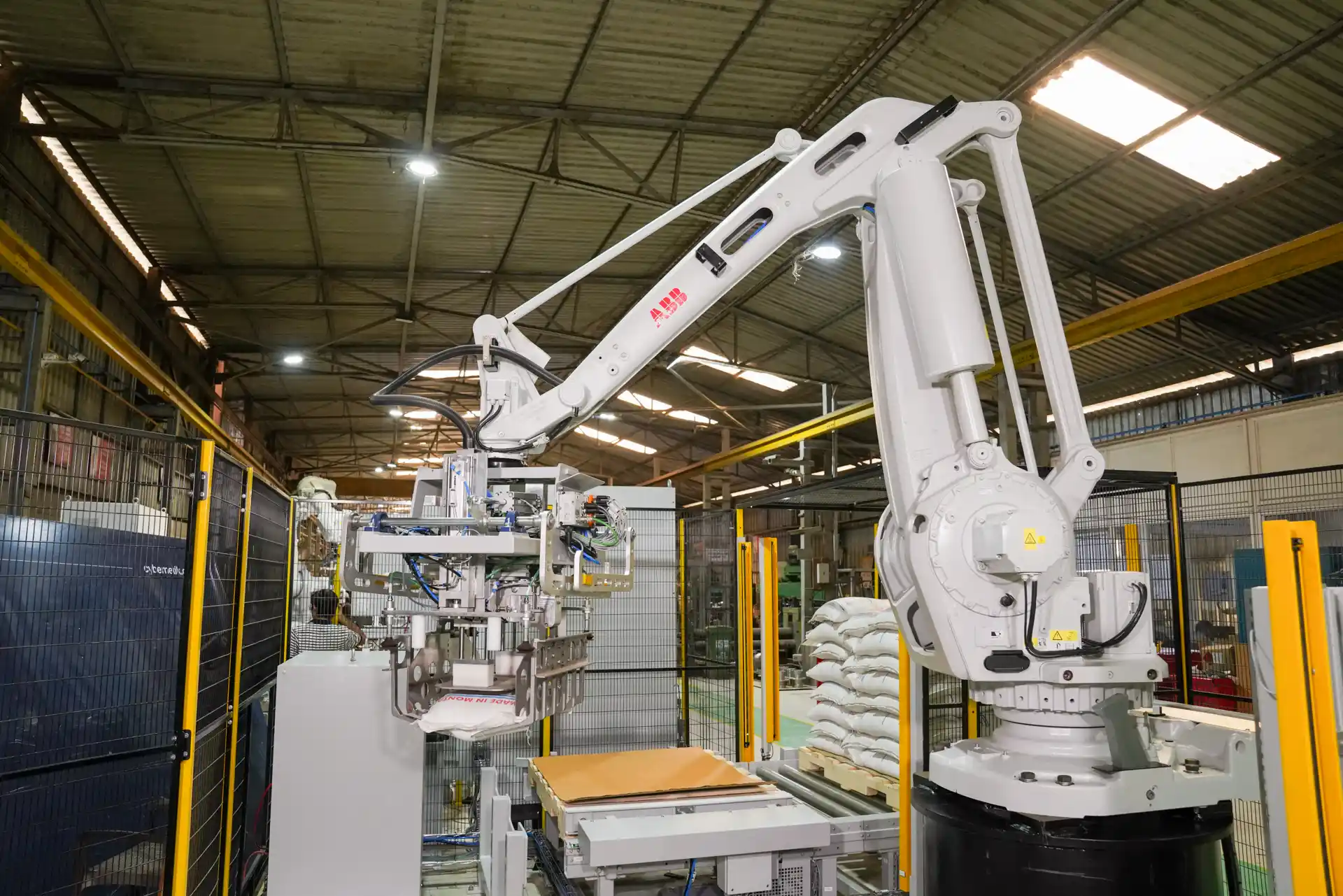
The six-axis robotic bag palletizer is the primary bag palletizing equipment for high-throughput industrial bulk packaging operations. Its six-axis robot arm delivers the flexibility, reach, and payload capacity required for multi-line, multi-SKU, high-volume bag palletizing.
| Parameter | Six-Axis Robotic Bag Palletizer |
|---|---|
| Capacity | Up to 600 bags/hr (10 bags/min; customisable) |
| Payload | 25 kg and 50 kg configurations (customisable) |
| Footprint | 5 × 5.5 m (customisable) |
| Reach | Up to 3.1 m |
| Stack Height | Up to 1,800 mm |
| Rated Power | 35 kW, 3-phase 415 VAC (customisable) |
| Pneumatics | 100 CFM @ 6 bar |
| Pallet Sizes | 1200×1200 mm, 1200×1000 mm, 1145×1145 mm (customisable) |
| Pallet Magazine | Up to 10 pallets of 150 mm each; customisable |
| Bag Types | Gusseted bags, gusseted flat-bottom bags, sacks, bales |
| Bag Material | Polyethylene (PE), Polypropylene (PP) |
| Pallet Material | Wooden, Plastic, Metal |
| Optional Features | Automated tool changer (drum handling), common gripper for bag and pallet, track and trace, pallet dispenser |
| Best For | Multi-line, multi-SKU high-throughput bulk bag operations; chemicals, construction, food, minerals |
| View Details | Bag Palletizer → |
 “The success of industrial bulk packaging depends on bag palletizing equipment engineered to handle heavy, deformable loads with consistency, safety, and operational efficiency.”

See it in action
Configuration C – Bag & Drum Palletizer (Dual-Format)
The bag & drum palletizer uses an automated tool changer to switch a single robot between bag gripper and drum gripper tooling – delivering two palletizing capabilities from one cell. Particularly valuable in bulk chemical and petrochemical manufacturing where the same line or adjacent lines pack dry products in bags and liquid formulations in drums or IBCs.
| Parameter | Bag & Drum Palletizer |
|---|---|
| Bag Speed | Up to 10 bags/min (customisable) |
| Drum Speed | Up to 6 drums/min (product-based; customisable) |
| Payload | 120 kg (customisable) |
| Footprint | 7 × 7 m (customisable) |
| Format Switching | Automated tool changer – bag to drum, no manual retooling |
| Common Gripper | Single gripper for SKU and pallet handling – optimises cycle time |
| Best For | Chemicals, agro, petrochemicals – dual bag + drum format lines |
| View Details | Bag & Drum Palletizer → |
How to Select the Right Bag Palletizing Equipment for Bulk Packaging
Industrial bulk packaging buyers who are evaluating bag palletizing equipment should work through five selection parameters before engaging vendors:
Parameter 1 – Throughput and Bag Weight
Throughput is specified in bags per hour at a given bag weight. These two variables must be specified together because the robot arm model, gripper design, and conveyor speed are all sized against the combination of speed and weight – not either in isolation. A system rated for 600 bags per hour at 25 kg uses a different robot, gripper, and conveyor architecture than one rated for 600 bags per hour at 50 kg. Specify the worst-case combination: highest throughput at maximum bag weight.
Parameter 2 – Bag Format Range
A dedicated single-SKU line (one bag format, one weight) is suited to the gantry configuration. A line running multiple bag formats – gusseted, flat-bottom, valve-filled sacks, bales – within a shift requires the six-axis robotic configuration with recipe-based changeover and tooling specified to cover the full format range. Confirm with the vendor that the quoted tooling covers your complete SKU range without mechanical changeover before signing a purchase order.
Parameter 3 – Dual-Format Requirements
If your bulk packaging line palletizes both bags and drums – the common situation in chemical, agro, and petrochemical manufacturing – the bag & drum palletizer with automated tool changer is the correct configuration. The capital cost premium over a dedicated bag-only system is consistently less than the cost of purchasing and installing a separate drum palletizer, and the operational benefit of a single PLC/SCADA architecture for both formats is significant.
Parameter 4 – Plant Layout and Footprint
The gantry configuration occupies a 10 × 8 m footprint; the six-axis robotic configuration occupies 5 × 5.5 m. If floor space is constrained, the robotic configuration is the more compact choice. Both are designed with ergonomic access on all sides for maintenance and cleaning without disassembly. Confirm the available floor area, ceiling height (for 1,800 mm pallet stack plus robot clearance), and the infeed conveyor route from the bagging machine before finalising the layout.
Parameter 5 – Environment and Compliance Specification
Standard industrial specification is the baseline. Chemical and petrochemical environments may require ATEX-rated specification for hazardous dust classifications. Food environments require GMP-compatible construction and hygiene-compliant contact materials. Export-market operations may require CE marking, OSHA compliance, or FDA-compatible specification. All of these must be specified at the design stage – not retrofitted post-delivery.