
Key takeaways
Factory automation is only as strong as its weakest stage. For most manufacturing plants , food, chemical, FMCG, pharma, paints , that stage is end-of-line palletizing. The filling machines run at full rate. The case packers keep up. But at the final step, manual stackers slow the line, introduce inconsistency, and create ongoing ergonomic and safety liabilities. The fix is automated palletizing equipment that connects directly into the factory’s automation architecture and runs continuously at throughput rates no manual operation can match.
This guide covers what automated palletizing equipment does inside a factory automation context, why the technology has moved from large-plant specialty to mainstream manufacturing necessity, and how Cybernetik’s palletizer range delivers the right configuration for every load type, line speed, and factory footprint , from a single-line gantry system to a multi-robot, multi-line palletizing cell.
What Is Automated Palletizing Equipment?
Automated palletizing equipment is any machine or robotic system that picks finished packaging units from an infeed conveyor and places them in a defined, stable matrix on a pallet without direct manual involvement. It is the bridge between the packaging line and the warehouse or dispatch dock, and it determines how fast loaded pallets leave the facility and how consistently they arrive at their destination intact.
In a fully integrated factory automation setup, the palletizer is not a standalone machine. It is a node in a connected line that receives signals from upstream case packers, bag fillers, or drum filling systems; manages pallet dispensing and transfer automatically; and passes completed pallet data to the plant’s SCADA or ERP layer for traceability and dispatch scheduling.
Manual palletizing, by contrast, is a speed cap, a safety liability, and a quality variable. Workers lifting 25–50 kg bags or heavy cartons repeatedly across shifts accumulate injuries, slow down as fatigue sets in, and make stacking pattern errors that destabilize pallets in transit. Automated palletizing equipment removes all three problems at the source.
How Automated Palletizing Fits Into Factory Automation Architecture
The word ‘automated’ is important: palletizing equipment earns that label only when it is genuinely embedded in the factory’s control architecture, not merely running independently alongside it. Cybernetik’s palletizers are designed for full factory automation integration from the ground up:
Cybernetik’s Automated Palletizing Equipment Range
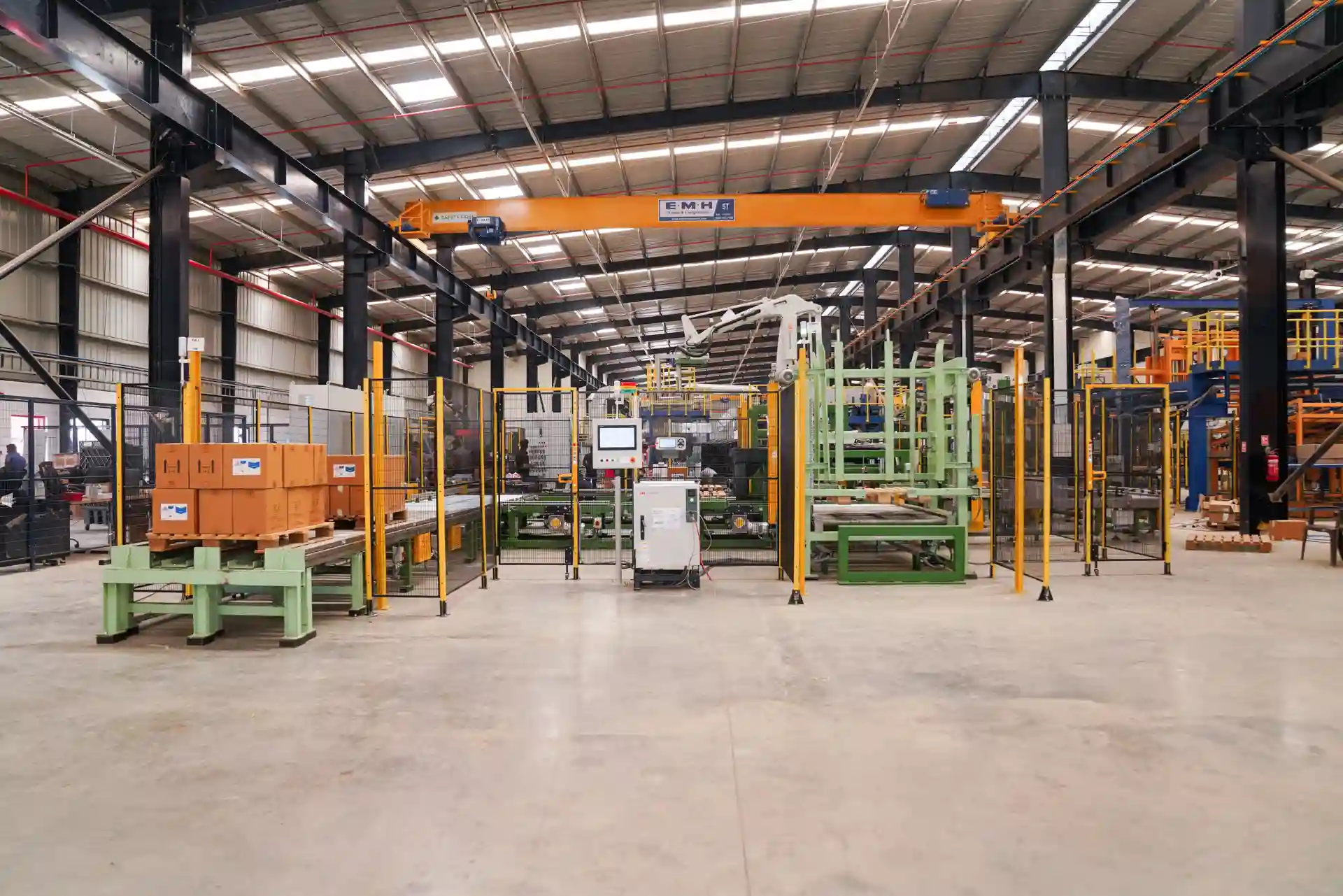
Cybernetik builds automated palletizing equipment across four primary configurations, each optimized for a distinct factory automation scenario. All share the same PLC/SCADA integration framework and modular design philosophy , the difference lies in the motion architecture, load type, and throughput band each is built for.
1. Robotic Palletizer, High-Speed Multi-Load Automation
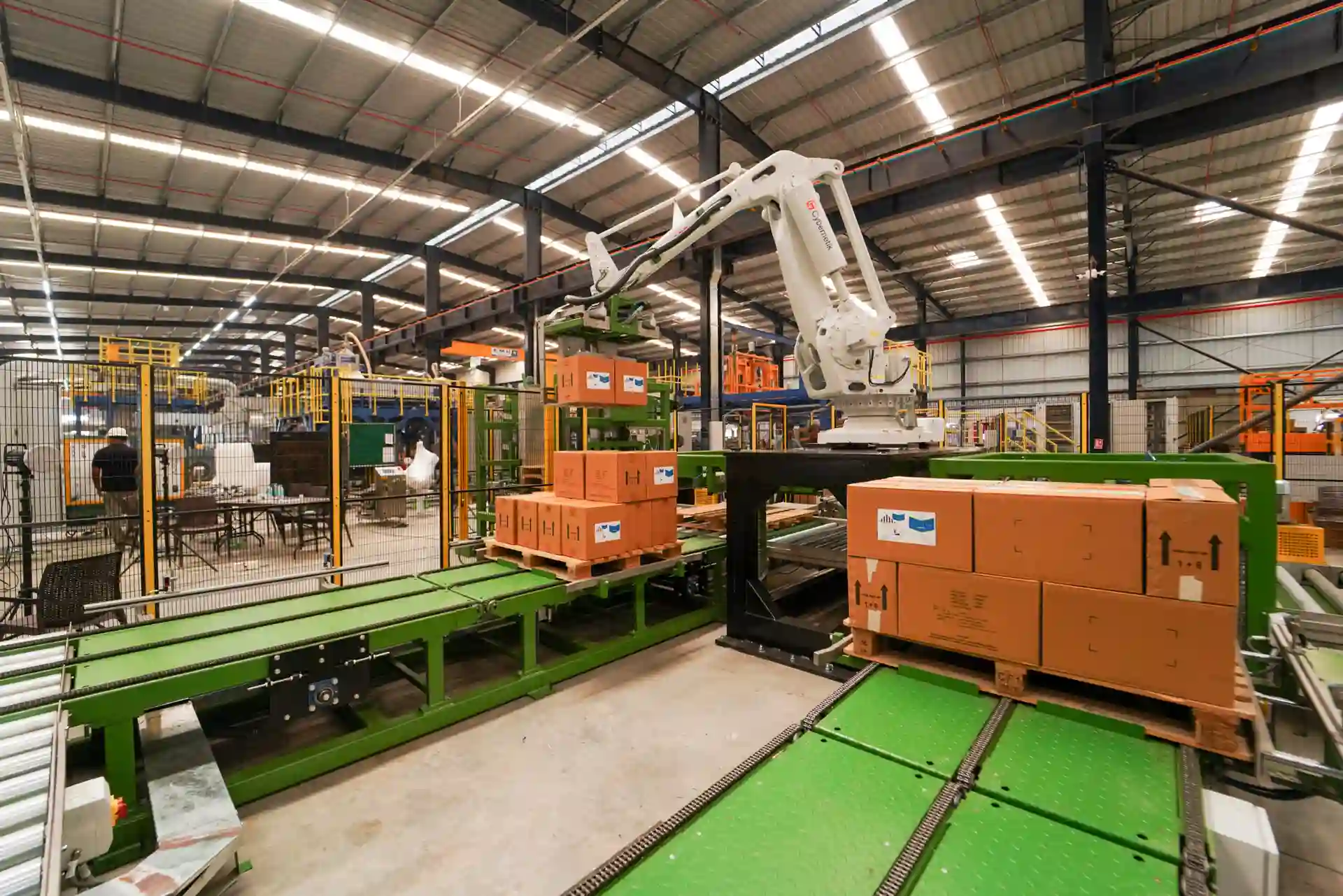
The Robotic Palletizer is Cybernetik’s primary high-throughput automated palletizing solution. A six-axis or four-axis robotic arm with servo/pneumatic end-of-arm tooling picks product from the infeed conveyor and places it in the programmed matrix layer by layer. It handles bags, cartons, drums, pails, sacks, and tins , and with the automated tool changer on the Bag and Drum Palletizer variant, a single robot can switch between bag and drum handling in the same cycle.
arm can be programmed to service multiple upstream lines simultaneously, palletizing product from each line onto dedicated pallets in the same cycle. This cuts the capital cost per line substantially compared to deploying one palletizer per line.
2. Gantry Palletizer, Compact Automation for Heavy Loads
The Gantry Palletizer uses a 3-axis servo-actuated overhead gantry to pick and place product onto the pallet in a linear motion path. Fewer moving parts than a six-axis arm means lower maintenance requirements, simpler programming, and lower total cost of ownership , the right tradeoff for factories running high-weight, uniform-SKU product where the primary automation goal is removing manual lifting, not multi-axis dexterity.
The Gantry Palletizer supports up to 10 SKU matrix formations via an optional rotary axis, and its compact footprint makes it particularly valuable in factories where floor space at the end of line is constrained. It is the standard choice for chemicals, fertilizers, building materials, and agro-processing plants where load weights regularly exceed 25 kg per unit.
3. Cobot Palletizer & Case Printer, Collaborative Factory Automation
The Cobot Palletizer & Case Printer brings a different dimension to factory automation: human-robot collaboration. The collaborative robot arm works safely in shared space with operators, no full safety fencing required , while simultaneously printing labels on cartons as it picks and places them on the pallet. The drop recovery system ensures matrix completeness even if a carton falls during the palletizing cycle.
For FMCG, food, and pharma factories with frequent SKU changeovers, multiple carton sizes, and a requirement to keep operators accessible to the palletizing zone, the cobot configuration delivers factory automation without the infrastructure cost or floor-space demand of a full robotic cell.
4. Robotic Carton Palletizer, Multi-Line High-Volume Automation
The Robotic Carton Palletizer is engineered for factories running multiple carton lines at high throughput. Two robots can separately and simultaneously palletize different-sized cartons at different stations in the same cycle , for example, triple-line medium cartons alongside double-line large cartons , with carton height adjustment for seamless integration with upstream case packing equipment. This is the configuration of choice for large beverage, food, and consumer goods factories where palletizing is a genuine production-rate bottleneck across multiple lines.
Automated Palletizing Equipment: Side-by-Side Comparison
Use the table below to match Cybernetik’s automated palletizing configurations to your factory automation requirements.
| Specification | Robotic Palletizer | Gantry Palletizer | Cobot Palletizer | Robotic Carton Palletizer |
|---|---|---|---|---|
| Motion Type | 6/4-axis robotic arm | 3-axis linear gantry | Collaborative robot arm | Dual 6-axis robots |
| Load Types | Bags, cartons, drums, pails, tins | Bags, boxes, drums, pails | Cartons (multi-size) | Cartons, corrugated boxes |
| Throughput | High; multi-line simultaneous | High; heavy loads | Low–Medium; sequential lines | Very high; dual-robot, multi-station |
| SKU Flexibility | Recipe-selectable (HMI) | Up to 10 formations via rotary axis | Single cobot, multiple carton types | Recipe-selectable, height-adjustable |
| Human Collab | Full guarding required | Full guarding required | Collaborative , shared space | Full guarding required |
| Special Feature | Auto tool changer (Bag & Drum) | Compact footprint, low OPEX | Integrated label printing + drop recovery | Simultaneous dual-station palletizing |
| Best For | High-load, multi-SKU, multi-line | Heavy uniform loads, space-constrained | Multi-SKU cartons, human access needed | Multi-line high-volume carton operations |
 “Factory automation reaches its full potential when automated palletizing eliminates manual handling, synchronizes production flow, and ensures consistent end-of-line performance.”

See it in action
Five Factory Automation Problems Palletizing Equipment Solves
Automated palletizing equipment is not just about speed. In a factory automation context, it solves five distinct operational problems that manual stacking cannot address:
1. Throughput Ceiling at End of Line
Manual stacking caps line output at human speed , typically 6 to 12 bags or cases per minute per operator. Cybernetik’s robotic palletizers operate continuously at rates that match or exceed the upstream filling and packing stages, removing the palletizing bottleneck entirely from the throughput equation.
2. Ergonomic Injury and Safety Compliance
Repetitive heavy lifting at end of line is one of the highest-risk operations in any factory. Automated palletizing equipment eliminates this exposure entirely. Cybernetik’s systems meet international safety compliance requirements , light curtains, guarding, emergency stops, ISO 13849 and ISO 12100 compliance on the pail palletizer range , replacing the human injury risk with a fully guarded automated cell.
3. Pallet Instability and Transit Damage
Manual stacking introduces pattern inconsistency that compounds into pallet instability, especially at layer interfaces. Automated palletizing equipment places every unit in the exact programmed position, layer after layer, with the interlocking matrix that maximizes pallet stability under transport load. Cybernetik’s recipe-selectable matrix formation stores multiple validated stack patterns that operators cannot inadvertently modify.
4. Labor Dependency and Shift Continuity
In factories running three shifts, manual palletizing is a headcount dependency that creates production risk during shift transitions, absenteeism, or labor shortages. Automated palletizing equipment runs continuously across shifts without performance degradation, removing headcount from the critical path at end of line.
5. Multi-SKU Changeover Delays
Plants producing multiple products on the same line face a hidden factory automation cost: the time lost retooling or retraining for each product changeover at the palletizing stage. Cybernetik’s HMI-driven recipe management eliminates this , a changeover from one SKU matrix to another is a menu selection, not a mechanical adjustment, and takes seconds rather than minutes.
When Is It Time to Install Automated Palletizing Equipment?
The business case for automated palletizing equipment becomes clear when a plant shows any combination of the following:
Where two or more of these apply simultaneously, automated palletizing equipment typically pays back within 18 to 36 months through labor savings, reduced product damage, higher throughput utilization, and lower safety incident costs.