
Key takeaways
Packaging is the last thing that happens to a product and the first thing a customer sees, which gives it an odd position in most plants. It is treated as downstream of the real work, yet it sets the ceiling on how much of that work can ship, and it is where a surprising share of labor cost and product loss actually sits.
Automated packaging equipment is the set of machines that take a finished product and turn it into something shippable without an operator doing it by hand. That covers a wide range, from a single filling machine to a fully integrated line running from product to palletized load under one control system.
This guide sets out how packaging equipment is organized, what each stage does, the levels of automation available, and how to approach a packaging project without buying machines that do not talk to each other.
The Three Levels of Packaging
Packaging equipment is conventionally grouped by how close it sits to the product. Keeping the three levels separate is useful, because each has different drivers and different failure modes.
Most plants automate these in reverse order of when they were built, which is to say unevenly. A common pattern is a fully automatic filler feeding a manual case packing station feeding a palletizer, and the manual stage in the middle becomes the constraint on both machines around it.
Primary Packaging Equipment
Filling and weighing
The stage that determines both product giveaway and pack accuracy. Weighing may be by load cell, multihead weigher or loss-in-weight feeder, and feeding by gravity, vibratory pan, auger or impeller depending on how the product behaves. Staged coarse and fine feeding is what allows tight tolerance without sacrificing rate, and it is the single feature most worth checking on any filling machine.
Bagging and pouching
Open-mouth bag fillers for 25 to 50 kg sacks, valve bag packers where the bag self-closes and dust control matters, bulk bag fillers for totes, and form fill seal machines that create, fill and seal small bags from roll stock in one continuous operation.
Carton and container filling
Weigh-and-fill systems that dose product directly into cartons or containers, usually with an integrated check weigher verifying every pack rather than sampling.
Flow wrapping
Product is fed into a continuous film wrapper and sealed into individual packs. The feeding stage rather than the wrapper is normally the limit, which is why flow feeders are engineered as their own subsystem.
Secondary Packaging Equipment
Case erecting
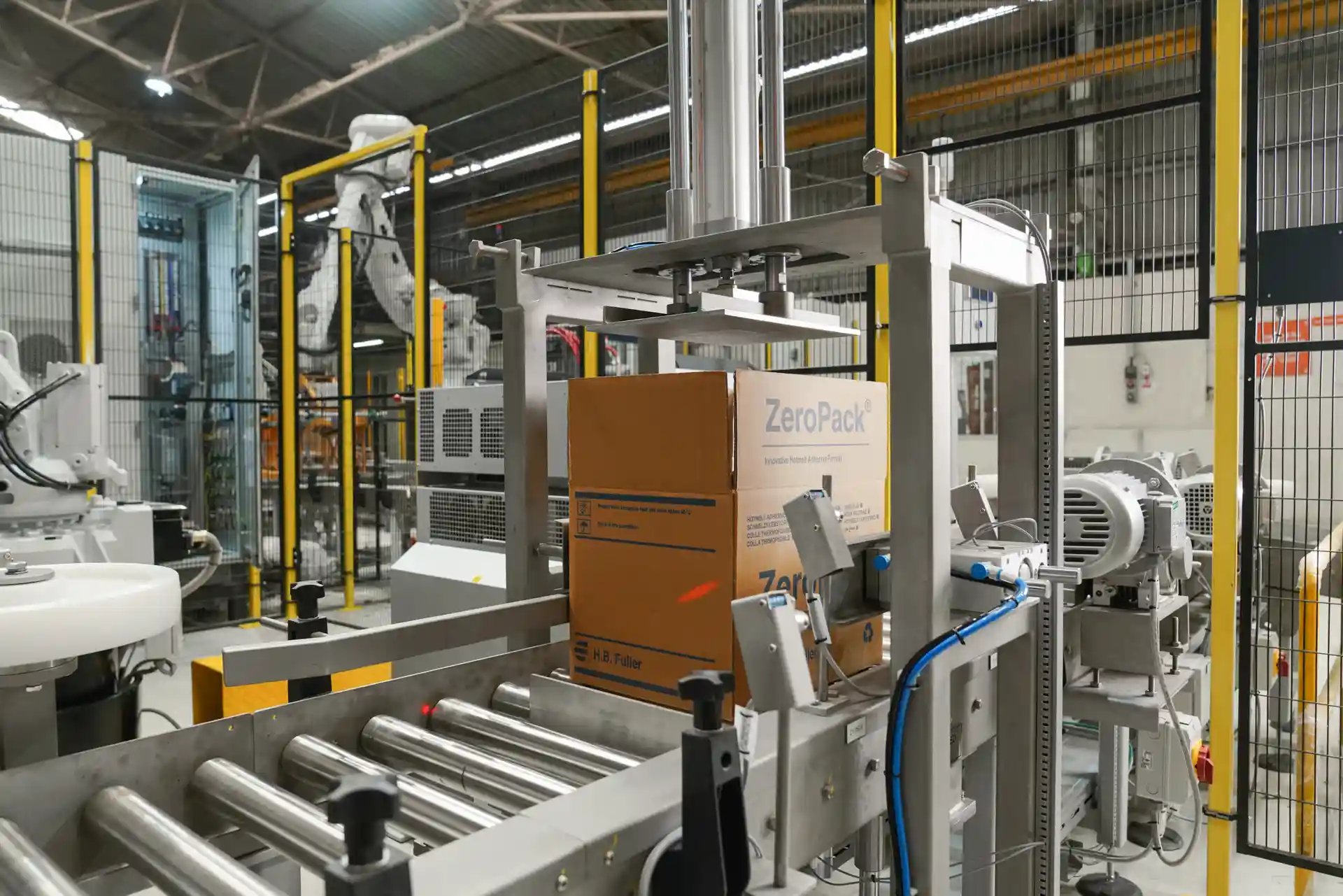
Flat corrugated blanks are drawn from a magazine, formed into a three-dimensional case and bottom-sealed with hot melt or tape. This stage feeds everything downstream, so its rate sets a hard ceiling on the case packing line.
Case packing
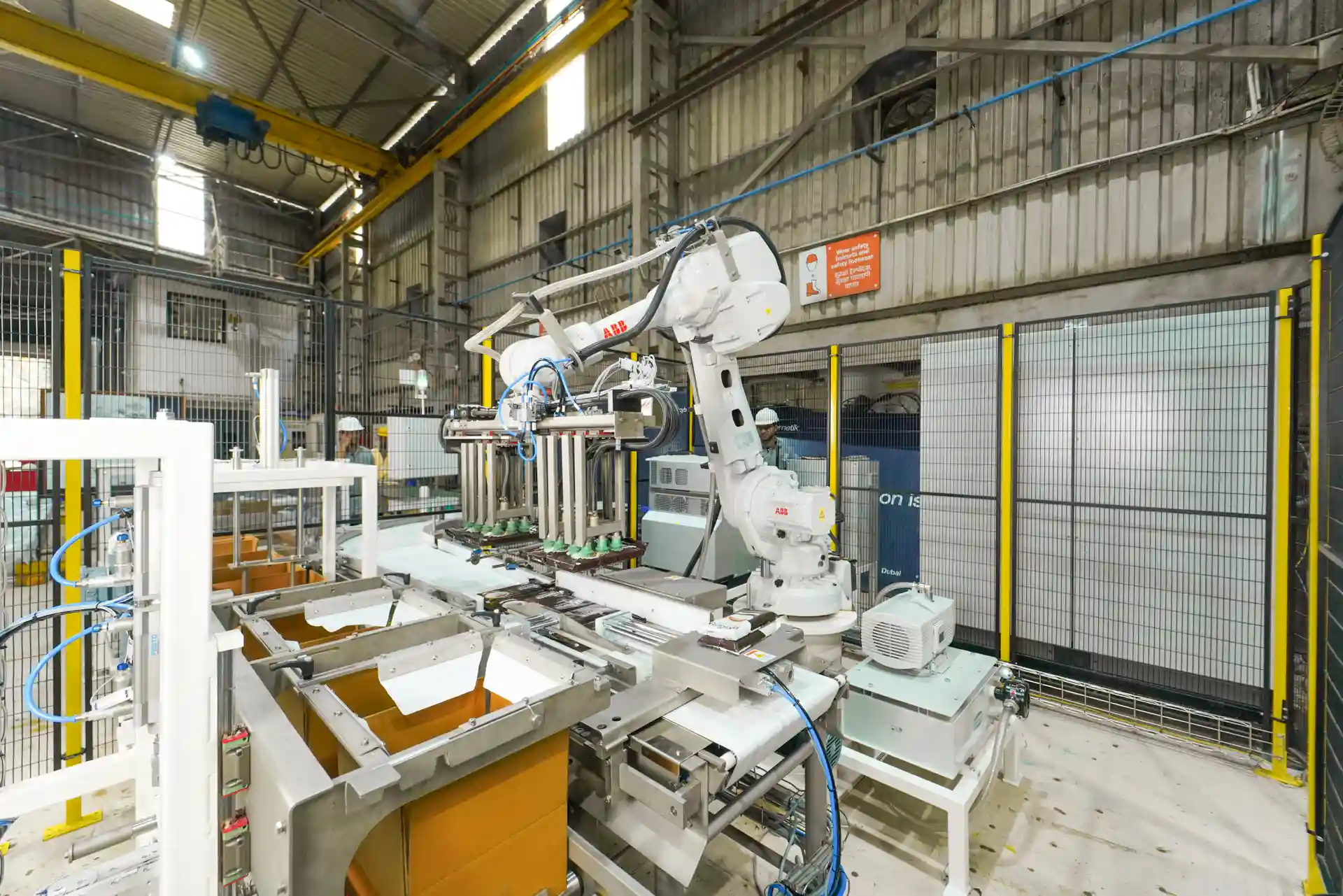
Primary packs are collated and loaded into the erected case. Configuration varies widely by product: SCARA robots for pouches, six-axis robots for bottles and heavier collations, and dedicated mechanical packers for high-rate single-format production. Vision-guided pickup handles product arriving in random orientation, which removes the need for upstream aligning equipment.
Case sealing and coding
Inline sealers close the case with tape, hot melt or both, and coding applies date, batch and barcode information. Tamper-evident sealing is standard where pharmaceutical or high-value food product is involved.
Tertiary Packaging Equipment
Palletizing
Cases are stacked onto pallets in a defined pattern. Conventional palletizers are fast and rigid; robotic palletizers handle multiple patterns and multiple product lines with recipe changes rather than mechanical adjustment, and can pick more than one case per cycle. Collaborative palletizers work in operator-proximate spaces where fencing a full robot cell is impractical.
Load securing
Stretch wrapping, strapping or shrink hooding holds the pallet together in transit. Under-wrapping causes transit damage claims; over-wrapping wastes film on every pallet shipped, which at volume is a real number.
The Layer Most Projects Underestimate
Between every stage above sits equipment that never appears on a packaging capex list and frequently causes more trouble than the machines do.
Levels of Automation
Automation is a spectrum rather than a switch, and most plants sit at different points on it at different stages of the line.
| Automation level | What the operator still does | Where it fits | Main constraint |
|---|---|---|---|
| Manual | Everything: filling, closing, packing, stacking | Very low volume, prototype runs, highly variable product | Labor cost and output ceiling |
| Semi-automatic | Loads and presents material; machine performs the operation | Lower volumes and plants testing whether to automate further | Operator stays on the line |
| Automatic | Supervises, refills consumables, handles changeover | Steady volume on a limited number of formats | Changeover time between formats |
| Robotic | Selects recipe and monitors | Multi-format production where flexibility matters | Capital cost and integration complexity |
| Integrated line | Manages the line as one system | High volume with full traceability requirements | Requires a single owner across all stages |
The right level is rarely the highest one. It is the one where labor saved, giveaway recovered and downtime avoided justify the capital, at the volume you actually run, with the number of formats you actually produce. A plant running fifteen formats at moderate volume is usually better served by robotic flexibility than by high-speed fixed automation, even though the fixed machine quotes a higher rate.
 “Successful packaging automation starts with a complete line strategy, allowing manufacturers to scale from semi-automatic operations to integrated robotic systems without creating costly integration gaps.“

See it in action
Approaching a Packaging Automation Project
Start at the constraint, not at the worst machine
The stage limiting output is not always the one causing complaints. Time each stage across a full shift and find where product waits. Automating a stage that is not the constraint moves the bottleneck without raising output.
Decide the control architecture before buying machines
If the line will eventually run under one control system with line-wide recipes and traceability, that has to be specified from the first purchase. Machines bought individually arrive with incompatible controls, and integrating them afterward costs more than the difference would have at the outset.
Count the interfaces
Multi-vendor procurement usually looks cheaper on capital and reappears as cost during commissioning: handoffs nobody owns, cycle time mismatches that surface only under load, and a support structure where every supplier points at another. On a packaging line, where one stage stopping halts everything, that ambiguity is expensive.
Phase it deliberately
Full-line automation in one step is rarely necessary. A phased path works if the phases were planned together, with conveyor heights, control interfaces and floor space allowed for from the start. It fails when each phase is scoped independently.
Packaging Automation from Cybernetik
Cybernetik designs, builds, installs and supports complete packaging lines rather than individual machines, spanning primary filling and bagging, secondary case erecting, packing and sealing, and tertiary palletizing under a single control architecture.
| Cybernetik packaging equipment | Rated performance |
|---|---|
| Automatic carton box making machine (case erector) | 15 to 30+ cartons per minute |
| SCARA pouch case packer | Up to 40 pouches per minute |
| Six-axis bottle case packer | Up to 120 bottles per minute, 200 kg payload |
| Flow wrapper feeding, chocolate bar format | Up to 400 parts per minute |
| Robotic vision-guided flow feeder | Up to 480 parts per minute, random orientation |
| Fine screw feeder | Powders and granules to 0.1 percent weight tolerance |
| Open-mouth bag filler | 25 kg and 50 kg bags, up to 4,500 kg/hr, 0.1 percent tolerance |
| Auger valve bag packer | Up to 3,000 kg/hr at 0.1 percent tolerance |
| Impeller valve bag packer | Up to 6,000 kg/hr at 0.5 percent tolerance |
| Robotic carton palletizer | Up to three cartons handled simultaneously |
| Inline case sealer | Tape, hot-melt or combined sealing |
| Line control | Unified PLC and SCADA architecture across all stages |
Because every stage runs under a unified PLC and SCADA architecture, a recipe change propagates across the line simultaneously rather than requiring each machine to be reconfigured separately. That is what keeps format flexibility usable in practice rather than theoretical.