
Key takeaways
India’s wind sector spent several years being overshadowed by solar. That has changed. The country added a record amount of wind capacity last year, the order pipeline is substantial, and the conversation among manufacturers has moved from whether demand will return to whether factories can supply what is coming in the shape it is now being ordered.
The trends worth following in 2026 are larger turbines being built domestically, factory capacity that already exceeds home demand and is turning toward exports, repowering emerging as a second market, offshore preparation beginning in earnest, and rising quality expectations as components get bigger. Each of those lands on the factory floor rather than only in policy documents.
Where the Sector Stands
| Measure | Where it stands |
|---|---|
| Installed wind capacity | About 58.1 GW as of July 2026, up from 21 GW in 2014 |
| FY 2025-26 additions | A record 6.05 GW, beating the previous best of around 5.5 GW |
| FY 2026-27 plan | Around 8 GW of additions |
| Target | 100 GW by 2030, which needs close to 10 GW a year |
| Pipeline | Roughly 43 GW under construction |
| Domestic manufacturing capacity | About 24 GW a year against installations of about 6 GW |
| Offshore installed | None yet, with the first 1 GW supported by viability gap funding |
| Repowering potential | About 25 GW across more than 19,000 older turbines |
Two numbers in that table set up most of what follows. Installations reached a record 6.05 GW in FY 2025-26, taking cumulative capacity to about 58 GW by July 2026, and the target of 100 GW by 2030 implies annual additions closer to 10 GW. At the same time, domestic manufacturing capacity is roughly 24 GW a year, which is several times current installation volumes.
Capacity Is Not the Constraint, Utilization Is
A manufacturing base sized at around 24 GW a year, serving installations of about 6 GW, means most plants are running well below what they could produce. That is unusual in a growing sector, and it shapes strategy in three ways.
First, it makes the Indian wind industry an export story as much as a domestic one, since the surplus capacity has to find a market. Second, it puts pressure on cost per unit, because a plant running at partial utilization carries fixed costs across fewer units. Third, it rewards flexibility, since a factory that can switch between models and platforms keeps itself busier than one built around a single product.
For manufacturing teams, that translates into a familiar set of priorities: shorter changeovers, equipment that handles more than one component size, and automation aimed at consistency and labor cost rather than at raw speed.
Turbines Are Getting Bigger, and India Now Builds Them
Turbines rated above 5 MW are now produced in India, which is a genuine shift. For a decade the domestic market was dominated by machines in the 2 to 3 MW range, and the tooling, buildings and handling equipment in most plants were built around that.
| What gets bigger | What it changes in the factory |
|---|---|
| Blade length | Longer molds, larger buildings, more resin per blade and longer cure cycles |
| Root diameter | Bigger machining equipment and tighter accuracy over a larger circle |
| Component weight | Heavier cranes, stronger floors and different handling at every stage |
| Tower sections | Larger rolling and welding capacity, and more transport constraints |
| Nacelle assemblies | More sub-assembly work and larger test facilities |
| Logistics | Road movement becomes the practical limit on what a plant can ship |
The blade is where this is felt most. A longer blade needs a longer mold and a bigger building, more material per unit and a longer cure, and it arrives at the finishing and machining stages as a much larger object to handle.
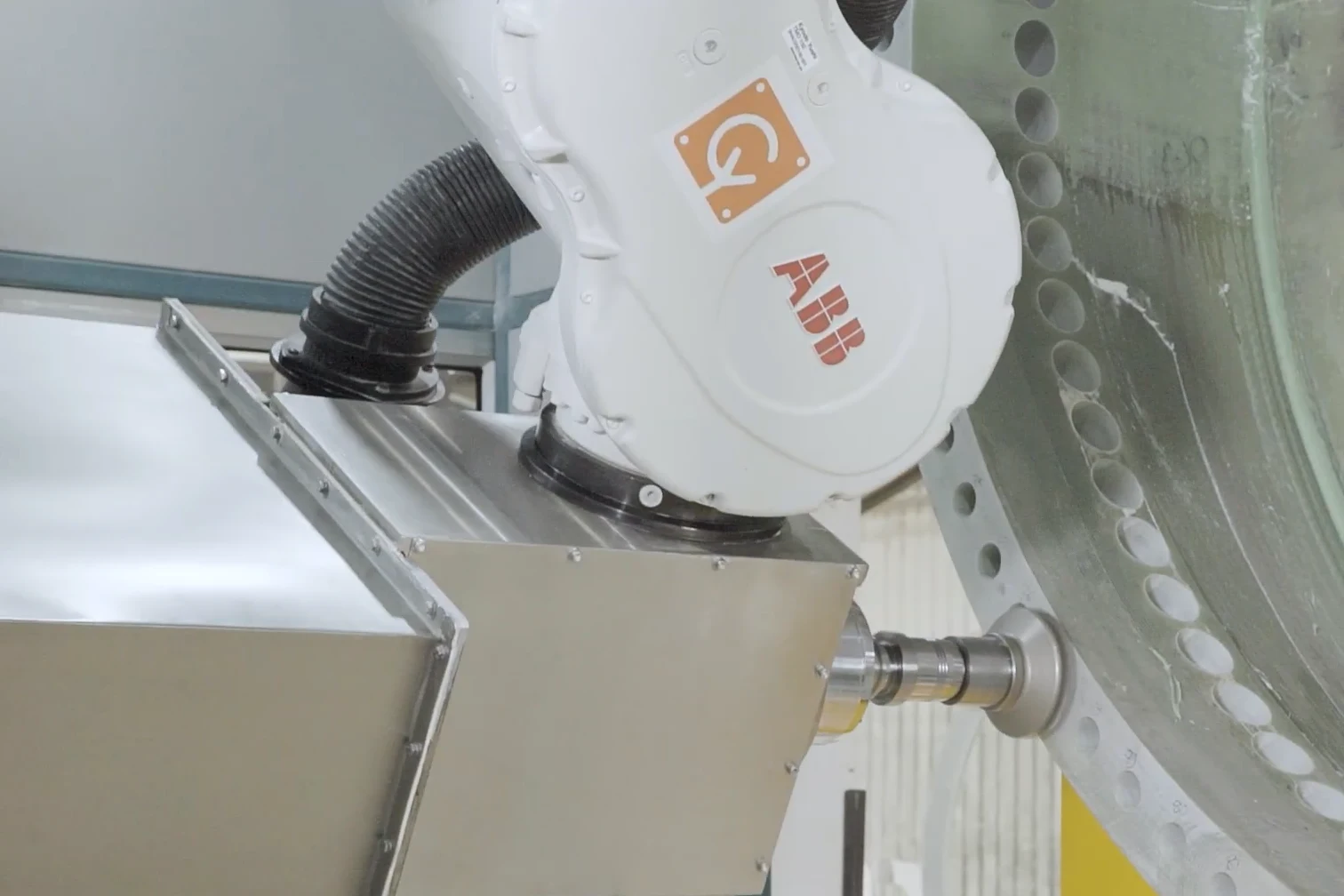
The root end concentrates the difficulty. As blades grow, root diameters grow with them, and the bolt circle has to be machined accurately across a larger circle so that every bolt shares the load evenly. Why that accuracy matters so much is covered in the article on wind turbine blade root manufacturing.
Logistics is the constraint that decides how far this can go. Indian roads limit what can realistically be moved, which is why blade length and tower section size are as much a transport question as an engineering one, and why factory location increasingly matters as much as factory capability.
Repowering Becomes a Second Market
India has more than 19,000 older turbines, many below 1 MW, occupying some of the best wind sites in the country. Estimates put the repowering opportunity at around 25 GW, and the case is straightforward: modern machines on those sites can roughly double the energy produced, lifting capacity utilization from the mid teens to about 30 percent.
Progress has been slow, largely because the commercial arrangements are difficult. Sites are often owned by many small investors on old power purchase agreements, and getting everyone to agree to shut down working turbines is harder than the engineering.
For manufacturers, two things follow. Repowering demand is for modern turbines on constrained sites, which means machines that suit existing land parcels and grid connections rather than the largest available model. And it creates a decommissioning stream: thousands of old turbines will eventually come down, and their blades will need somewhere to go, which is the circularity question below.
Offshore Moves From Policy to Preparation
India has no offshore wind capacity yet. What it does have is a funded start: viability gap funding of about ₹7,453 crore supporting the first 1 GW, split between Gujarat and Tamil Nadu, against an assessed offshore potential of around 70 GW across both coasts.
Offshore does not simply mean bigger versions of onshore equipment. It brings different structures, heavier towers and foundations, marine-grade protection, and a supply chain that includes ports, vessels and installation capability that India is still building. Manufacturing for offshore tends to cluster near ports, because moving very large components inland is impractical.
For most Indian manufacturers in 2026, offshore is a preparation question rather than an order book. The practical steps are understanding what the first projects will require, deciding whether a port-side facility is part of the plan, and building the quality documentation that offshore projects demand from the start.
Quality Expectations Rise With Component Size
A longer blade is not simply a scaled version of a shorter one. Loads at the root grow faster than length, fatigue cycles accumulate over a longer service life, and a defect that was tolerable in a smaller blade can matter in a larger one.
That pushes several things up the priority list in a factory. Process control during layup and infusion, because defects locked into the laminate are expensive to find and harder to repair on a large component. Inspection coverage, since checking a sample of a 90 meter blade is not the same as checking a sample of a 45 meter one. And machining accuracy at the root, where bolt circle position, face flatness and hole perpendicularity determine how evenly load is shared.
The production sequence those checks fit into, from mold preparation through layup, infusion, bonding, finishing and machining, is set out in the guide to wind turbine blade manufacturing.
Automation Reaches the Blade Shop
Blade manufacturing remains among the most labor-intensive work in the renewable sector. Layup, finishing, grinding and painting are still largely manual in many plants, and they are also dusty, repetitive and physically demanding.
The tasks moving to automation first are the ones where consistency and working conditions both improve: root machining, edge trimming, surface finishing and inspection scanning. None of them removes the skilled work of building a blade, and all of them reduce variation between shifts.
The broader pattern across renewable energy manufacturing, and where automation earns its place, is covered in the article on renewable energy automation.
 “Automation helps wind energy manufacturers improve consistency, reduce repetitive manual work, and adapt to larger component platforms. The greatest gains come from combining the right technology with flexible, application-specific engineering.”

See it in action
Blade Recycling Becomes a Real Question
Blades are built to survive decades of weather and load, which is exactly what makes them difficult to dispose of. As India begins to decommission its early fleet through repowering, the volume of retired blades will grow.
Work is happening in several directions internationally: mechanical recycling into filler and composite materials, cement kiln co-processing, chemical routes that recover fibers and resins, and resin systems designed from the start to be separable. None is yet the default answer, and Indian manufacturers are more likely to encounter the question first through customer requirements and tender conditions than through regulation.
The design consequence is worth noting now. Choices made in the blade shop today, particularly resin systems and bonding methods, determine how recyclable a blade will be in twenty years.
Grid Constraints Shape What Gets Ordered
Renewable curtailment in India reached roughly 470 GWh in the first quarter of 2026, with most of it caused by network limitations rather than oversupply. That is a grid problem, and it reaches manufacturing indirectly.
When generation is curtailed, developers care more about when power is delivered than about peak output alone. That is pushing more capacity into hybrid wind and solar tenders and round-the-clock supply contracts, which in turn favors turbines that perform well at moderate wind speeds and projects paired with storage. Manufacturers see this as demand shifting toward particular machine classes rather than as a change in total volume.
Supply Chain and Localization
Turbine manufacturing depends on a long list of bought-in items: castings, forgings, bearings, gearboxes, generators, converters, blade resins, carbon and glass fiber, and control electronics. Some are made in India in volume, others are still imported, and the balance is shifting as domestic demand becomes steadier.
Two pressures are pushing localization forward. Developers and tenders increasingly ask where components come from, and exchange rate and shipping volatility make imported content harder to price over a long project. Against that, some items involve specialized metallurgy or high tooling cost that only make sense at volumes India is just beginning to reach.
The practical approach most manufacturers are taking is to map their bill of material by risk rather than by value, identify the items where a single overseas supplier could stop a line, and develop a second source for those first. Long-lead castings and large bearings usually top that list.
People and Skills
A larger, more automated factory needs a different mix of skills from the one most plants have. Composite layup remains skilled manual work, while machining, inspection and robotic finishing need people who can set up equipment, read measurement data and correct a process rather than only operate a machine.
Plants that handle this well tend to plan training alongside equipment purchases rather than after installation, and to keep the people who ran the manual process involved in commissioning the automated one. They know where the product actually varies, and that knowledge is difficult to recover once they have moved on.
What Manufacturers Should Be Doing
Blade Root Machining from Cybernetik
Cybernetik builds machining systems for wind blade roots, which is the stage where the accuracy discussed above is either achieved or lost. The TurboMac range covers pitch circle diameters from 2,800 to 3,000 mm for blades of around 65 to 70 meters, and from 3,000 to 4,800 mm for blades up to about 100 meters, which spans the platforms Indian manufacturers are moving toward.
The accuracy figures are what matter for load sharing across the bolt circle: pitch circle diameter held within plus or minus 1 mm, milling flatness within 0.500 mm and hole perpendicularity within plus or minus 0.250 mm. Those tolerances are the difference between every bolt carrying its share and a few bolts carrying more than they were designed for, which is a fatigue problem that appears years into service rather than at the factory.
The systems are part of Cybernetik’s wind energy automation work, delivered for blade manufacturers including Siemens Gamesa and Suzlon, and backed by more than three decades of custom automation and over 400 robotic solutions across industries. As blades grow and volumes rise, the two questions that tend to come up are whether existing machining equipment covers the new root diameters and whether the process can hold its tolerances at a higher rate, both of which are easier to answer before a new platform is committed than after.