
Key takeaways
Battery manufacturing is really two industries wearing one name. One of them coats metal foil with chemistry and rolls it into cells. The other takes finished cells and builds them into packs. They share a supply chain and almost nothing else: different capital scale, different facilities, different failure modes, usually different companies.
Confusing the two is the most common error in scoping a battery project. A company that says it wants to manufacture batteries may mean building a gigafactory measured in hundreds of millions of dollars, or may mean assembling packs from purchased cells on a line an order of magnitude cheaper. This guide covers both, in sequence, and marks clearly where one ends and the other begins.
The Two Halves
Cell manufacturing converts raw active materials into sealed, formed, graded cells. It requires dry rooms, solvent recovery, precision web handling and formation capacity, and it is capital intensive enough that plants are built at gigawatt hour scale to be viable.
Pack assembly takes those finished cells and builds modules and packs around them. It requires precision handling, testing, welding and traceability, at a fraction of the capital cost, and it is where most vehicle manufacturers, storage integrators and tier one suppliers actually invest. The distinction is covered further in the guide to EV battery manufacturing equipment.
Part One: Cell Manufacturing
1. Electrode slurry mixing
Active material, conductive additive and binder are mixed into a slurry. Cathode slurries typically combine a lithium metal oxide or lithium iron phosphate with carbon black and a fluoropolymer binder in solvent; anode slurries combine graphite with water based binders. Dispersion quality set here determines electrode uniformity everywhere downstream, and it cannot be corrected later.
2. Coating and drying
Slurry is applied to metal foil, aluminium for the cathode and copper for the anode, usually by slot die coating on both faces, then passed through multi zone drying ovens. Coating weight per unit area is the single most controlled parameter in the plant, because it sets cell capacity directly. Solvent is captured and recovered rather than vented, which is a significant part of a cell plant’s cost and complexity.
3. Calendering
The coated foil is compressed between rollers to a target thickness and porosity. This densifies the electrode, improves particle to particle contact and raises energy density. It is also easy to overdo. Excess pressure fractures active material particles and restricts the electrolyte pathways the cell needs to deliver current quickly.
4. Slitting and notching
The wide coated web is slit into electrode strips and notched to form tabs. Edge quality is a safety characteristic rather than a cosmetic one. Burrs left by worn blades, and metal particles released during cutting, are a leading cause of internal short circuits, which is the defect class behind most battery safety recalls.
5. Cell assembly by winding or stacking
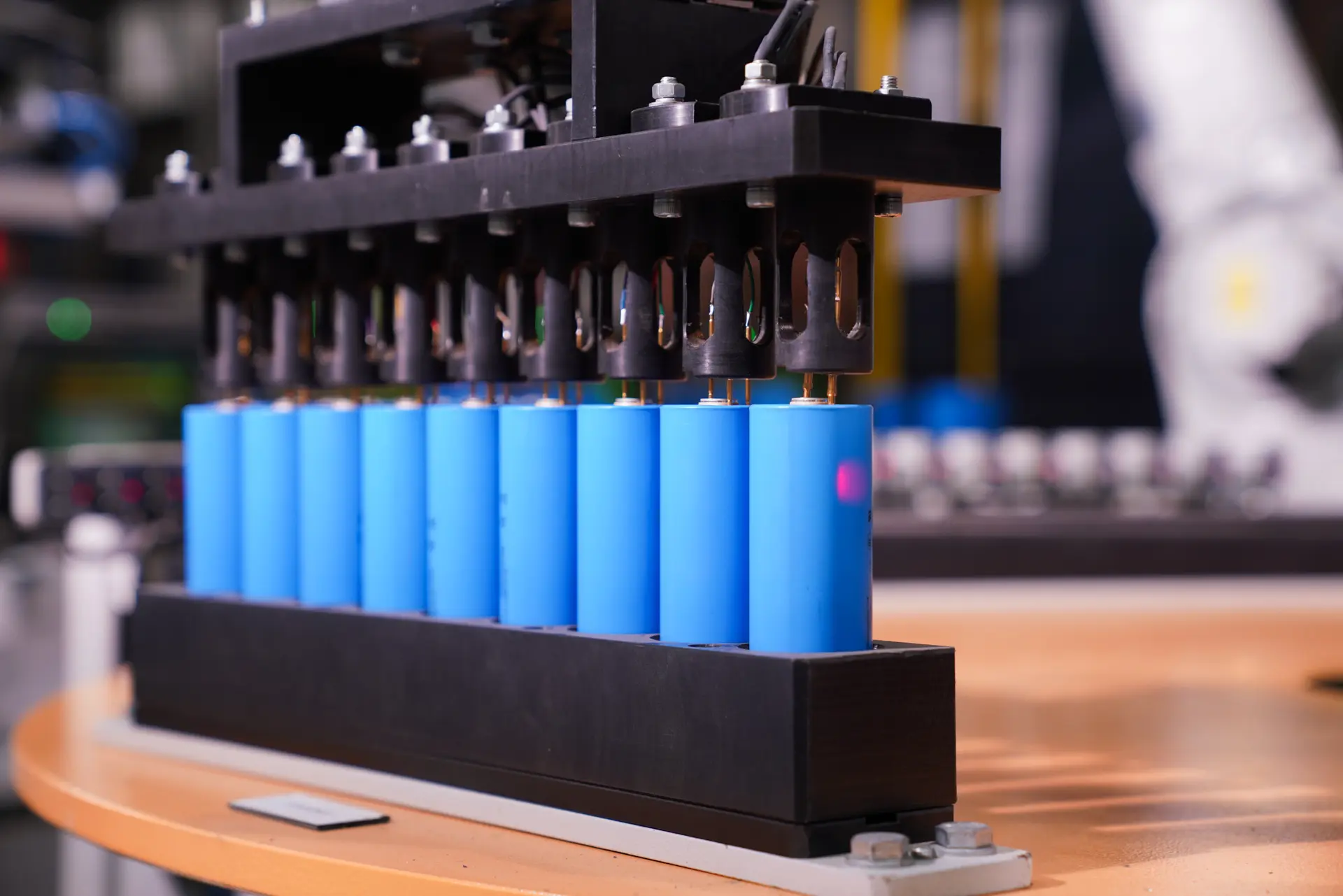
Electrodes and separator are combined into the cell body. Cylindrical and many prismatic cells are wound into a jelly roll; pouch and some prismatic formats are stacked sheet by sheet or Z-folded. Alignment tolerance is tight, because anode has to overhang cathode at every edge. Where it does not, lithium plates at the exposed boundary and dendrites begin forming.
6. Electrolyte filling and sealing
The assembled cell is dried under vacuum to drive out residual moisture, filled with electrolyte under vacuum, allowed to wet through the electrode stack, and sealed. Moisture control is absolute here. Water reacts with the electrolyte salt to produce hydrofluoric acid, which is why filling areas operate as dry rooms rather than ordinary factory space.
7. Formation and aging
The cell receives its first controlled charge and discharge cycles. During this, a solid electrolyte interphase layer forms on the anode surface, and the quality of that layer governs how the cell will age for the rest of its life. Pouch cells are degassed after formation. Cells then rest under controlled temperature for days or weeks while self discharge behaviour is monitored.
8. Grading and end of line testing
Cells are measured for capacity, open circuit voltage, internal resistance and self discharge rate, then sorted into grades. This is the output of the cell plant and the input to everything that follows.
Why Cell Plants Do Not Look Like Other Factories
Two environmental requirements drive most of the cost. Dry rooms hold dew points far below anything a conventional air conditioning system produces, because moisture at parts per million damages the chemistry. Particle control matters just as much, since a metallic particle of a few tens of micrometres landing on an electrode can bridge the separator and short the cell.
Add solvent recovery, formation equipment that must charge and discharge millions of cells, and weeks of aging inventory sitting in temperature controlled racks, and the economics explain themselves. Cell plants are built at gigawatt hour scale because nothing smaller absorbs that overhead.
Part Two: Module and Pack Assembly
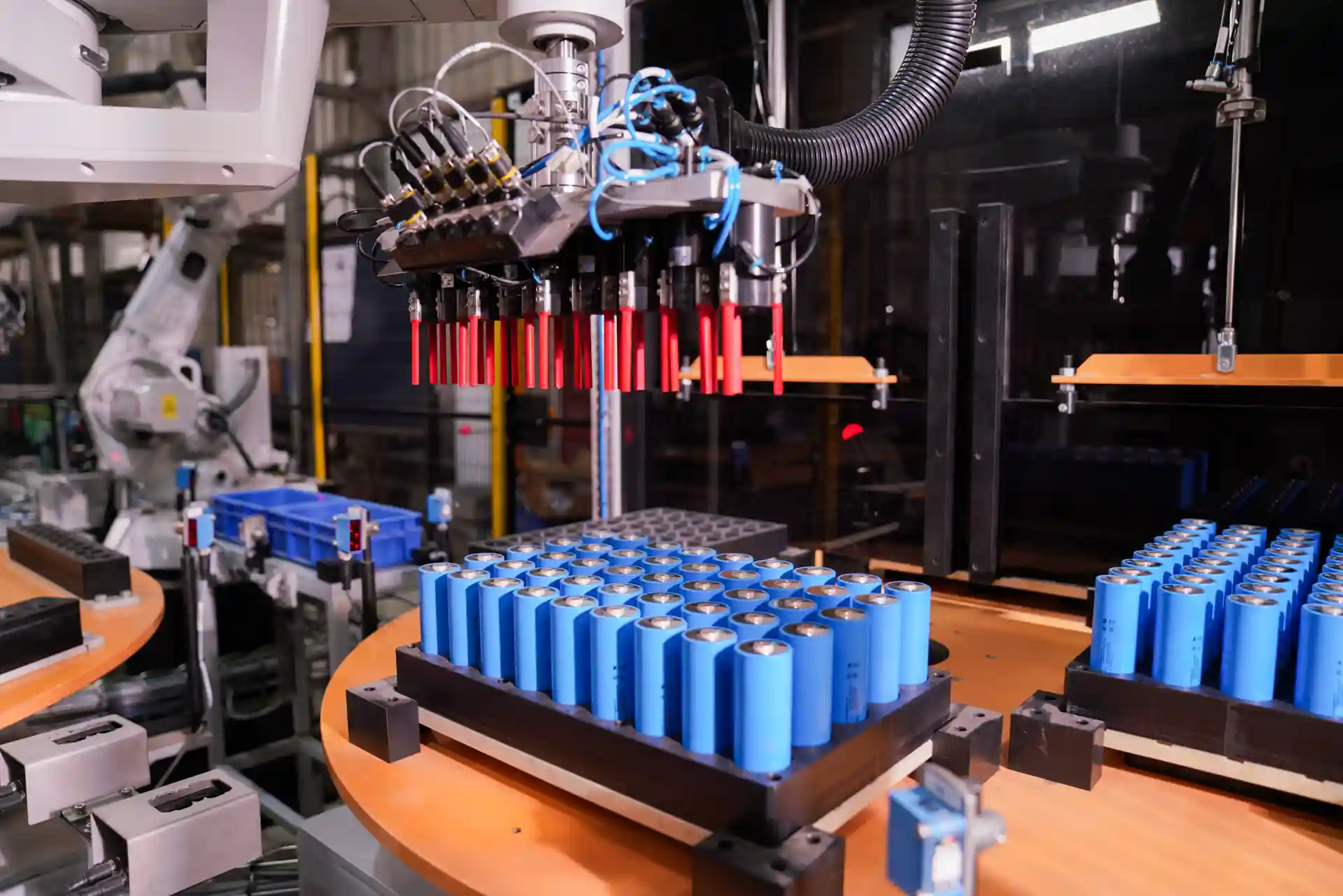
Graded cells arrive at a pack line and the character of the work changes completely. There is no chemistry here, only precision handling, measurement and joining.
Cells are scanned into a traceability record, tested for open circuit voltage and internal resistance and sorted into narrow bands, plasma cleaned at the terminals, fitted with insulation verified by vision, then welded to busbars in the required series and parallel configuration. Modules receive sense wiring and a battery management system, packs are closed with thermal interface material and sealed, and every unit passes end of line electrical, communication and leak testing before laser marking. The full sequence is set out in the guide to lithium battery pack assembly.
One point is worth repeating because it connects the two halves. Cell grading discipline at the end of cell manufacturing, and cell sorting discipline at the start of pack assembly, are doing the same job from opposite ends. A pack performs at the level of its weakest cell, so any grading looseness at either point shows up years later as a pack that aged unevenly.
 “Most costly battery defects are created early and detected late, which is why inline measurement and process traceability are fundamental to achieving consistent manufacturing yield.”

See it in action
Where Yield Is Actually Lost
Most defects in battery manufacturing are created early and detected late, which is what makes the process expensive to get wrong. The table below maps the stage to the failure and to the consequence.
| Stage | What goes wrong | What it costs downstream |
|---|---|---|
| Slurry mixing | Incomplete dispersion leaving agglomerates of active material or binder | Local resistance hot spots and capacity below specification, undetectable until formation |
| Coating | Loading weight varying across the web width or along its length | Cells that grade into different bands from the same batch, plus lithium plating risk where anode is under coated |
| Calendering | Over compression cracking active material particles | Reduced rate capability and shortened cycle life in an otherwise perfect cell |
| Slitting | Burrs on the cut edge, or metal particles released into the process | Internal short circuits, the defect class behind most battery safety recalls |
| Winding or stacking | Electrode misalignment leaving anode overhang insufficient at the edges | Lithium plating at the exposed edge and dendrite formation over time |
| Electrolyte filling | Incomplete wetting of the electrode stack | Dead zones that do not participate, showing as accelerated capacity fade |
| Formation | Charge protocol deviating from the specified profile | A poorly formed SEI layer, which permanently caps cycle life |
The pattern is consistent. Almost nothing in this list is visible when it happens. Agglomerates, coating variation, particle cracking and incomplete wetting all pass visual inspection and only declare themselves at formation, at grading, or in the field. That is why inline measurement at each stage outperforms end of line inspection, and why traceability that ties a finished cell back to a coating run and a slitting blade is worth building from the start.
Cybernetik’s Role in Battery Manufacturing
Cybernetik builds turnkey automation for the pack assembly half of this process, covering cell handling through to end of line testing. Battery pack assembly automation handles cylindrical diameters of 32, 33, 35, 40, 42 and 46 mm plus prismatic, pouch and blade formats, at speeds up to 6,000 cells per hour.
The company has operated for more than three decades, is headquartered in Pune with offices in the United States and the UAE, and has installed over 6,000 systems across 30 plus countries, including more than 400 custom robotic automation solutions. In battery manufacturing that work has been delivered for manufacturers including Hero MotoCorp, TVS Motor, Livguard and Matter. More background sits on the Cybernetik about page.