
Key takeaways
Until last year, a new plant building was one of the slowest assets on the books. Nonresidential real property is depreciated over 39 years, so a $20 million facility returned roughly $500,000 of deduction a year while the equipment inside it could be written off immediately.
Section 168(n), added by the 2025 tax law, changes that for a narrow set of buildings. It lets a manufacturer elect to deduct 100% of the cost of qualified production property in the year it is placed in service. Qualifying turns on two date windows, on how the space is used, and on an election that has to be made on time.
The IRS issued interim guidance in Notice 2026-16 on February 20, 2026, which taxpayers can rely on until proposed regulations arrive. It filled in most of the questions the statute left open, including definitions, basis allocation, related-party leases and how recapture works. What follows covers the dates, the qualifying space, the election and the recapture risk. It is general information, not tax advice.
What Section 168(n) Changes
QPP is the portion of nonresidential real property used as an integral part of a qualified production activity in the United States. Instead of 39-year recovery, the elected portion is deducted in full in the placed-in-service year.
The provision sits alongside the rules you already use for equipment. Machinery, conveying, packaging lines and controls are covered by bonus depreciation and Section 179. Before Section 168(n), the building around them was the one large item still stuck on a long schedule. Now a greenfield plant can, in principle, be expensed almost in full in the year it starts running.
The Two Date Windows
Both windows have to be satisfied. Missing either one disqualifies the building, whatever else is true about it.
| Requirement | Window |
|---|---|
| Construction begins | After January 19, 2025 and before January 1, 2029 |
| Property placed in service | After July 4, 2025 and before January 1, 2031 |
For the construction start date, the IRS applies the same concepts used for bonus depreciation, including the written binding contract test and, for self-constructed property, the point at which physical work of a significant nature begins. A project designed in 2024 but contracted and broken ground in mid-2025 is generally fine. A project that started on site in 2024 is generally not.
The back end of the window matters just as much on large builds. A plant that breaks ground in 2028 has to be operating before 2031, which is tight for a complex facility. If the schedule is at risk, that is a reason to bring commissioning forward rather than let it drift.
What Counts as a Qualified Production Activity
The activity has to involve manufacturing, production or refining of tangible personal property, and it has to result in a substantial transformation of the property. Chemical processing and certain agricultural activities are included.
The substantial transformation test is worth thinking about early. Assembling, packing or simply storing goods is unlikely to clear it on its own, while processing raw materials into a different product does. For plants that do both under one roof, the split matters for how much of the building qualifies.
Two carve-outs come up often. A facility where food is prepared and sold at the same retail location does not qualify, even though ingredients are transformed there, so the provision is aimed at industrial food plants rather than restaurants or in-store bakeries. And a landlord who builds a facility and leases it to a manufacturer does not get the deduction simply because a tenant runs production in it. Related-party lease arrangements have their own rules in the notice.
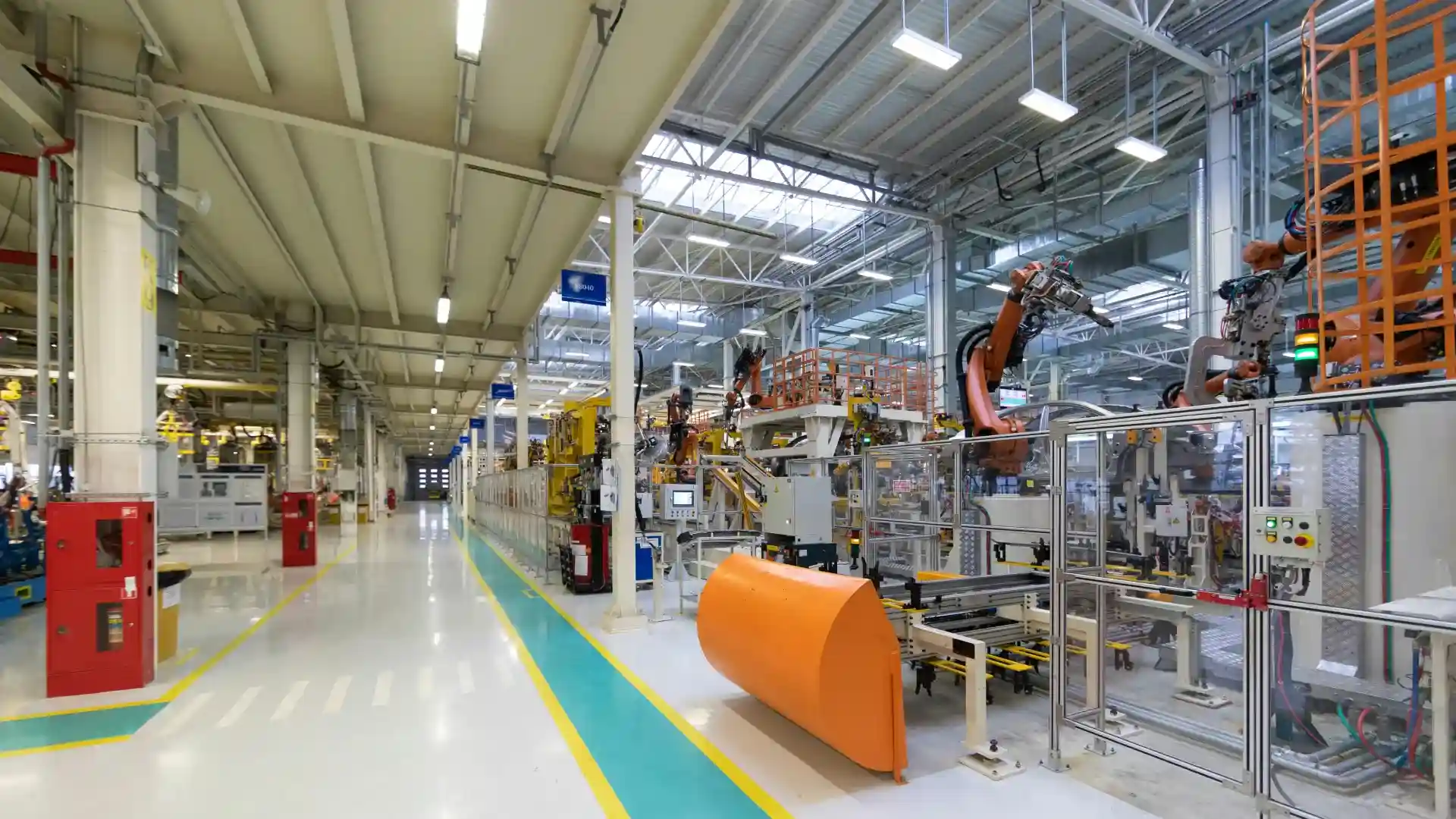
Which Parts of the Building Qualify
This is where most of the work sits on a real project. QPP covers the portion of the building used as an integral part of the production activity, and specific uses are excluded even when they sit inside the same shell.
| Space | Generally Treated As |
|---|---|
| Production and process floor | Qualifying |
| Storage of raw materials and inputs used in production | Can qualify as an essential activity |
| Storage of finished products | Excluded |
| Offices and administrative areas | Excluded |
| Research, engineering and software development space | Excluded |
| Sales areas | Excluded |
| Parking and lodging | Excluded |
Based on Notice 2026-16. Treatment depends on the facts of each facility, so confirm the classification of your space with your tax advisor before the election is made.
The practical consequence is that a building has to be measured, not just described. Square footage, drawings and a written allocation methodology become tax documents. The notice includes allocation rules for mixed-use facilities and a de minimis provision for small amounts of non-qualifying space, so a modest office block inside a production building does not automatically break the claim.
Two design decisions are worth having early, while layout is still on paper. Where the boundary sits between production space and warehouse space, and whether finished goods storage is inside the same structure or attached to it, can change how much of the building qualifies.
Expansions, Retrofits and Dual-Use Infrastructure
Most plants are not greenfield. The common questions are whether a new production bay attached to an existing building can qualify, and how to treat shared services.
A newly constructed addition is generally assessed on its own facts, with the same construction start and placed-in-service windows applied to that work. A straight retrofit inside an existing building is different: interior improvements usually run through the qualified improvement property rules and bonus depreciation rather than Section 168(n), and certain items such as roofs, HVAC and fire protection can be picked up under Section 179 instead.
Shared infrastructure is addressed directly in the interim guidance, which includes rules for dual-use infrastructure and for allocating basis between qualifying and non-qualifying portions. Utilities, process services and structural elements that serve both a production hall and an office block have to be split on a documented basis rather than claimed in full.
Used Buildings and Acquisitions
Original use generally has to begin with the taxpayer, which points the provision at new construction. There is an exception for acquired property, set out in the notice, which broadly requires that nobody used the property in a qualified production activity between January 1, 2021 and May 12, 2025, that the buyer never used the property before acquiring it, and that it was not bought from certain related parties or in a transaction where basis carries over.
In plain terms, buying an idle building and converting it to production can work, while buying a plant that was already running production usually does not.
The Election
Section 168(n) is elective, not automatic. The election is made on a timely filed original return for the year the property is placed in service, it can apply to all or part of a qualifying project, and it cannot be made retroactively on an amended return.
That single sentence carries more weight than it looks. A company that builds a plant, places it in service, and only asks about Section 168(n) the following year will usually have missed it. The decision belongs in the project plan, not in the filing cycle.
There is also a rule about relying on the interim guidance. A taxpayer that chooses to rely on Notice 2026-16 has to rely on all of it, rather than picking the favorable parts and taking a different position elsewhere.
Section 168(n) or Qualified Improvement Property?
These two get confused because both accelerate deductions on buildings. They are not alternatives. Qualified improvement property covers certain interior improvements made to an existing nonresidential building after it was first placed in service, and it is eligible for bonus depreciation. Section 168(n) covers the building itself, but only where it is newly constructed or newly acquired under the used property exception, and only for the portion used in production.
On a project that includes both new construction and work inside an existing structure, the two run side by side and the invoices need to make clear which is which.
The 10-Year Recapture Rule
If the property stops being used in a qualified production activity within 10 years of being placed in service, depreciation recapture applies under the Section 1245 rules, which means part of the benefit comes back as ordinary income.
Ten years is a long time in manufacturing. Lines get repurposed, production moves, buildings get converted to warehousing, and companies get sold. Before electing, it is worth asking what the facility is likely to be doing in year eight, and recording the intended use at the outset, because that documentation is what supports the position later.
How QPP Works With Equipment Expensing
On a greenfield project, three provisions run in parallel. The building portion that qualifies goes under Section 168(n). The production equipment goes under bonus depreciation, which is 100% and permanent for qualifying property acquired after January 19, 2025. Section 179 can be pointed at selected assets, including certain building improvements that bonus depreciation does not reach.
Take a $30 million plant: $18 million of building, of which $14 million is production space and $4 million is offices, finished goods storage and parking, plus $12 million of process and packaging equipment. With a valid election, the $14 million qualifying portion and the $12 million of equipment can both be deducted in the year the plant is placed in service. The remaining $4 million of building stays on the 39-year schedule.
The numbers are illustrative, and the allocation is the part that would need real work on a real project. But the shape of the answer is what has changed: the building is no longer the slow half of the investment.
 “The building and the equipment inside it can now benefit from different expensing provisions. Coordinating both plans helps manufacturers manage large-scale facility investments.”

See it in action
Documentation That Supports the Claim
Because the election is made on the original return and the recapture window runs for a decade, the file you build during construction is the file you will rely on years later. Worth keeping together:
A Checklist for a Greenfield Project
- Fix the construction start date in writing. Contracts, notices to proceed and site records establish which window you are in.
- Map the space before design is frozen. Classify every area as production, support or excluded, and keep the drawings that show it.
- Agree an allocation methodology early. Square footage is the common basis, but it needs to be documented and applied consistently.
- Plan commissioning against the 2031 deadline. The building has to be in service, not merely finished.
- Diarize the election. It has to be made on the original return for the placed-in-service year.
- Record the intended use. The 10-year recapture rule makes contemporaneous documentation valuable.
- Model the state position. State conformity to Section 168(n) varies, as it does for bonus depreciation.
Why the Provision Is Worth the Effort
The compliance load here is heavier than for equipment expensing. There is space to classify, an allocation to document, an election to time and a decade of recapture exposure to monitor. On a small project that may not be worth it.
On a large build it usually is. Deducting the production portion of a new facility in year one rather than over 39 years pulls a substantial amount of cash forward, and for a company funding successive phases of expansion, that cash is what pays for the next line. The window also closes: construction has to start before 2029 and the building has to be running before 2031, so projects already on the drawing board are the ones this was written for.
Where the Equipment Plan Meets the Tax Plan
Cybernetik designs and builds the process and packaging systems that fill these buildings, supporting US plants through Cybernetik Inc in Summerville, South Carolina, with more than 6,000 installations worldwide since 1989. On a new facility, two parts of our work touch the tax position directly.
Powder and liquid handling, industrial cooking, conveying, bagging, case packing and palletizing come from one engineering group, which keeps the equipment schedule tied to the construction schedule instead of running behind it. We do not advise on tax treatment or prepare elections.