
Key takeaways
Most industrial mixers move material around. A high shear mixer does something different: it applies enough localised force to physically break structures apart. That distinction matters, because a large proportion of mixing problems in food, pharmaceutical and chemical plants are not mixing problems at all. They are dispersion problems, and no amount of gentle folding will solve them.
If a powder forms lumps that survive twenty minutes in a blender, if an oil and water phase separates within an hour of being combined, or if a gum hydrates unevenly and leaves fisheyes in the batch, the requirement is shear, not agitation.
The Working Principle
A high shear mixer consists of a rotor turning at high speed inside a closely fitted stator, or a set of high-speed blades operating within a vessel. The essential feature is the narrow gap and the speed across it.
Material is drawn into the rotor by centrifugal action, accelerated, and forced through the gap between rotor and stator, or between the blade tips and the surrounding fluid. Within that gap the velocity difference across a very short distance produces an extremely high shear rate. Agglomerates entering the zone are torn apart, droplets are subdivided into smaller droplets, and solids are wetted and dispersed into the liquid phase.
The material then discharges radially at speed and returns to the vessel, drawing fresh material into the rotor behind it. That circulation is the second half of the job. Shear happens only in the gap, so the entire batch has to pass through it repeatedly for the result to be uniform. A mixer that shears intensely but circulates poorly produces an over-processed fraction and an untouched one.
What high shear actually achieves
Where High Shear Is the Right Answer
The useful test is whether the problem involves structures that must be destroyed rather than materials that must be combined. Two examples make the distinction clear. Blending three free-flowing powders in fixed proportions is a distribution problem, and a ribbon blender does it more cheaply and more gently. Dispersing a cocoa powder into a fat phase without lumps is a shear problem, and no ribbon blender will achieve it.
| Mixer type | How it works | What it is for |
|---|---|---|
| High shear mixer | A high-speed rotor forces material through a narrow gap, generating intense localised shear | Breaking agglomerates, emulsifying, dispersing powders into liquids, hydrating gums |
| Ribbon blender | Counter-rotating helical ribbons move material axially through a horizontal trough | Gentle bulk blending of free-flowing dry powders at large batch sizes |
| Paddle mixer | Angled paddles lift and fold material | Blending fragile or granular products where shear would damage them |
| Ploughshare mixer | Plough-shaped tools throw material into a fluidised bed, with optional choppers | Three-dimensional mixing with moderate shear and liquid addition |
| Air blender | Compressed air pulses fluidise and mix the batch | Very gentle blending of abrasive or friable powders |
Shear is not free. The same energy that breaks agglomerates also heats the batch, and in temperature-sensitive products that heat has to be accounted for through jacketing or through limiting mix time. It can also damage material that was supposed to stay intact, which is why fragile inclusions such as nuts, fruit pieces or coated particles are normally added after high shear mixing rather than during it.
Industrial Applications
Benefits Over Conventional Mixing
 “The value of high shear mixing lies not in how fast the mixer turns, but in how effectively it applies shear and circulates the entire batch through the mixing zone.”

See it in action
Specification Points That Matter
Batch size and vessel arrangement
High shear mixers are built as in-tank units, as inline units in a recirculation loop, or as column-lift arrangements where the mixing head descends into a mobile vessel. The last is common in food plants running multiple products, because the batch travels in its own buggy and the mixer stays fixed, which removes a cleaning cycle between products.
Tip speed rather than rpm
Shear rate depends on the velocity at the blade or rotor tip, which is a function of both rotational speed and diameter. Comparing two mixers on rpm alone is misleading unless their rotor diameters match. Ask for tip speed.
Viscosity range
A mixer that performs well in a thin liquid may fail to circulate a viscous batch, leaving material stagnant outside the shear zone. Where the product range spans viscosities, the mixer has to be specified for the thickest, and recipe control has to accommodate the rest.
Heat management
Energy input becomes heat. For temperature-sensitive products, jacketed vessels or bounded mix times are part of the specification rather than an operational workaround.
Hygiene and changeover
Rotor and stator assemblies have close clearances, which is exactly where product lodges. GMP construction, accessible geometry and a realistic cleaning procedure between products decide whether multi-product operation is practical.
Cybernetik High Shear Mixing
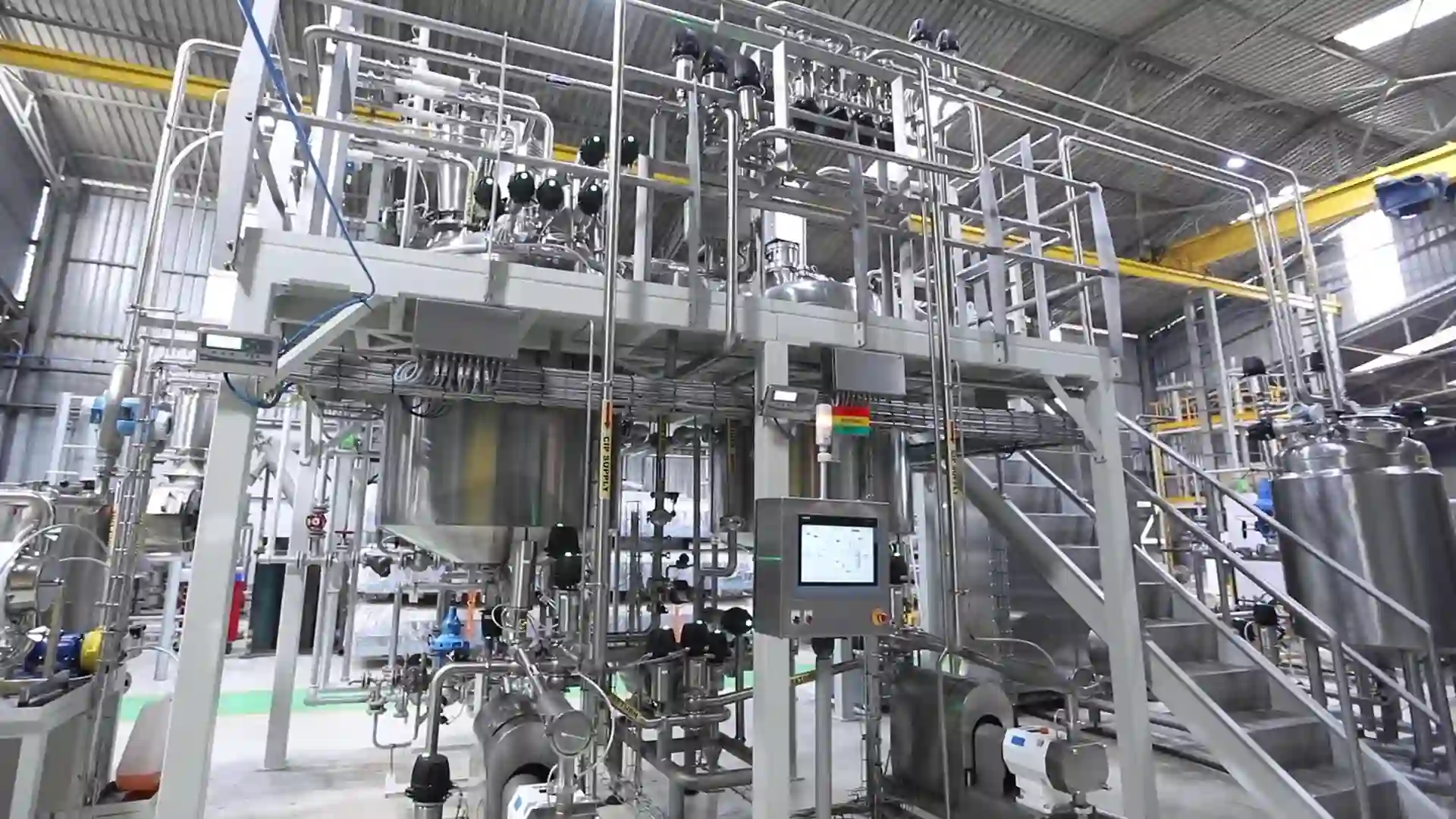
Cybernetik’s Column Lift High Shear Mixer uses a vertically mounted mixing vessel with a high-speed, counter-rotating blade system, producing a homogeneous mix in minutes across pre-mixing and post-mixing stages.
In operation, a buggy is loaded onto the mixer and secured by a mechanical stopper. The operator selects the recipe, the high-speed agitator descends into the buggy and mixes the product, and the buggy is then unloaded for the next process stage. Because the product never leaves its own vessel, the mixer itself does not need cleaning between compatible products.
| Parameter | Specification |
|---|---|
| Capacity | 500 litres, customisable |
| Speed | Up to 3000 rpm, customisable |
| Materials of construction | SS304 or SS316 |
| Vessel arrangement | Vertically mounted mixing vessel with buggy loading |
| Blade system | High-speed, high-shear counter-rotating blades |
| Control | Recipe-based mixing for products of varying viscosity |
| Safety | Mechanical clamping mechanism securing buggy position during operation |
| Build standard | GMP built for food processing duty |
The mixer sits within a wider mixing and blending range that includes plough shear mixers for three-dimensional mixing with liquid injection, ribbon blenders for bulk dry blending, paddle and continuous paddle mixers for gentle duty, air blenders, and flavour mixing systems, alongside the conveying, sifting, grinding and packing equipment they connect to.
Cybernetik has operated for more than three decades, is headquartered in Pune with additional facilities in Gujarat and Raigad and international offices in the United States and UAE, and has installed over 6,000 systems across 30 plus countries, including more than 400 custom automation solutions. With over 600 employees and divisions spanning Process Automation, Packaging Automation, CleanTech, Extraction, Labs and Defence, a mixer is specified with knowledge of the whole line around it. Further background sits on the Cybernetik about page.