
Key takeaways
Most conveyor problems in a processing plant are not conveyor problems. They are elevation problems. Product has to move from floor level into a hopper, a weigher or a packaging machine, and the moment a belt is tilted beyond a certain angle, the product starts sliding back down it.
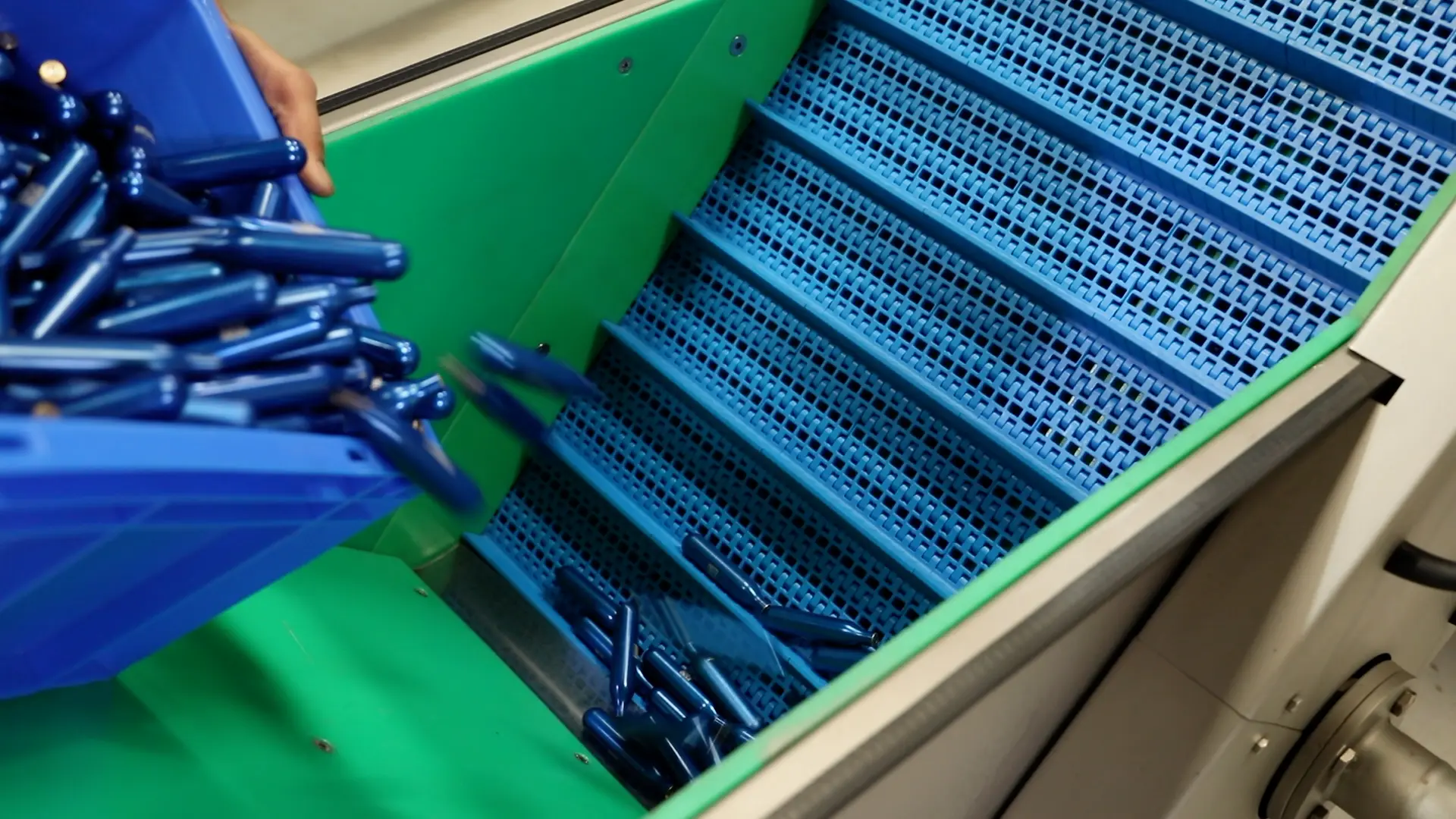
A cleated belt conveyor solves that by giving the product something to sit against. Raised cleats, also called flights, are bonded to the belt surface at regular intervals so material is carried in pockets rather than resting on a smooth incline. Simple in principle. The engineering sits entirely in choosing the right cleat, on the right belt, at the right angle, for a specific material.
This guide covers how incline angle drives the decision, which cleat profiles suit which materials, the specification points that matter during selection, and the mistakes that produce a conveyor which spills, jams or cannot be cleaned.
Why Incline Angle Drives Everything
Every bulk material has an angle of repose, the steepest slope at which a pile of it remains stable. Push a conveyor past a related limit and material begins to slip backwards against the belt surface.
For most free flowing materials, a flat belt conveyor carries reliably up to roughly 15 to 20 degrees. Beyond that, throughput falls as an increasing fraction of the load rolls or slides back, and the belt starts returning product to the feed point instead of delivering it.
Cleats extend the usable range considerably. A cleated belt commonly handles 30 to 45 degrees, and with corrugated sidewalls closing the ends of each pocket, elevation approaching vertical becomes possible. That range is why cleated belts appear wherever floor space is tight and vertical distance has to be covered without a bucket elevator.
The practical rule is to establish the required lift height and the available floor length first. Those two numbers fix the angle, and the angle largely dictates the cleat profile. Selecting a cleat before knowing the angle is working backwards.
Cleat Profiles and What They Suit
Cleat geometry is the single most consequential choice in the specification, and it is decided by material behaviour rather than by preference.
| Cleat profile | Shape | Best suited to | Watch out for |
|---|---|---|---|
| T-cleat | Vertical wall standing perpendicular to the belt | General purpose inclines with free flowing granular or piece goods | Material can roll back over the cleat on steeper angles |
| L-cleat or scoop | Angled back toward the belt, forming a pocket | Steeper inclines and materials prone to rolling | Sticky products lodge in the pocket and need discharge assistance |
| V-cleat or chevron | Shallow chevron pattern across the belt | Wet, damp or lightly sticky products on gentle inclines | Limited retention; not a substitute for a true cleat on steep runs |
| Box cleat with sidewalls | Cleat closed at both ends by corrugated sidewalls | Steep to near vertical elevation of powders and fine material | Highest cost, hardest to clean, needs larger pulley diameters |
| Low profile cleat | Short cleat, often closely pitched | Gentle inclines where the cleat only needs to prevent creep | Insufficient on anything approaching the material angle of repose |
Two dimensions matter alongside profile. Cleat height sets how much material each pocket holds, which combines with belt speed to give throughput. Cleat pitch, the spacing between cleats, sets how many pockets are on the belt at once. Tall cleats at wide pitch and short cleats at close pitch can deliver similar throughput with very different behaviour at the loading and discharge points.
Selection Criteria
1. Material characteristics
Bulk density fixes the load per pocket and therefore the drive sizing. Particle size relative to cleat height determines whether material sits in the pocket or bridges across cleats. Moisture and stickiness decide whether the product will release at discharge or need a scraper. Abrasiveness drives belt compound selection. These four properties, established before anything else, eliminate most of the option space.
2. Belt material and compliance
PVC suits general industrial duty. Polyurethane is the usual choice for food contact, offering better cut resistance and easier cleaning. Silicone handles high temperature or very sticky applications. For food and pharmaceutical work the belt has to carry appropriate food contact certification, and that requirement extends to the cleats themselves, not just the base belt.
3. Cleat attachment method
Cleats are either welded or vulcanised to the belt as a continuous bond, or mechanically fastened. Welded attachment leaves no crevice at the cleat root where product can lodge, which matters in hygienic applications and matters again during washdown. Mechanically fastened cleats are replaceable individually, which suits abrasive duty where cleats wear faster than the belt. The trade-off is straightforward: hygiene favours welded, maintainability favours fastened.
4. Sidewalls and skirting
Cleats prevent material moving down the belt. They do nothing about material moving sideways off it. Fixed skirting along the conveyor frame contains product on gentle inclines. Corrugated sidewalls bonded to the belt travel with the material and are necessary on steep runs, particularly with fine powders that would otherwise cascade off the edges.
5. Hygiene and cleanability
In food processing, the cleat root is the critical detail. A sharp internal corner traps product and resists washdown; a radiused root does not. Frame design matters equally, with open construction, sloped surfaces and no closed hollow sections. Where the conveyor feeds snack food automation lines or similar hygienic production, cleaning access should be considered at specification rather than discovered at commissioning.
6. Belt speed and throughput
Cleated conveyors generally run slower than flat belts. Higher speeds throw material against cleats at loading and fling it at discharge, both of which cause spillage and product damage. Throughput is raised by increasing pocket volume, through cleat height, belt width or closer pitch, rather than by increasing speed.
7. Loading and discharge arrangement
Loading should place product into a pocket, not onto a cleat. A feed point mismatched to cleat pitch will deposit part of each batch on top of the cleats where it rides insecurely. At discharge, free flowing material leaves under gravity, but damp or sticky products often need a brush, scraper or belt flexing arrangement to clear the pockets fully.
8. Pulley diameter and tracking
Cleats change how the belt behaves around pulleys. Larger diameters are needed than an equivalent flat belt would require, since the cleat opens as it wraps the pulley and stresses the bond. Cleats are also frequently notched at the belt edges so tracking guides can operate, and this detail is worth confirming with the supplier rather than assuming.
 “Cleated belt conveyors transform vertical elevation challenges into controlled material movement by carrying products in engineered pockets rather than relying on friction alone.”

See it in action
Where Cleated Belt Conveyors Are Used
Common Selection Mistakes
Cleated Belt Conveyors from Cybernetik

Cybernetik designs and builds flight cleated belt conveyors as part of an integrated material handling range rather than as standalone units, engineered around the material being conveyed and the equipment on either side of it.
That range also covers trough belt conveyors for bulk horizontal transfer, vibratory conveyors, screw conveyors, bucket elevators and cooling and submerged conveyor systems, which means the conveyor specified is the one the duty actually calls for rather than the one the supplier happens to make. Where the requirement is high volume horizontal movement, a trough belt conveyor is frequently the better answer, and saying so is part of the engineering.
The company has operated for more than three decades, is headquartered in Pune with offices in the United States and the UAE, and has installed over 6,000 systems across 30 plus countries, including more than 400 custom automation solutions across food, pharmaceutical, chemical and industrial processing.