
Key takeaways
The rapid growth of electric vehicles is increasing demand for battery manufacturing systems that can deliver higher production volumes without compromising quality, safety, or consistency. As EV batteries become more complex, manufacturers are moving beyond manual production methods and adopting automation across cell, module, and pack manufacturing.
Automation connects material handling, assembly, inspection, testing, and production monitoring into a coordinated manufacturing process. Robotics can perform repetitive operations with consistent accuracy, while automated inspection and testing systems help identify production issues before batteries move to the next stage.
For EV battery manufacturers, the goal is not simply to automate individual machines. A well-designed automated production environment improves material flow, assembly consistency, quality control, traceability, and production scalability.
What Is EV Battery Manufacturing Automation?
EV battery manufacturing automation refers to the use of robotics, automated equipment, sensors, inspection technologies, and control systems to perform and coordinate battery production processes.
Automation can be implemented across different stages of EV battery manufacturing, from handling individual cells to assembling complete battery packs.
Automated Cell Handling
Battery cells must be transported and positioned carefully throughout the manufacturing process. Automated handling systems can move cells between inspection, sorting, assembly, and testing stations while reducing unnecessary manual handling.
Controlled movement is particularly important when manufacturing high-volume battery systems because consistent positioning supports reliable downstream assembly.
Automated Module Assembly
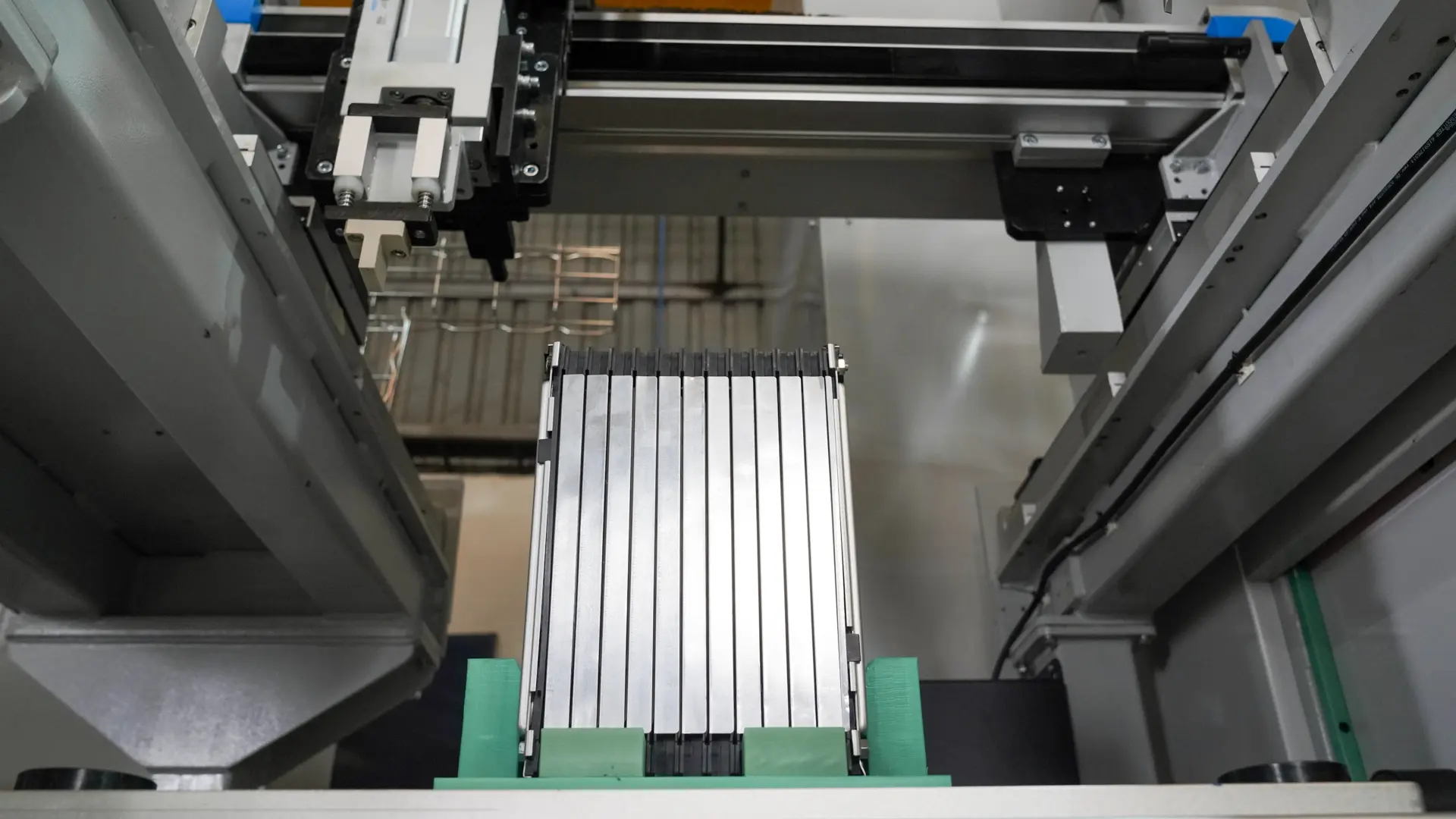
Battery module production involves multiple components that must be assembled in a precise sequence. Automated systems can support cell positioning, component placement, joining operations, and inspection.
Automation helps maintain consistent assembly parameters across production cycles while reducing process variation.
Automated Battery Pack Assembly
At the pack level, multiple modules and supporting components are integrated into a complete battery system. Automated assembly equipment can coordinate material movement and component placement while integrating inspection and testing operations into the production line.
Why Is Automation Important for EV Battery Manufacturing?
1. Increasing EV Battery Production Volumes
The expansion of electric mobility is creating demand for higher battery production capacity. Manufacturers need production systems that can operate consistently at scale while maintaining quality.
Automated equipment allows repetitive manufacturing operations to run continuously with controlled process parameters. This helps manufacturers increase throughput without relying entirely on additional manual labor.
2. Maintaining Consistent Assembly Quality
Battery manufacturing involves numerous components and precise assembly requirements. Small variations during production can affect battery performance, reliability, and safety.
Automation provides repeatable movement and process control, helping manufacturers maintain consistent assembly quality across large production volumes.
3. Reducing Manual Handling
Manual handling can introduce variation and increase the possibility of component damage or incorrect positioning. Automated material handling and robotic systems reduce unnecessary operator involvement in repetitive production activities.
Operators can instead focus on process monitoring, quality control, maintenance, and other higher-value manufacturing activities.
How Automation Is Transforming EV Battery Production
Robotics Improves Manufacturing Precision
Robotics plays an important role in modern EV battery manufacturing because many assembly operations require controlled and repeatable movements.
Robotic systems can support cell handling, component placement, module assembly, material transfer, and other repetitive manufacturing operations.
The primary advantage is consistency. Once a process is validated, robotic equipment can repeat the same operation across thousands of production cycles while maintaining predefined parameters.
Automated Material Handling Improves Production Flow
Material handling connects different stages of battery manufacturing. Delays between production stations can create bottlenecks and reduce overall line efficiency.

Automated conveyors, transfer systems, and robotic handling equipment help maintain a continuous flow of cells, modules, components, and completed assemblies.
A connected material handling system can also coordinate production between upstream and downstream equipment, reducing unnecessary movement and manual intervention.
Automated Inspection Strengthens Quality Control
Quality inspection is critical in EV battery manufacturing because defects can affect battery performance and safety.
Automated inspection systems can examine components and assemblies during production instead of relying entirely on manual inspection. Vision-based systems can check component positioning, surface conditions, assembly accuracy, and other predefined quality parameters.
Detecting defects earlier allows manufacturers to isolate affected products before they progress further through the production process.
Automated Testing Verifies Battery Performance
Testing is another important part of battery manufacturing automation. Automated testing equipment can evaluate electrical and functional parameters according to predefined production requirements.
Automating testing provides consistent test procedures and creates production data that can be used for quality verification and traceability.
Key Automation Technologies Used in EV Battery Manufacturing
| Technology | Manufacturing Application | Primary Benefit |
| Robotics | Cell and component handling | Repeatable operations |
| Automated conveyors | Material transportation | Continuous production flow |
| Machine vision | Component inspection | Consistent quality verification |
| Automated testing | Battery validation | Repeatable testing |
| PLC and HMI systems | Process control | Centralized operation |
| Data monitoring | Production tracking | Improved traceability |
Automation Across the EV Battery Manufacturing Process
1. Battery Cell Manufacturing
Cell manufacturing involves multiple stages where controlled processing and inspection are essential. Automation can support material movement, process monitoring, inspection, and handling throughout these operations.
Automated systems also help reduce unnecessary manual contact with cells and provide consistent production conditions.
2. Battery Module Manufacturing
Module assembly brings multiple cells and components together into a functional unit. Automation can coordinate cell positioning, component handling, joining processes, inspection, and material transfer.
A properly integrated module assembly line can maintain consistent production flow while reducing variation between individual modules.
3. Battery Pack Manufacturing
Battery pack assembly involves integrating modules with electrical, mechanical, thermal, and protective components. Automated systems can coordinate assembly operations while ensuring that components are positioned and connected according to predefined requirements.
Automation also allows inspection and testing stages to be integrated into the production workflow.
The Role of Machine Vision in EV Battery Manufacturing
Machine vision is becoming increasingly important as manufacturers look for more reliable ways to identify production defects.
Vision systems can inspect battery components without requiring operators to manually examine every product. Depending on the application, inspection systems can identify alignment issues, surface defects, missing components, and other predefined abnormalities.
Machine vision also provides a consistent inspection method across high-volume production. When integrated with automated production equipment, inspection results can be used to identify defective products and prevent them from continuing through the manufacturing process.
 “The future of EV battery production lies in intelligent automation that connects every stage of manufacturing, from cell handling and module assembly to pack integration and final testing.”

See it in action
How Automation Improves Battery Manufacturing Traceability
Traceability is increasingly important in EV battery manufacturing because manufacturers need visibility into production history and quality information.
Automated systems can capture information associated with individual cells, modules, and battery packs throughout production. This information can include inspection results, test measurements, process parameters, and production timestamps.
A connected traceability system makes it easier to identify where a production issue occurred and determine which products may be affected.
For high-volume battery production, this level of visibility supports quality management and helps manufacturers analyze production performance over time.
Automation and Production Safety
Battery manufacturing requires careful control of production processes because batteries involve electrical, chemical, and mechanical components.
Automation can reduce operator exposure to repetitive or potentially hazardous manufacturing operations. Automated handling systems can transport components between production stations, while controlled equipment can perform repetitive assembly and testing tasks.
Safety systems can also be integrated into automated production lines to monitor equipment conditions and stop operations when predefined safety conditions are triggered.
Automation therefore contributes not only to production efficiency but also to the development of more controlled manufacturing environments.
Automation Supports Scalable EV Battery Production
One of the major advantages of automation is its ability to support production growth.
Manufacturers may begin with a specific production capacity and later need to increase output as EV demand grows. Modular and integrated automation systems make it easier to expand individual production stages without completely redesigning the manufacturing facility.
Scalable automation can support:
Challenges in Implementing EV Battery Manufacturing Automation
Automation provides significant advantages, but successful implementation requires careful planning.
Production Line Integration
New automation equipment must work with existing manufacturing processes, utilities, software, and material handling systems. Poor integration can create bottlenecks even when individual machines perform efficiently.
Manufacturers should therefore evaluate the complete production workflow before implementing automation.
Initial Investment
Automated manufacturing systems require a higher initial investment than many manual processes. The business case should consider long-term productivity, labor requirements, quality improvements, equipment utilization, and scalability rather than focusing only on upfront cost.
Process Flexibility
EV battery technologies continue to evolve. Manufacturing equipment should therefore provide sufficient flexibility to accommodate changes in battery formats, production volumes, and assembly requirements.
Why Choose Cybernetik for EV Battery Manufacturing Automation?
Cybernetik develops automation solutions for battery manufacturing that combine automated material handling, assembly systems, inspection technologies, and integrated production controls.
The company’s solutions are designed to support different stages of battery manufacturing, including battery module and battery pack assembly applications.
Key capabilities include:
Cybernetik’s approach focuses on combining automation, process engineering, and production integration to help manufacturers build scalable battery manufacturing operations.