
Key takeaways
The rapid expansion of electric vehicles (EVs), Battery Energy Storage Systems (BESS), and renewable energy technologies has accelerated the demand for advanced battery manufacturing. To remain competitive, manufacturers must produce high-quality battery packs while achieving higher production throughput, consistent quality, and lower operating costs.
Traditional manufacturing processes often struggle to meet these requirements due to manual assembly, inconsistent quality, limited process traceability, and production bottlenecks. As battery technologies continue to evolve, manufacturers are increasingly investing in automation to improve operational efficiency and support large-scale production.
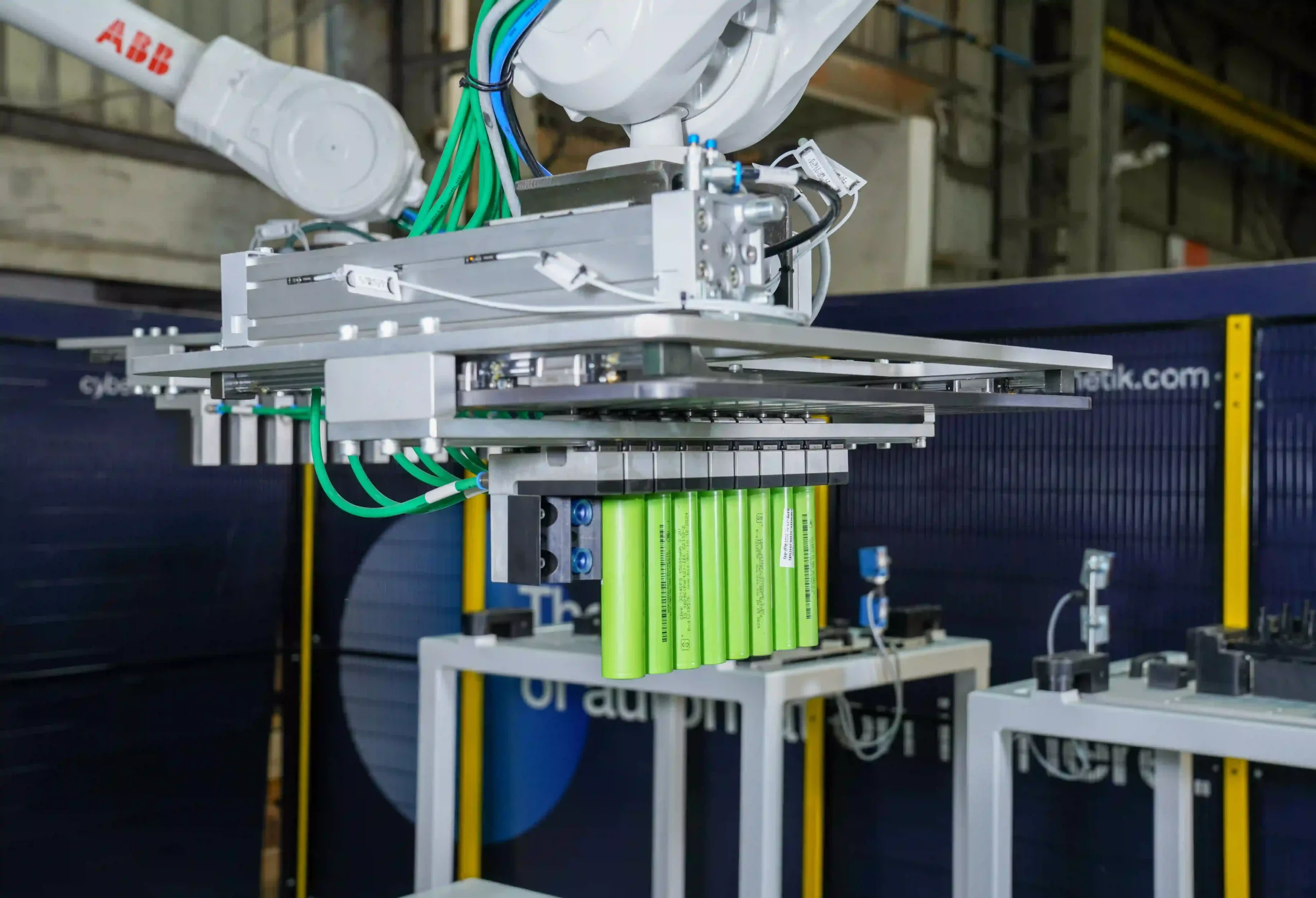
Battery manufacturing automation combines robotics, machine vision, intelligent material handling, and digital manufacturing technologies to automate critical production processes. From cell preparation and module assembly to battery pack assembly, quality inspection, and end-of-line testing, automation enables manufacturers to improve product consistency, enhance workplace safety, and optimize production performance.
This guide explores the fundamentals of battery manufacturing automation, its benefits, key production stages, enabling technologies, and the factors manufacturers should consider when building scalable, future-ready battery production facilities.
What Is Battery Manufacturing Automation?
Battery manufacturing automation is the use of advanced industrial automation technologies to optimize and control every stage of battery production. These systems integrate robotics, automated assembly equipment, machine vision, intelligent material handling, and digital manufacturing platforms to improve manufacturing precision, operational efficiency, and product quality.
Unlike manual manufacturing processes, automated production systems perform repetitive, high-precision operations with exceptional consistency while generating real-time production data for monitoring and process optimization. This enables manufacturers to reduce variability, improve traceability, and increase overall equipment effectiveness (OEE).
Automation can be implemented throughout the battery production process, including:
By connecting these processes within a smart manufacturing environment, manufacturers can improve production throughput, reduce manual intervention, and achieve consistent product quality across every battery pack.
Why Battery Manufacturing Automation Matters
The global transition toward electrification and renewable energy has significantly increased the demand for reliable, high-performance battery systems. Manufacturers must not only increase production capacity but also ensure every battery pack meets stringent quality, safety, and performance requirements.
Battery manufacturing automation helps manufacturers achieve these objectives by improving process consistency, operational efficiency, and manufacturing flexibility.
Consistent Product Quality
Battery cells, modules, and packs require extremely precise positioning, assembly, and inspection. Automated manufacturing systems minimize process variation and deliver repeatable production results, helping manufacturers achieve higher product reliability and reduce quality defects.
Increased Production Throughput
Automated production lines operate continuously with minimal interruptions, allowing manufacturers to significantly increase production capacity while maintaining consistent quality. Higher throughput enables facilities to meet growing market demand without sacrificing manufacturing performance.
Improved Workplace Safety
Battery manufacturing involves handling sensitive components, electrical systems, and high-energy materials. Automation reduces manual interaction with these processes, helping manufacturers improve workplace safety while minimizing the risk of operator-related errors.
Enhanced Process Traceability
Modern battery manufacturing systems capture production data throughout every stage of the manufacturing process. This enables complete traceability of components, simplifies quality assurance, and supports compliance with customer and industry requirements.
Lower Total Manufacturing Costs
Although automation requires an initial capital investment, it delivers long-term value by reducing material waste, minimizing rework, improving equipment utilization, lowering labor dependency, and optimizing overall manufacturing efficiency.
Industries Benefiting from Battery Manufacturing Automation
Battery manufacturing automation supports a broad range of industries where precision, scalability, and production reliability are critical to business success.
Common applications include:
As demand for electrification continues to grow worldwide, manufacturers across these industries are investing in intelligent automation solutions to improve operational performance, accelerate production, and maintain a competitive advantage in rapidly evolving markets.
Benefits of Battery Manufacturing Automation
| Benefit | How Automation Helps | Business Impact |
|---|---|---|
| Increased Productivity | Automates repetitive and precision-critical manufacturing processes with minimal downtime. | Improves production throughput and manufacturing capacity. |
| Consistent Product Quality | Delivers repeatable assembly processes and automated quality control. | Reduces defects and improves battery performance. |
| Enhanced Workplace Safety | Minimizes manual handling of battery cells and high-voltage components. | Creates a safer and more efficient production environment. |
| End-to-End Traceability | Captures production data throughout the manufacturing process. | Strengthens quality assurance and regulatory compliance. |
| Lower Operating Costs | Reduces waste, rework, labor dependency, and unplanned downtime. | Improves operational efficiency and long-term return on investment (ROI). |
Key Stages of Battery Manufacturing Automation
Modern battery production relies on a series of interconnected manufacturing processes that require exceptional precision, consistency, and traceability. Automation enables each stage to operate with greater accuracy while reducing manual intervention, improving production throughput, and maintaining stringent quality standards.
Below are the key stages where automation plays a critical role.
Cell Preparation and Inspection
Battery manufacturing begins with preparing and inspecting individual battery cells before they enter the assembly process. Any variation in cell quality can affect the performance, safety, and lifespan of the finished battery pack.

Automated inspection systems use machine vision, sensors, and intelligent software to verify that every cell meets predefined quality standards.
Typical inspection activities include:
Identifying defects early helps manufacturers reduce scrap, prevent downstream quality issues, and improve production efficiency.
Battery Module Assembly
Once approved, battery cells are assembled into modules using automated production systems that ensure accurate positioning and repeatable assembly.
Robotics and precision handling equipment improve manufacturing consistency while minimizing the risk of cell damage during assembly.
Common automated operations include:
Automation enables manufacturers to increase production throughput while maintaining consistent module quality across every production cycle.
Battery Pack Assembly
Battery pack assembly is one of the most critical stages in the manufacturing process because it combines battery modules into a complete energy storage system. During this stage, modules are integrated with structural components, electrical connections, thermal management systems, sensors, and the Battery Management System (BMS).
Because battery pack performance depends on assembly precision, manufacturers increasingly rely on advanced automation to improve consistency, traceability, and production efficiency.
Cybernetik’s Battery Pack Assembly Automation solutions support high-volume battery production by integrating robotics, intelligent process control, automated inspection, and flexible manufacturing technologies. These systems are engineered to accommodate multiple battery cell formats – including cylindrical, prismatic, pouch, and blade cells – allowing manufacturers to adapt to evolving battery technologies while maintaining high production standards.
Automated Inspection and Quality Testing
Quality assurance is essential throughout the battery manufacturing process. Automated inspection and testing systems verify that every battery module and pack meets design specifications before advancing to the next production stage.
Automated testing typically includes:
- Assembly verification
- Electrical performance testing
- Weld inspection
- Dimensional validation
- Surface quality inspection
- Functional testing
These systems help manufacturers detect defects early, reduce rework, and improve first-pass production quality.
End-of-Line Validation and Traceability
Before shipment, every battery pack undergoes final validation to confirm that it meets performance, safety, and quality requirements.
End-of-line automation records production data throughout the manufacturing process, creating complete traceability for every battery pack.
This information supports:
- Product quality documentation
- Regulatory compliance
- Warranty tracking
- Process optimization
- Continuous improvement initiatives
Comprehensive traceability enables manufacturers to maintain greater visibility across production while supporting long-term quality management.
 “One packaging platform can serve multiple industries, but performance depends on configuring the equipment around each industry’s unique production and compliance requirements.“

See it in action
Battery Pack Assembly: The Foundation of Battery Manufacturing
Battery pack assembly is one of the most critical stages in the battery manufacturing process because it directly affects product safety, performance, and long-term reliability. During this stage, battery modules are integrated with electrical interconnections, thermal management systems, structural components, sensors, and Battery Management Systems (BMS) to create a complete battery pack.
Because even minor assembly variations can impact battery performance, manufacturers increasingly rely on intelligent automation to achieve consistent production quality.
Cybernetik provides advanced Battery Pack Assembly Automation Solutions designed to support manufacturers in building efficient, scalable, and future-ready battery production facilities. These solutions integrate industrial robotics, intelligent process control, automated inspection, and digital traceability to improve manufacturing precision and operational efficiency.
Cybernetik’s modular automation platforms support multiple battery cell formats, including:
- Cylindrical cells
- Prismatic cells
- Pouch cells
- Blade cells
By combining flexible automation with integrated quality control, manufacturers can increase production throughput while maintaining consistent battery performance and supporting future product innovations.
Choosing the Right Battery Manufacturing Automation Solution
Selecting a battery manufacturing automation solution is a strategic investment that affects production efficiency, product quality, and long-term manufacturing competitiveness. The right automation platform should not only meet current production requirements but also provide the flexibility to accommodate future battery technologies and increasing production volumes.
Manufacturers should evaluate several important factors before implementing an automated production line.
Manufacturing Flexibility
Battery technologies continue to evolve, requiring manufacturers to support multiple cell formats, module configurations, and battery pack designs. Flexible automation systems allow production lines to adapt to new products without extensive equipment modifications.
Look for solutions that support:
- Multiple battery cell formats
- Modular production layouts
- Product changeovers
- Future production expansion
- Flexible automation architecture
Production Capacity and Scalability
Growing market demand requires manufacturing systems that can scale efficiently as production requirements increase.
Scalable automation solutions allow manufacturers to:
- Increase production throughput
- Expand manufacturing capacity
- Add additional assembly stations
- Integrate new inspection technologies
- Introduce future battery platforms
This flexibility helps manufacturers maximize return on investment while reducing future expansion costs.
Quality Assurance and Traceability
Battery manufacturing requires complete visibility throughout the production process. Every battery component should be traceable from incoming materials through final product validation.
Modern automation systems should provide:
- Component traceability
- Production data collection
- Barcode and QR code tracking
- Automated quality inspection
- Digital production records
- End-of-line validation reports
These capabilities strengthen quality assurance while supporting customer, regulatory, and industry requirements.
System Integration
Modern battery manufacturing facilities operate interconnected production environments where equipment must communicate seamlessly across multiple systems.
An effective automation platform should integrate with:
- PLC-based machine controls
- Manufacturing Execution Systems (MES)
- Enterprise Resource Planning (ERP) systems
- Machine vision platforms
- Robotic automation systems
- Production monitoring dashboards
Integrated manufacturing environments improve operational visibility, simplify production management, and support continuous process optimization.
Why Manufacturers Choose Cybernetik
As battery production continues to evolve, manufacturers require automation partners with expertise in robotics, intelligent manufacturing, and integrated production systems.
Cybernetik delivers advanced battery manufacturing automation solutions that combine engineering expertise with scalable production technologies. From concept development and system design to commissioning and lifecycle support, Cybernetik helps manufacturers build highly efficient battery production facilities tailored to their operational goals.
Its automation platforms integrate robotics, intelligent inspection, material handling, digital manufacturing, and production analytics into a connected manufacturing ecosystem that supports consistent quality, improved throughput, and long-term operational reliability.
Whether supporting electric vehicle battery production or large-scale Battery Energy Storage Systems (BESS), Cybernetik’s automation solutions help manufacturers improve productivity, reduce operational complexity, and prepare for the next generation of battery manufacturing.
Future Trends in Battery Manufacturing Automation
Battery manufacturing is rapidly evolving as manufacturers invest in smart factories, digital transformation, and connected production technologies. The next generation of battery production facilities will rely on intelligent automation to improve operational efficiency, enhance quality control, and support the growing demand for electric mobility and energy storage solutions.
Manufacturers adopting these technologies will be better positioned to scale production, reduce operating costs, and respond quickly to changing market requirements.
Future Trends in Battery Manufacturing Automation
| Future Trend | Description | Business Benefit |
|---|---|---|
| Industry 4.0 Integration | Connects production equipment, sensors, and manufacturing systems through real-time data exchange. | Improves operational visibility, production planning, and overall equipment effectiveness (OEE). |
| Artificial Intelligence (AI) | Uses AI-powered analytics and machine vision to optimize production processes and identify defects automatically. | Enhances product quality, reduces downtime, and improves manufacturing efficiency. |
| Collaborative Robots (Cobots) | Enables robots to safely work alongside operators for assembly, inspection, and material handling tasks. | Increases manufacturing flexibility while improving workplace safety and productivity. |
| Digital Manufacturing | Integrates automation, production analytics, and process monitoring into a connected manufacturing ecosystem. | Supports data-driven decision-making and continuous process optimization. |
| Sustainable Manufacturing | Improves energy efficiency, reduces material waste, and optimizes resource utilization throughout production. | Lowers operating costs while supporting environmental sustainability initiatives. |