
Key takeaways
At the end of every high-output packaging line, one question determines whether your throughput targets are met or missed: can your palletizing stage keep up? For manufacturers handling bags of cement and chemicals, cartons of food and beverages, drums of lubricants, or pails of paint, a manual palletizing station is a capacity ceiling – slow, injury-prone, and inconsistent. An engineered industrial palletizer removes that ceiling entirely.
This guide covers what an industrial palletizer does, why it matters for heavy-duty operations, and how Cybernetik’s four palletizer configurations – Robotic, Gantry, Cobot, and Bag & Drum – address the distinct demands of food, chemical, FMCG, pharma, and industrial manufacturing plants across the world.
What Is an Industrial Palletizer and Why Does It Matter?
An industrial palletizer is an automated system that picks finished packaging units – bags, cartons, boxes, drums, or pails – from a production line and places them in a pre-defined, stable matrix on a pallet, ready for storage or dispatch. It sits at the end of the line, downstream of the filling, sealing, and case-packing stages, and its output determines how quickly loaded pallets leave the facility.
In manual or semi-automatic setups, workers lift, orient, and stack heavy units layer by layer. The problems compound quickly:
A purpose-built industrial palletizer eliminates all four failure modes and, on most lines, pays back its capital cost within 18 to 36 months through labor savings, reduced product damage, and higher throughput.
Cybernetik’s Industrial Palletizer Range: Four Configurations for Every Load Type
Cybernetik’s palletizing range is built on a single engineering philosophy: modular design, servo/pneumatic precision, and upstream-downstream integration under a unified PLC and SCADA architecture. Each configuration is optimized for a specific load type, throughput band, and facility footprint.
1. Robotic Palletizer
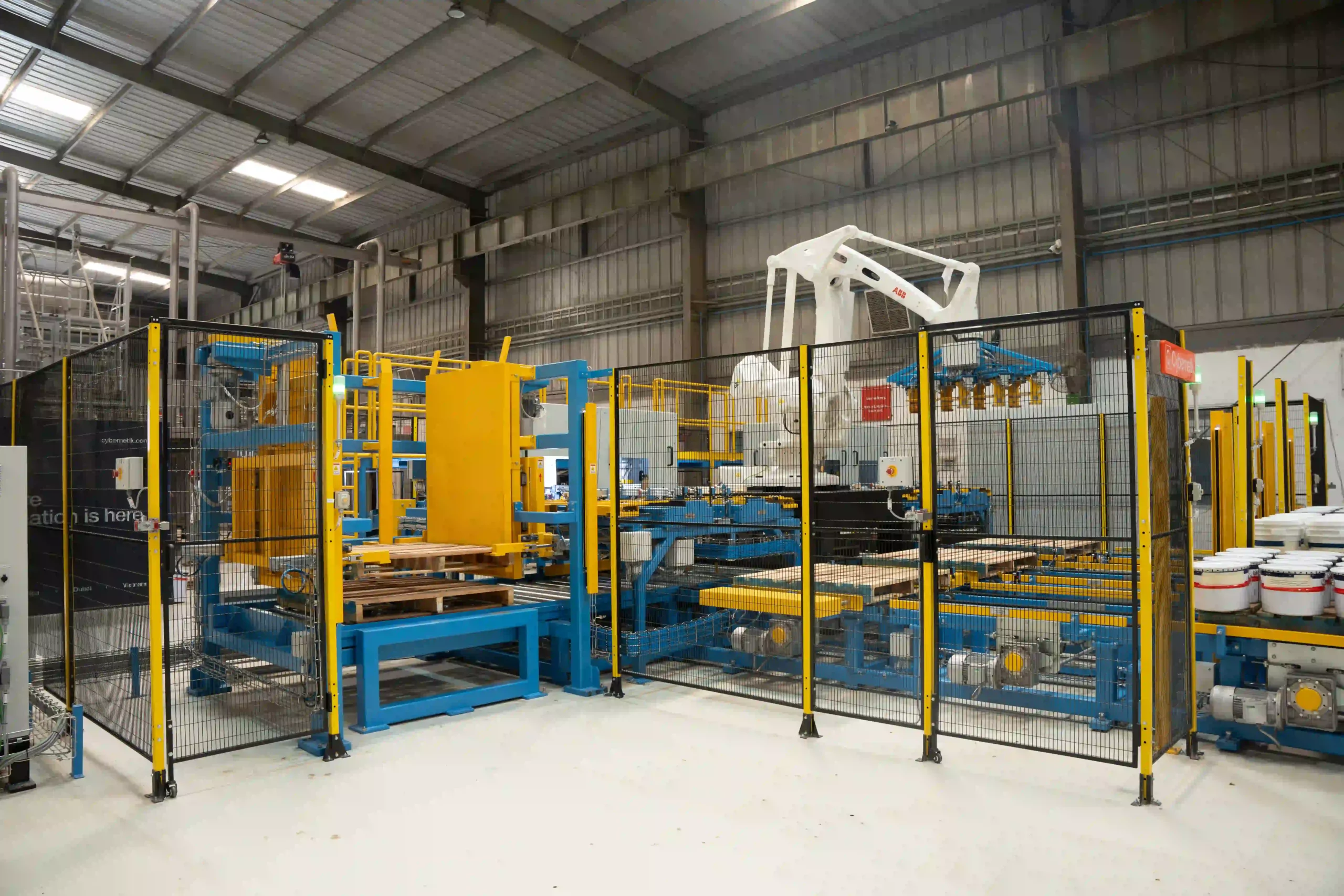
Cybernetik’s Robotic Palletizer is the flagship heavy-duty configuration, designed for high-speed, multi-SKU palletizing of bags, cartons, drums, and pails. A six-axis or four-axis robotic arm with servo/pneumatic end-of-arm tooling picks product from the infeed conveyor and places it in the programmed matrix on the pallet. Key engineering decisions that drive performance:
For heavy industrial loads, Cybernetik’s Bag and Drum Palletizer variant handles both bag and drum formats with the same robotic arm and an automated tool changer – a particularly strong fit for chemical and lubricant plants that run both product types on adjacent lines.
2. Gantry Palletizer
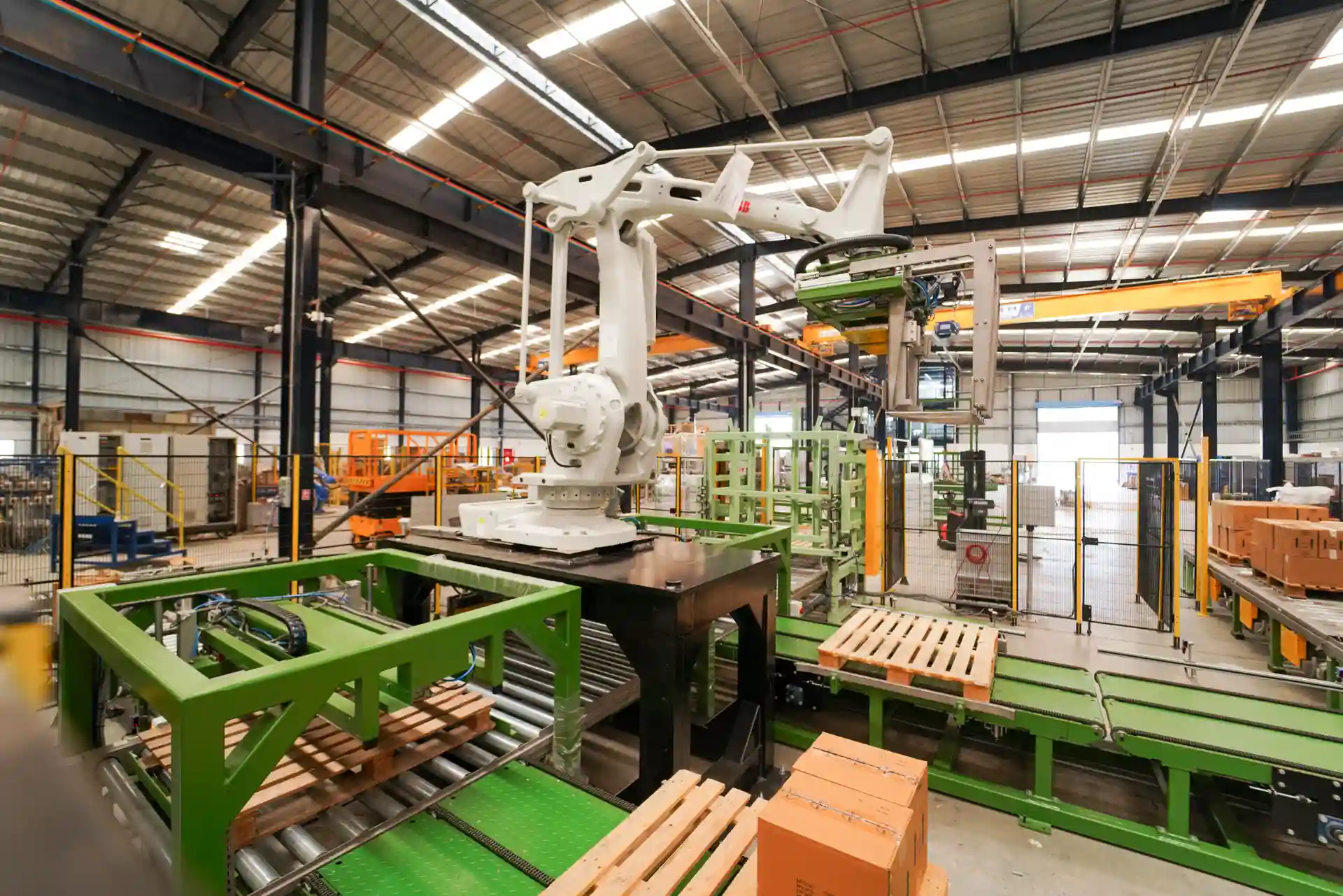
The Gantry Palletizer is Cybernetik’s answer to operations where compactness, reliability, and low total cost of ownership matter more than multi-axis dexterity. A 3-axis servo-actuated gantry moves over the infeed and pallet zone, picking and placing product in a straight, repeatable motion path. Advantages for heavy-duty applications:
The Gantry Palletizer is a strong fit for high-load, medium-complexity applications in chemicals, fertilizers, and building materials where simplicity and ruggedness outweigh the flexibility of a multi-axis robot.
3. Cobot Palletizer & Case Printer
Cybernetik’s Cobot Palletizer & Case Printer is built for operations that need safe human-robot collaboration on the floor – typically low-to-medium throughput lines or plants where operators must work alongside the machine. It combines carton palletizing with integrated label printing in a single pick-and-place cycle:
This configuration is particularly well-suited for FMCG, food, and pharma operations with frequent SKU changeovers and multi-size carton palletizing requirements, where a full robotic cell would be over-specified.
4. Robotic Carton Palletizer
For operations that run cartons, rigid boxes, and corrugated boxes at high speed across multiple lines, Cybernetik’s Robotic Carton Palletizer delivers the highest throughput configuration in the range. Two robots can separately and simultaneously palletize multiple-sized boxes at different stations – for example, triple-line medium cartons alongside double-line large cartons – with carton height adjustment for seamless integration with upstream case packing systems. A single robot variant handles diverse box variants, including simultaneous palletizing from multiple lines onto separate pallets, using adaptable grippers and conveyors for different box sizes and weights.
Choosing the Right Industrial Palletizer: Side-by-Side Comparison
The table below compares Cybernetik’s four primary palletizer configurations across the parameters that matter most to a plant head or packaging engineer evaluating a capital investment.
| Specification | Robotic Palletizer | Gantry Palletizer | Cobot Palletizer |
|---|---|---|---|
| Load Types | Bags, cartons, drums, pails, sacks, tins | Bags, boxes, drums, pails | Cartons (multi-size) |
| Best For | High-speed, multi-SKU heavy-duty lines | Heavy loads, compact floor, low OPEX | Human-robot collab; label printing integrated |
| Throughput | High; simultaneous multi-line | High; servo-actuated | Low to medium; multi-line sequential |
| SKU Flexibility | Recipe-selectable matrix (HMI) | Up to 10 SKU formations via rotary axis | Single cobot, multiple carton types |
| Safety | Full guarding, light curtains, E-stops | Light curtains, guarding, tower lamp | Collaborative – reduced fencing required |
| Special Feature | Automated tool changer (Bag & Drum) | Compact footprint, fewer moving parts | Integrated case printer + drop recovery |
| Typical Industry | Chemical, food, fertilizer, pharma | Chemical, building materials, agro | FMCG, food, pharma, consumer goods |
Heavy-Duty Palletizing: The Engineering Details That Matter
When loads are heavy – 25 to 50 kg bags, 200-litre drums, or stacked pails of paint – the engineering of the palletizer determines whether the line is reliable or chronically problematic. Cybernetik’s industrial palletizers address the five critical design requirements for heavy-duty applications:
1. Gripper Design and Load Security
Each gripper is custom-engineered for the specific product – mechanical grippers with pneumatic actuation for rigid bags and drums, vacuum grippers for cartons and pails, and servo grippers for high-precision fragile loads. The wrong gripper drops product; the right one holds at speed. Cybernetik’s end-of-arm tooling is customized per project and validated at the rated throughput before commissioning.
2. Pallet Stability and Matrix Optimization
A stable pallet is one where no unit shifts during transit. Cybernetik’s recipe-selectable matrix formation ensures each layer is placed in the pattern that maximizes interlocking between layers and load distribution across the pallet surface. For heavy or irregular loads, the HMI stores multiple matrix recipes – a plant running different bag weights can switch patterns in seconds without manual retooling.
3. Integration with Upstream Case Packers and Filling Lines
An industrial palletizer that runs in isolation creates a buffer management problem – product piles up upstream or the palletizer starves. Cybernetik’s palletizers are designed for direct integration with upstream case packers and high-speed bagging machines via roller and belt conveyors with synchronized PLC control. The same SCADA recipe that defines throughput rate also governs the palletizing matrix, so upstream and downstream run in lockstep.
4. Safety Architecture for Heavy Loads
A 50 kg bag moving at palletizing speed is a significant kinetic hazard. Cybernetik’s industrial palletizers incorporate light curtains that halt the robot on any human entry, full perimeter guarding on non-collaborative configurations, emergency stop circuits, and tower lamps and buzzers for real-time status signaling. All configurations meet international safety compliance requirements for industrial automation.
5. Downstream Stretch Wrapping and Dispatch Readiness
A loaded pallet is not dispatch-ready without stretch wrapping. Cybernetik’s palletizers include outfeed roller conveyors that transfer loaded pallets directly to the stretch wrapping or dispatch zone, completing the end-of-line sequence without manual forklift intervention at the palletizer itself. For operations that need label printing at the pallet stage, the Cobot Palletizer & Case Printer integrates this within the palletizing cycle.
 “Selecting the right palletizer is not simply about automation – it’s about building an end-of-line system that supports long-term efficiency, scalability, and workplace safety”

See it in action
Industries Where Cybernetik Industrial Palletizers Deliver the Most Value
Industrial palletizers are consequential in any high-volume operation, but the return on investment is fastest where load weight, throughput, and compliance requirements converge: