
Key takeaways
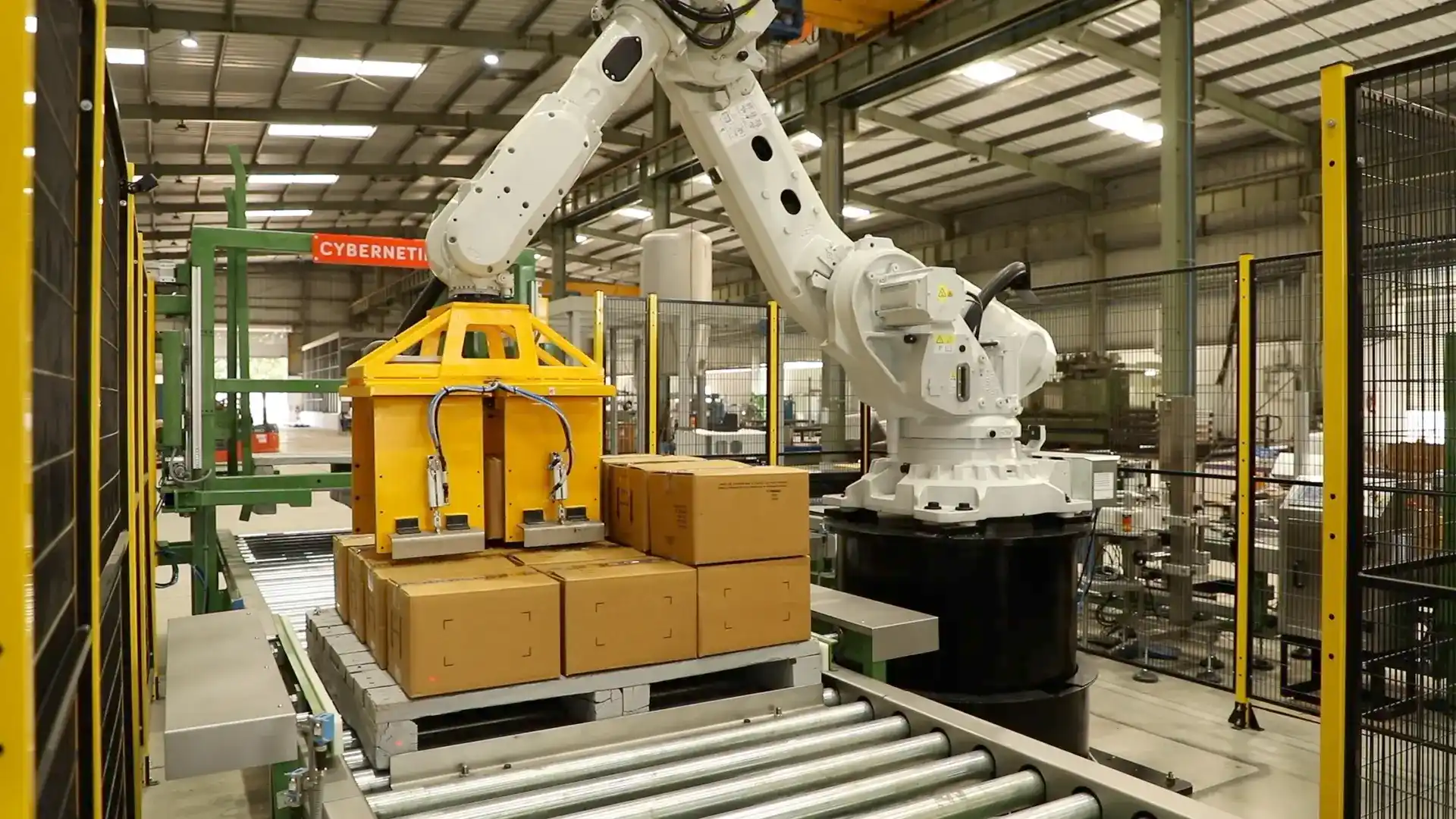
Not every end-of-line palletizing challenge requires a full industrial robotic cell with perimeter guarding, a dedicated footprint, and a capital commitment sized for high-volume continuous operation. For mid-volume manufacturers, operations with constrained floor space, lines where human operators work alongside the machine, or facilities that need case label printing integrated into the palletizing step , a palletizing cobot is often the more precise engineering answer.
A palletizing cobot , a collaborative robot applied to end-of-line pallet stacking, delivers automation at a scale and physical form factor that industrial robots cannot match in certain environments. It works safely alongside operators without requiring full perimeter guarding, occupies a fraction of the floor space of a conventional robotic palletizer, and in Cybernetik’s configuration integrates case printing directly into the pick-and-place cycle. This guide covers what a palletizing cobot is, how it works, its key benefits for manufacturers, how it compares to an industrial robotic palletizer, and the specific scenarios where it is the right choice.
What Is a Palletizing Cobot?
A palletizing cobot is a collaborative robot , a robot arm designed to operate in close proximity to human workers with built-in force and speed limiting that prevents injury on contact , applied to the task of stacking product units onto pallets at the end of a packaging line. Unlike a conventional industrial palletizer, which operates within a guarded enclosure that excludes human presence during operation, a palletizing cobot is designed for shared workspaces where operators work alongside the machine.
The defining technical characteristics of a collaborative robot that make it suited to palletizing applications are:
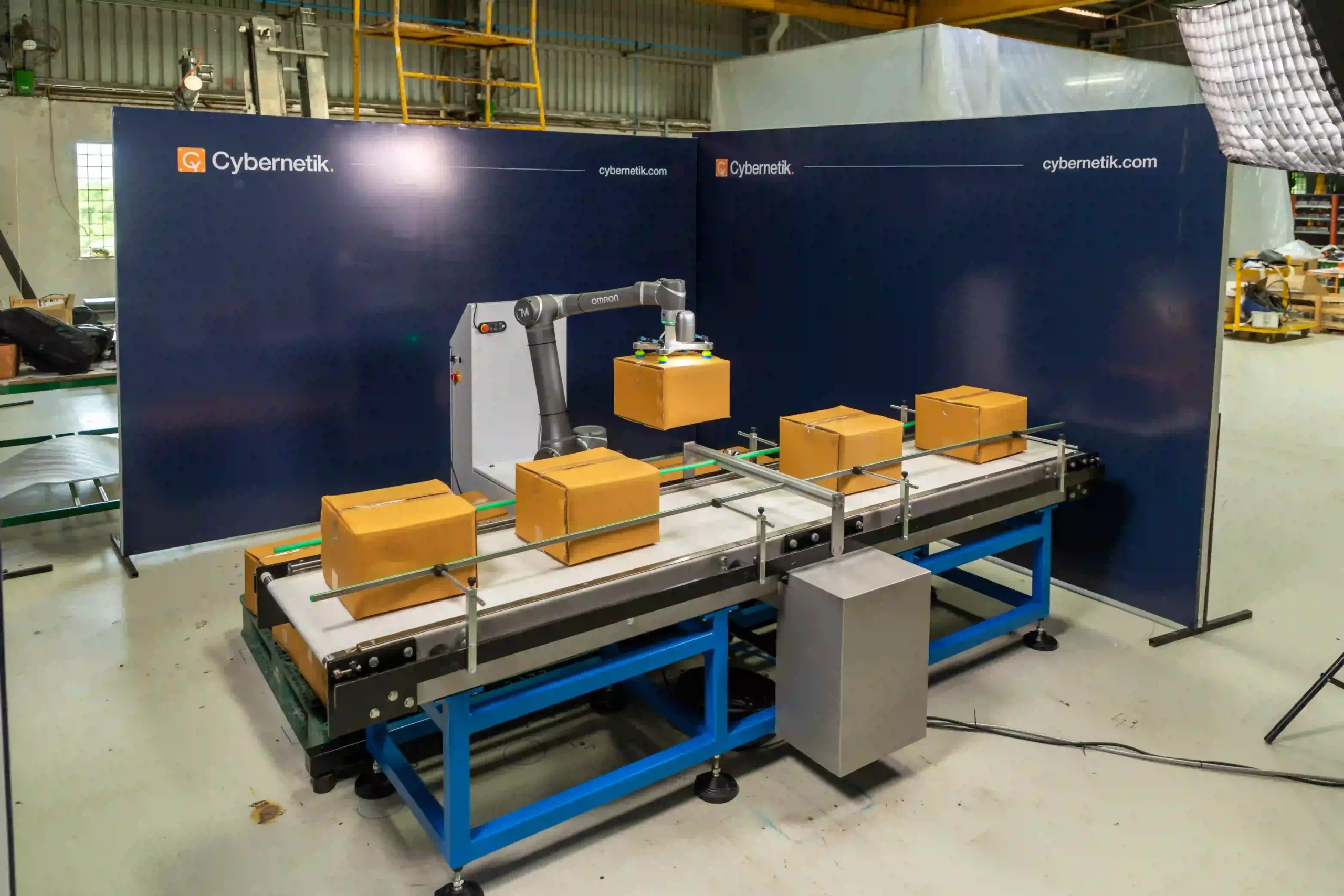
Cybernetik’s cobot palletizer and case printer combines these collaborative robot characteristics with an integrated case printing function , the cobot picks cartons from the infeed conveyor, guides them through a label printing station, and places them on the pallet in the selected matrix formation. All in a single pick-and-place motion, without a separate labelling station.
How Cybernetik’s Palletizing Cobot & Case Printer Works
The Cybernetik Cobot Palletizer & Case Printer operates in a continuous cycle that integrates carton referencing, label printing, and pallet stacking into a single automated sequence:
Step 1, Carton Referencing on the Conveyor
Cartons arriving from the upstream packaging line are referenced on the infeed conveyor , positioned precisely at the pick-up point by a reference system. This ensures that the cobot arm arrives at a known carton location on every cycle, maintaining consistent cycle time regardless of minor upstream variation in carton arrival position.
Step 2, Cobot Pick-Up and Label Printing
The palletizing cobot picks the referenced carton and , in the same motion , guides it through the integrated label printing station before placing it on the pallet. Label printing and pallet placement occur within a single pick-and-place cycle, eliminating the need for a separate labelling conveyor, a dedicated label applicator station, or operator intervention in the labelling step. This is the feature that makes Cybernetik’s cobot palletizer and case printer configuration distinctly more efficient than a standalone cobot palletizer paired with a separate labelling line.
Step 3, Multi-Line Palletizing
A single palletizing cobot serves multiple upstream lines sequentially , picking from one infeed, placing on one pallet position, then moving to the next infeed and pallet position. Customisable matrix formations ensure optimal pallet space utilisation and load stability for each carton size and weight combination. Recipe selection on the HMI switches between matrix patterns without manual retooling.
Step 4, Drop Recovery
If a carton falls during palletizing, the drop recovery system activates: the cobot places the next carton in the position of the fallen unit, ensuring the matrix remains complete and the pallet pattern is not compromised by a single drop event. This self-correcting feature is particularly valuable in mid-volume operations where an operator monitoring the line cannot intervene quickly enough to prevent a pattern gap from propagating through the rest of the pallet layer.
Cybernetik Cobot Palletizer & Case Printer: Technical Specifications
| Parameter | Cobot Palletizer & Case Printer |
|---|---|
| Payload | 25 kg |
| Speed | 3 cartons/min |
| Footprint | 3.5 × 1.5 m |
| Product Type | Cartons of multiple sizes |
| Case Printing | Integrated , label printing in pick-and-place cycle |
| Matrix Formation | Customisable , optimal pallet space utilisation and load stability |
| Multi-Line Capability | Single cobot palletizes on multiple lines sequentially |
| Drop Recovery | Automatic , places next carton in position of fallen unit |
| Changeover | Remote control , easy reprogramming via HMI |
| Safety | Force and speed limiting , shared workspace operation; no full perimeter guarding required |
| Industry | Food, FMCG, consumer goods, pharmaceuticals |
| Workspace Mode | Human-robot coexistence , operator can work alongside cobot |
| View Full Solution Page | Cybernetik Cobot Palletizer & Case Printer → |
Palletizing Cobot vs Industrial Robotic Palletizer: Choosing the Right Configuration
The choice between a palletizing cobot and a conventional industrial robotic palletizer is not a question of which is better , it is a question of which fits the specific throughput, floor space, workspace, and operational requirements of the line. The comparison below covers the seven parameters that determine the right choice.
| Parameter | Palletizing Cobot | Industrial Robotic Palletizer |
|---|---|---|
| Throughput | 3 cartons/min (mid-volume) | Up to 15 cartons/min (high-volume) |
| Payload | 25 kg | Up to 150 kg |
| Footprint | 3.5 × 1.5 m | 5 × 5.5 m (robotic bag); larger for gantry |
| Safety guarding | No full perimeter guarding , shared workspace | Full guarded enclosure required |
| Human coexistence | Yes , operator works alongside cobot | No , operator excluded during operation |
| Case printing | Integrated in pick-and-place cycle | Separate labelling station required |
| Changeover ease | Operator-level via remote control | PLC recipe management , faster at scale |
| Multi-format handling | Multiple carton types , single cobot | Full format range via tooling + recipe |
| Capital cost | Lower entry point | Higher , full cell integration |
| Best for | Mid-volume, constrained space, human coexistence, case printing needed | High-volume, heavy payload, dedicated cell, max throughput priority |
| Cybernetik product | Cobot Palletizer & Case Printer | Full Palletizer Range |
 “The strength of a palletizing cobot lies in making automation accessible through compact design, easy programming, and safe human-robot collaboration.“

See it in action
When a Palletizing Cobot Is the Right Choice
The following scenarios consistently point toward a palletizing cobot as the correct configuration, either as the sole palletizing solution or as part of a mixed-configuration line where a cobot handles one set of requirements and an industrial robot handles another.
Industries Where Palletizing Cobots Deliver the Strongest Fit
Cybernetik’s palletizing cobot is deployed across the following industry segments, where the combination of mid-volume throughput, constrained end-of-line space, operator coexistence requirements, and case printing needs aligns with the cobot’s design parameters.
| Industry | Why Cobot Fits | Typical Product Format |
|---|---|---|
| Food & Bakery | Mid-volume multi-SKU lines; GMP-compatible operation; frequent changeovers | Cartons of packaged food, biscuits, snacks |
| FMCG & Consumer Goods | High SKU variety; constrained warehouse end-of-line; case printing required | Cartons , personal care, household, packaged goods |
| Pharmaceuticals | GMP environment; operator coexistence; lower throughput; audit traceability via case printing | Cartons of pharmaceutical packs, nutraceuticals |
| Confectionery & Chocolate | Multiple carton sizes; frequent SKU changes; case labelling compliance | Cartons post chocolate bar case packer |
| Beverages | Mid-volume regional distribution lines; constrained plant layouts | Cartons of bottles or cans in cases |
| Chemicals , Light Formulations | Mid-volume specialty chemical carton lines; operator proximity for sample checking | Cartons of packaged specialty chemicals |