
Key takeaways
Choosing a palletizing machine is one of the highest-impact decisions a plant head or operations director makes for their end-of-line. The right choice eliminates the last major manual bottleneck on the packaging line, improves pallet consistency, reduces injury risk, and unlocks throughput growth without proportional headcount growth. The wrong choice , a machine under-specified for payload, over-simplified for your SKU range, or sourced without integration scope , creates a new bottleneck in a different form.
This complete buyer’s guide covers everything a manufacturer needs to know before purchasing a palletizing machine: what it is, how it works, the full range of machine types, palletizer price factors, a ten-point buyer’s checklist, integration considerations, and industry applications. All specifications reference Cybernetik’s palletizing machine range, which serves manufacturers across food, FMCG, chemicals, pharmaceuticals, and paints in 30+ countries.
What Is a Palletizing Machine?
A palletizing machine is an automated system that receives filled and sealed product units, bags, cartons, drums, pails, or tins, at the end of a packaging line and stacks them onto pallets in a controlled, repeatable matrix pattern, without manual handling. The machine replaces the manual palletizing station where operators stack units by hand, typically at significant physical cost and with inherent output variability.
A palletizing machine performs four core functions in every cycle:
The entire cycle is managed by a PLC and SCADA control architecture with recipe storage, meaning product changeover is a selection on the HMI, not a mechanical event. Cybernetik’s palletizing machines are engineered for upstream and downstream integration, modular design to fit existing layouts, and customisable gripper tooling for every product format.
Types of Palletizing Machines: Which Configuration Fits Your Line?
Cybernetik manufactures eight distinct palletizing machine configurations. Each is matched to a specific combination of product type, throughput requirement, payload, and plant environment. Understanding the differences before engaging a vendor eliminates mismatched specifications and post-purchase surprises.
1. Six-Axis Robotic Palletizing Machine
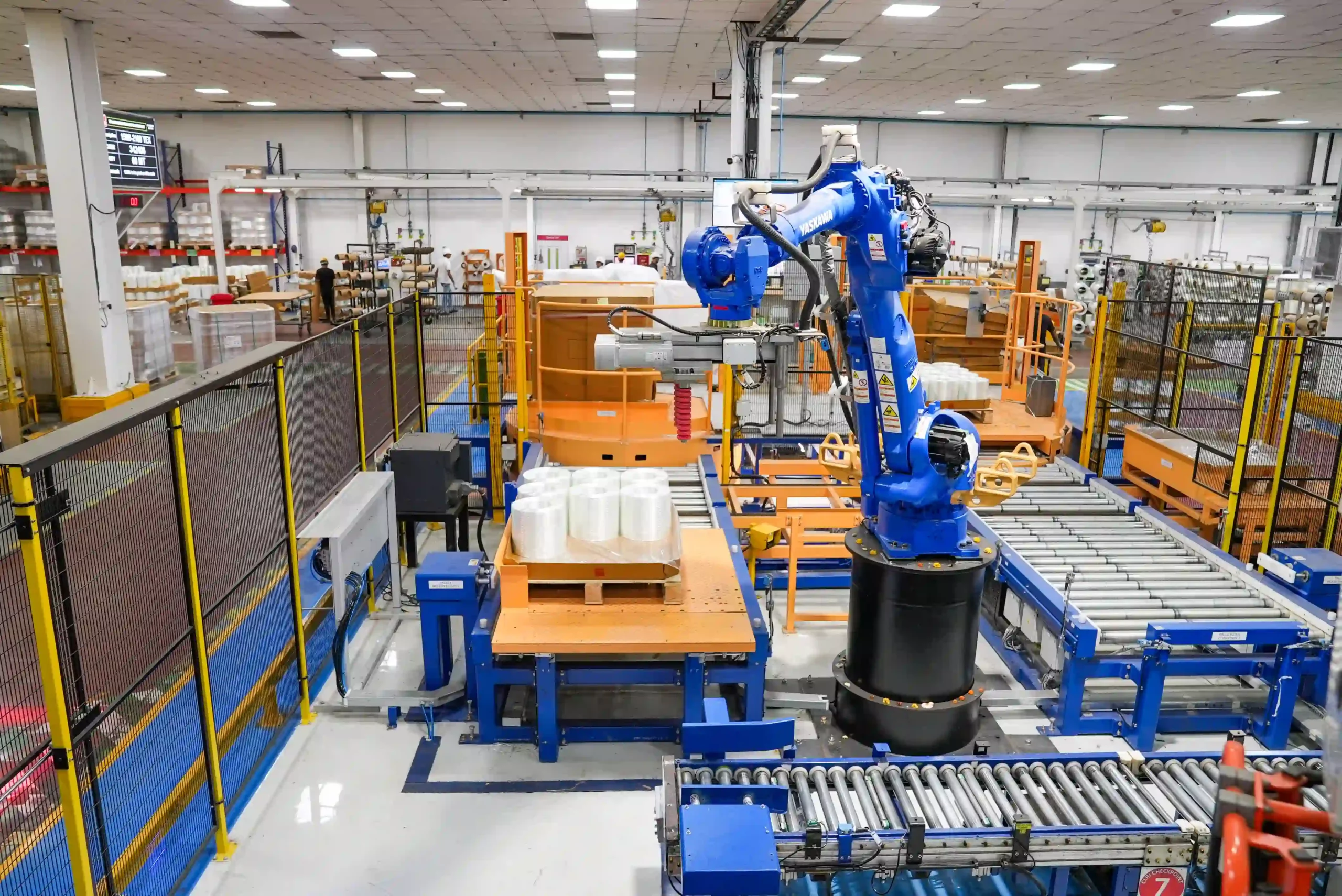
The six-axis robotic palletizing machine is the most versatile configuration in the range. A six-axis industrial robot arm with servo or pneumatic end-of-arm tooling handles bags, cartons, drums, and pails at payloads up to 150 kg for cartons and 120 kg for drums. The six-axis architecture allows the robot to reach any point in the pallet cell from any angle , essential for mixed-SKU lines with frequent changeovers, multi-line infeed, and irregular product geometries. Recipe change on the HMI updates gripper orientation, layer pattern, and speed automatically.
Capacity range: Up to 10 bags/min | Up to 15 cartons/min | Up to 12 drums/min | Up to 28 pails/min
2. Bag Palletizing Machine
The bag palletizing machine is purpose-built for gusseted bags, flat-bottom bags, sacks, and bales in polyethylene and polypropylene. Key specifications: up to 600 bags per hour, 50 kg payload, vertical stack height up to 1,800 mm, and a reach of up to 3.1 m. The common gripper option allows the same robot to handle both bag pick-and-place and pallet positioning , eliminating a separate pallet-handling mechanism and reducing capital cost. The automated tool changer enables the same cell to palletize multiple unit types.
Applications: Chemicals, fertilisers, food grains and powders, animal feed, cement, pharmaceuticals.
3. Box and Carton Palletizing Machine
The box palletizer and robotic carton palletizer handle corrugated, rigid, and handle-with-care boxes at up to 1,800 boxes per hour, 150 kg payload. The system can simultaneously palletize up to three boxes per cycle and handle multiple carton variants from different lines onto dedicated pallets within the same cycle , a significant throughput advantage for multi-SKU FMCG and food operations. The multiple line carton palletizer variant extends this to a single robot servicing multiple production lines simultaneously.
Applications: Food and beverage, FMCG, pharmaceutical, chemicals, adhesives.
4. Pail Palletizing Machine
The pail palletizer handles pails (paint buckets) and similar round, unstable formats at up to 60 pails per minute, 450 kg payload for high-capacity variants. Specialised grippers handle up to four pails at a time. An optional elevated robot location above the pallet conveyor level enables uninterrupted palletizing across multiple lines simultaneously. A pail orientation feature rotates pail handles to prevent gripper interference , a critical operational detail for high-speed lines.
Applications: Paints, protective coatings, thinners, adhesives, edible oils, agro chemicals.
5. Drum Palletizing Machine
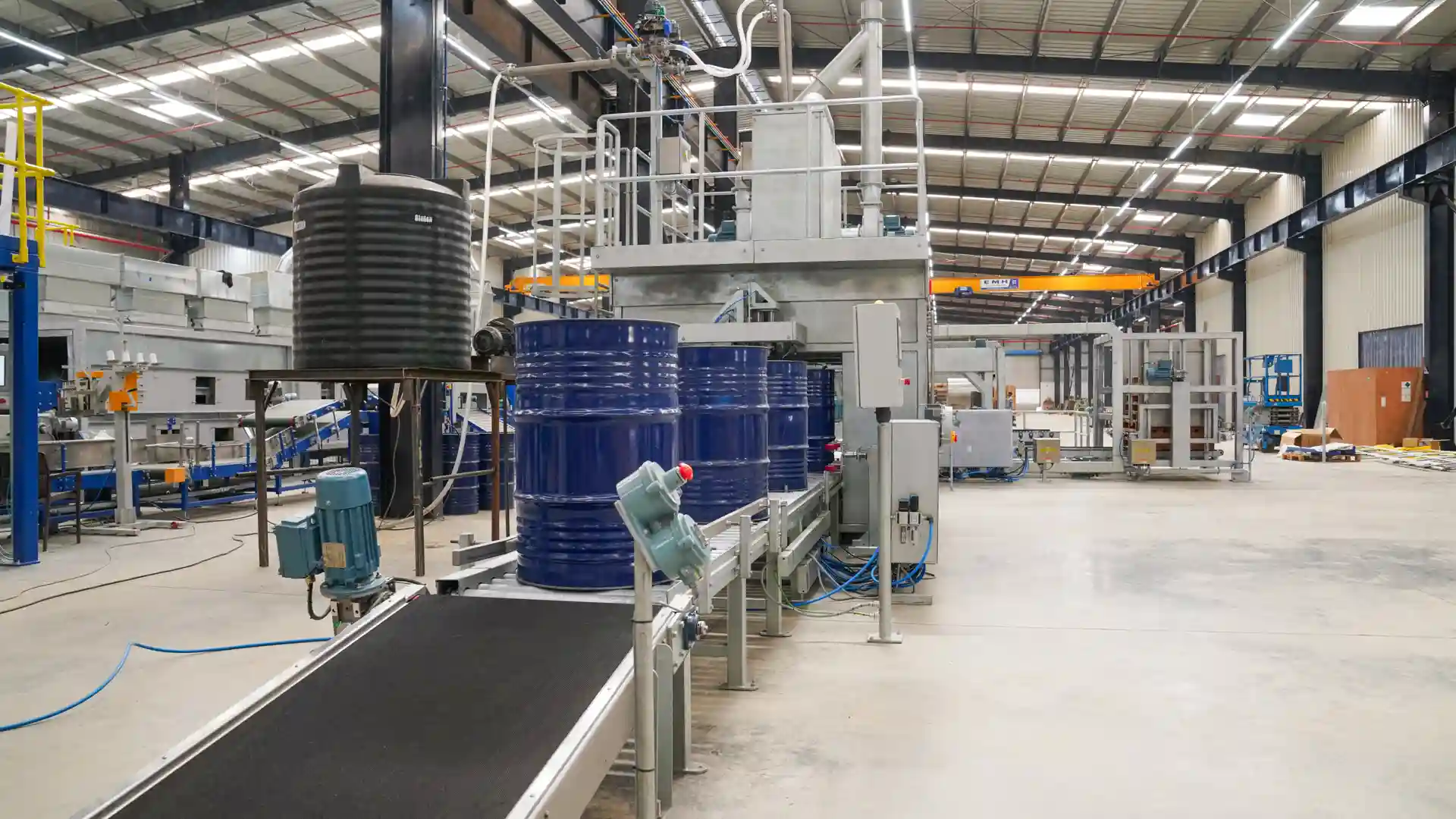
The drum palletizer provides reliable, rapid palletizing of heavy drums in the required matrix formation, up to 12 drums per minute at 120 kg payload. Designed for seamless integration into existing drum-filling setups, it handles standard 200-litre drums and IBC containers. The bag & drum palletizer variant uses an automated tool changer to switch a single robot between bag and drum handling , two palletizing machine capabilities in one cell.
Applications: Adhesives, specialty chemicals, industrial liquids, lubricants.
6. Gantry Palletizing Machine
The gantry palletizer uses a linear overhead gantry instead of a robot arm, moving along three linear and one rotary axes. Compact, easy to program, and well-suited to bag and uniform-box palletizing, the gantry is the right choice for single-SKU dedicated lines where overhead footprint is constrained and maximum cycle rate is the design priority. At up to 210 bags per hour, it is positioned as the entry configuration in the bag palletizing segment.
Applications: Dedicated single-SKU bag, sack, or uniform-carton lines.
7. Cobot Palletizing Machine
The cobot palletizer and case printer is a collaborative robot solution designed for shared human-robot workspaces, smaller footprints, and mid-volume lines. It integrates case label printing directly in the palletizing cell. The cobot operates at lower throughput than a full industrial robot but within a fraction of the floor space and without the requirement for full perimeter guarding , making it accessible for plants with constrained end-of-line areas or where operator co-presence is operationally required.
Applications: Mid-volume carton lines; plants with constrained floor space; operations requiring human-robot coexistence.
8. Multiline Pail Palletizing Machine
The multiline pail palletizer is Cybernetik’s highest-specification pail palletizing solution. A single robot positioned above the pallet conveyor level simultaneously services multiple production lines running different pail sizes, up to 60 pails per minute. This is the configuration of choice for high-volume paint and coatings manufacturers running multi-format, multi-line operations where a single dedicated pail palletizer per line would be cost-inefficient.
Applications: High-volume paints, coatings, adhesives, petrochemical, and agro chemical manufacturers.
Palletizing Machine Specifications: Full Range at a Glance
| Machine Type | Payload | Speed | Stack Height | Formats | Link |
|---|---|---|---|---|---|
| Six-Axis Robotic | Up to 150 kg | Up to 15 cartons/min | Up to 1,800 mm | Bags, cartons, drums, pails | View & Quote |
| Bag Palletizer | Up to 50 kg | Up to 600 bags/hr | Up to 1,800 mm | Bags, sacks, bales | View & Quote |
| Box Palletizer | Up to 150 kg | Up to 1,800 boxes/hr | Up to 1,800 mm | Cartons, rigid, corrugated | View & Quote |
| Pail Palletizer | Up to 450 kg | Up to 60 pails/min | Up to 1,800 mm | Pails, paint buckets | View & Quote |
| Drum Palletizer | Up to 120 kg | Up to 12 drums/min | Up to 1,800 mm | Drums, IBCs | View & Quote |
| Gantry Palletizer | Custom | Up to 210 bags/hr | As required | Bags, uniform boxes | View & Quote |
| Cobot Palletizer | Up to 20 kg | Mid-volume rates | As required | Cartons + label printing | View & Quote |
| Multiline Pail | Up to 450 kg | Up to 60 pails/min | Up to 1,800 mm | Multi-format pails, multiline | View & Quote |
 “A palletizing machine is more than an end-of-line investment; it is a strategic decision that shapes productivity, safety, and operational efficiency for years to come.”

See it in action
Palletizer Price: What Determines the Cost
The palletizer price a manufacturer pays is determined by the intersection of five variables. Understanding these variables allows a procurement team to build a realistic budget, compare vendor quotations on a like-for-like basis, and avoid the most common source of post-purchase cost surprises: an under-scoped integration.
Variable 1, Machine Type and Architecture
The machine type is the single largest determinant of palletizer price. A cobot palletizer for a low-volume, constrained-footprint line costs significantly less than a six-axis robotic palletizer engineered for a multi-line, multi-SKU food or chemical operation. The gantry configuration sits between the cobot and six-axis in both capability and price for single-SKU bag and box applications. Within the six-axis category, payload capacity (20 kg for cobot vs 150 kg for heavy-duty carton or 450 kg for pail) is the primary price driver within the type.
Variable 2, Throughput Requirement
Higher throughput demands faster robot models, heavier-duty conveyor systems, more sophisticated buffer management, and in some cases dual-robot configurations. The price difference between a 210 bags per hour gantry system and a 600 bags per hour six-axis robotic system reflects not just a different robot but a different conveyor architecture, control system, and pallet magazine specification.
Variable 3, End-of-Arm Tooling
Tooling is frequently underestimated in palletizer price comparisons. A standard vacuum gripper for uniform cartons is far simpler and less expensive than a servo-controlled adaptive gripper for mixed-format bags or a specialised four-pail gripper for paint bucket lines. The bag & drum palletizer’s automated tool changer , enabling one robot to switch between bag and drum tooling , adds capital cost upfront but removes the need for two separate palletizing machines, typically delivering a net cost saving.
Variable 4, Integration Scope
The most common source of palletizer price underestimation is a quotation that covers the machine alone and excludes upstream conveyor interfacing, downstream pallet discharge, safety fencing, SCADA connection, installation, and commissioning. A fully integrated system , connecting the palletizer to a case packer upstream and a stretch-wrapper downstream under a single PLC/SCADA architecture , costs more at purchase but eliminates the integration costs that appear after delivery with multi-vendor sourcing.
Variable 5, Environment and Compliance Specification
Standard industrial specification is the baseline. GMP and food-grade specification (stainless steel contact parts, food-grade belts, washdown-compatible construction) adds cost relative to the baseline. Explosion-proof specification for hazardous environments adds further. CE, OSHA, FDA, and ISO 12100/13849 certifications are included in Cybernetik’s standard delivery but should be verified explicitly in any competitive quotation.
To receive an accurate, configuration-specific palletizer price for your application, share four data points with Cybernetik’s engineering team: product type and dimensions, throughput requirement (units per hour), payload (maximum unit weight), and pallet size. Quotations are provided at no charge as part of the pre-sale process.
Industries That Use Palletizing Machines
Cybernetik’s palletizing machines operate across more than 30 countries in the following industry verticals. The specific machine type within each industry is driven by product format, throughput, and compliance requirements.
| Industry | Typical Product Format | Recommended Machine Type |
|---|---|---|
| Food & Beverage | Cartons, bags, pouches in cases | Box Palletizer / Bag Palletizer |
| Confectionery & Chocolate | Cartons, cases (post case-packer) | Robotic Carton Palletizer |
| Chemicals & Agro | Bags, sacks, drums | Bag Palletizer / Bag & Drum Palletizer |
| Paints & Coatings | Pails, drums | Multiline Pail Palletizer / Drum Palletizer |
| FMCG & Consumer Goods | Cartons, bottles in cases | Box Palletizer / Multiple Line Carton Palletizer |
| Pharmaceuticals | Cartons, GMP secondary packs | Robotic Carton Palletizer (GMP spec) |
| Adhesives & Specialty Chem | Drums, pails, IBCs | Drum Palletizer / Pail Palletizer |
| Textiles & Yarn | Yarn doffs, specialty formats | Robotic Doff Handling & Palletizing |