
Key takeaways
For a beverage, dairy, pharmaceutical or personal-care manufacturer, the bottle filling stage is rarely the line bottleneck. The real ceiling on throughput is set further downstream , at the point where filled, capped bottles must be grouped, oriented, and loaded into shipping cases or display cartons. Done manually, this stage is slow, inconsistent and contamination-prone; done with the wrong cartoner, it caps the entire line at a fraction of its rated speed and quietly bleeds yield through bottle marking, mis-orientation and case-flap failures.
This guide explains how a bottle cartoning machine automatic configuration actually works, the differences between linear, top-load and robotic cartoners, and how Cybernetik’s six-axis and SCARA-based bottle case packers reach up to 120 bottles per minute under GMP-grade conditions. Whether you pack PET water bottles, glass dairy containers, HDPE chemical bottles, or pharmaceutical syrup bottles, the right cartoning architecture decides whether your filler runs at rated speed or limps at 60 percent.
What Is an Automatic Bottle Cartoning Machine?
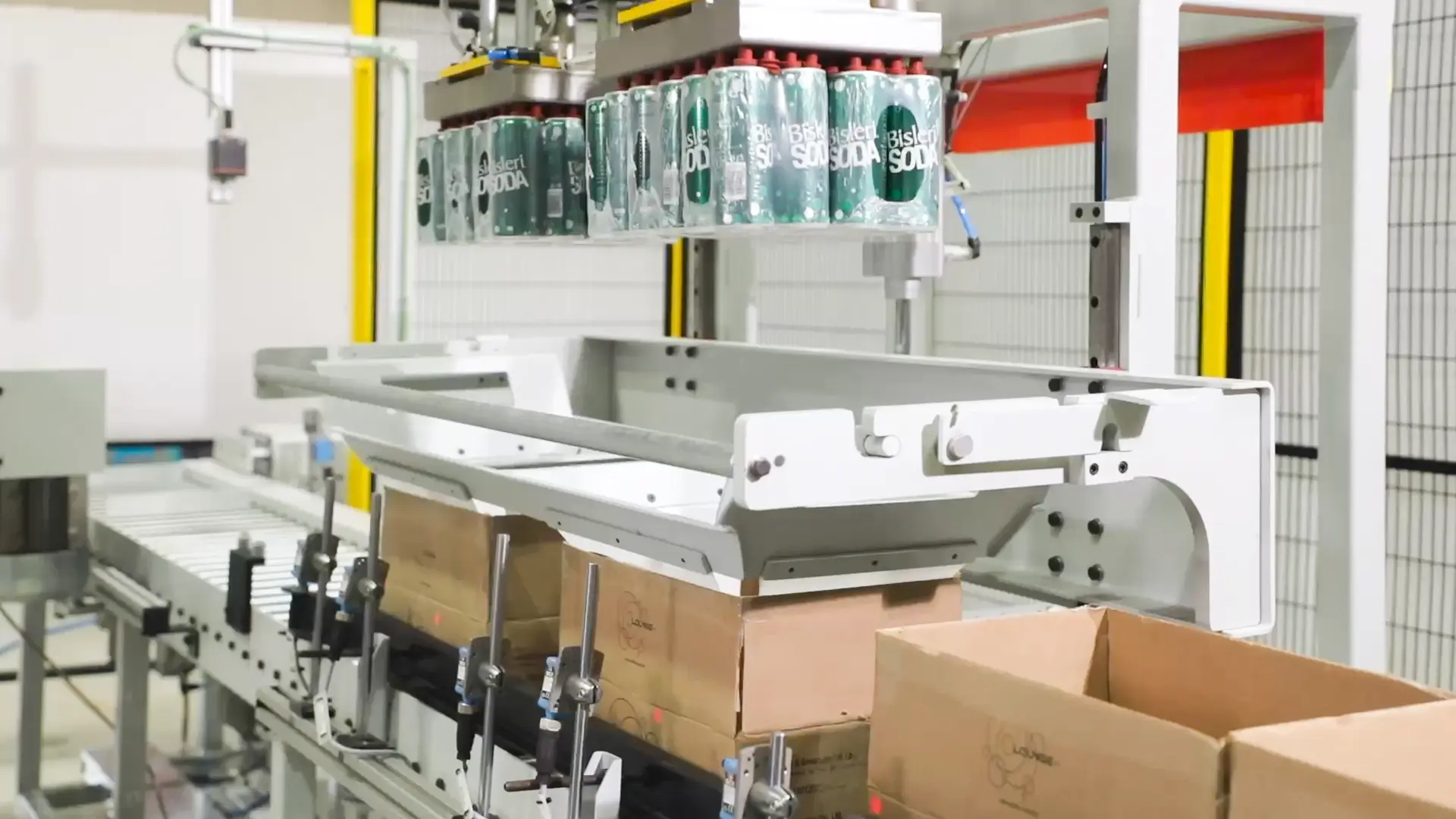
An automatic bottle cartoning machine is a piece of secondary packaging equipment that receives filled, capped bottles from the upstream filler/labeller and loads them into a shipping case, display carton or shrink-wrap tray in a defined matrix formation. The bottles arrive on a conveyor, are grouped or collated into a row or layer, picked or pushed into the pre-erected case, and the case is then sealed and transferred to the palletizing stage.
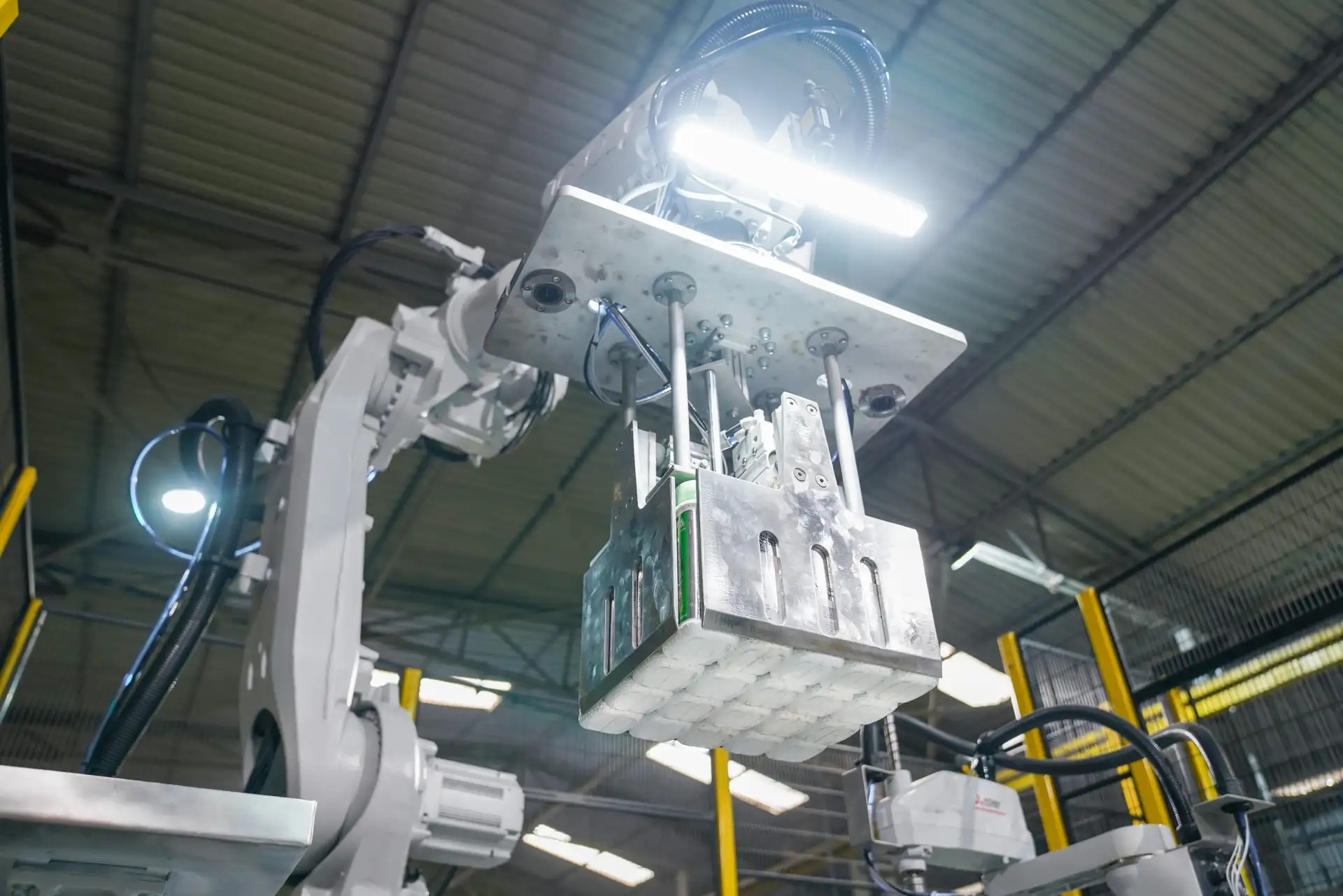
Cybernetik’s bottle case packer is a flexible system engineered for high-speed multi-SKU bottle cartoning. Built around either a six-axis robotic arm , for highest payload and the most complex pickup orientations , or a SCARA robot for lighter, faster cycles, it supports up to 120 bottles per minute with customizable matrix formations and end-of-arm grippers tuned to the specific bottle shape, surface finish and weight.
Sitting between the bottle filler and the palletizer, the cartoning stage absorbs all the variability of the upstream line , small surges, mis-aligned bottles, multi-SKU runs , and delivers a consistent, fully loaded, ready-to-palletize case at the rated cadence of the line.
How an Automatic Bottle Cartoning Machine Eliminates the Five Most Common Bottlenecks
1. Continuous Bottle Grouping at Filler Speed
Manual case packing can never sustain the cadence of a modern bottle filler running 100+ bottles per minute. Operators take micro-breaks, fatigue across the shift, and create wave-pattern surges that ripple back into the filler and forward to the palletizer. A bottle cartoning machine automatic configuration groups, picks and packs on every PLC cycle , eliminating wave patterns and letting the filler and palletizer both run at their rated speeds.
2. Vision-Guided Pickup for Random Bottle Orientation
Filled bottles do not always arrive at the cartoner in a perfect single file. Capping, labelling and metal-detection stages introduce orientation variance, especially on wide or unstable formats. Cybernetik’s robotic bottle cartoner integrates vision-guided pickup that reads each bottle’s position and orientation in real time and adjusts the gripper path to pick cleanly , eliminating jams from out-of-pitch bottles.
3. Customizable End-of-Arm Tooling for Multi-SKU Lines
PET water bottles, glass dairy bottles and round HDPE chemical bottles all need different gripping strategies. Cybernetik builds servo or pneumatic end-of-arm grippers tuned to the specific bottle , vacuum cups for smooth PET, soft clamp jaws for embossed glass, finger grippers for irregular shapes. Recipe selection on the HMI switches grip parameters automatically when the line changes SKU.
4. Consistent Case Loading with No Marking or Breakage
Bottle marking , scuff marks, label damage, surface scoring , is a top reason for retail rejection on beverage and personal-care lines. A bottle cartoning machine automatic system uses controlled vertical pickup and gentle deceleration into the case, with cushioned drop heights matched to the bottle weight, producing visually perfect loading without forcing operators to slow down the line.
5. Hand-Off to Sealing and Palletizing Under One Control Architecture
A cartoner does not run in isolation. It feeds a case sealer and then a robotic palletizer. Cybernetik delivers the entire chain , case erector, cartoner, sealer, palletizer , under a single PLC + SCADA architecture with unified safety interlocks and one HMI per line, so recipe changes propagate across every stage simultaneously.
Six-Axis vs SCARA vs Linear: Which Bottle Cartoning Configuration Fits Your Line?
Cybernetik configures bottle cartoning on a flexible robotic platform. The right choice depends on bottle weight, SKU mix, throughput and case format.
Six-Axis Robotic Bottle Cartoner
A six-axis arm handles the heaviest bottles and the most complex pickup orientations , including angled or top-load cartoning of glass bottles, large HDPE jars, or multi-SKU runs where the bottle and case orientation differ each cycle. Payloads up to 200 kg and speeds up to 120 bottles per minute make this the right specification for high-volume, multi-format lines in beverage, dairy and chemical industries.
SCARA Bottle Cartoner
A SCARA configuration is faster on lighter payloads and well suited to small-bottle pharma, condiment, sauces, and similar lines where each pick is light and the cycle time matters more than the lift envelope. Cybernetik’s SCARA bottle cartoner delivers high cadence pick-and-place into top-loaded cases with quick recipe-based changeover between bottle sizes.
Linear (Mechanical) Bottle Cartoner
For very large volume single-SKU lines , water, soft drinks at extreme throughput , a linear pusher mechanism remains attractive on capex and steady-state efficiency, but lacks the SKU flexibility of robotic configurations. Cybernetik recommends linear cartoning where the SKU is locked and throughput exceeds what a single robotic arm can handle.
Side-by-Side Specifications
The table below compares the three configurations on the parameters that matter most for a packaging engineer or plant head evaluating a bottle cartoning investment.
| Specification | Six-Axis Cartoner | SCARA Cartoner | Linear Cartoner |
|---|---|---|---|
| Throughput | Up to 120 bottles/min | Up to 60–80 bottles/min | 120+ bottles/min single SKU |
| Payload | Up to 200 kg, customized | Up to 6 kg | N/A (mechanical push) |
| SKU Flexibility | High; multi-SKU per recipe | High; SKU change via HMI | Low; mechanical changeover |
| Orientation Handling | Any angle, top or side load | Top-load preferred | Side-load only |
| Capex | Higher | Mid-range | Lower for single SKU |
| Hygiene | GMP-built option | GMP-built option | Limited GMP |
| Best For | Beverage, dairy, chemicals | Pharma, sauces, condiments | High-volume single SKU |
 “The success of a high-speed bottling line depends on a cartoning system that matches filling speed with accurate, reliable case loading.”
See it in action
Bottles and Case Formats Cybernetik’s Cartoning Machine Handles
Across installed lines in beverage, dairy, pharma and personal care, the same Cybernetik bottle cartoning platform has been configured for a wide range of bottle formats and case styles.
Bottle types handled
Case and carton formats
Matrix formations
The Cybernetik Advantage: Engineering Decisions That Matter in Bottle Cartoning
Across more than 30 countries and four manufacturing facilities, Cybernetik has refined a set of bottle cartoning build standards that translate directly into uptime and total cost of ownership:
When Should You Upgrade to a Bottle Cartoning Machine Automatic Configuration?
If your line shows any combination of the symptoms below, an automatic bottle cartoning machine will pay back faster than incremental fixes:
Where two or more of these are true simultaneously, the business case for a Cybernetik automatic bottle cartoner is typically self-funding within 12 to 24 months on labor, scrap and uptime savings alone.